


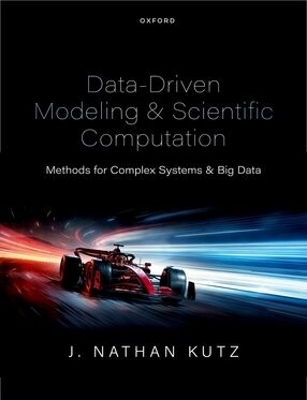
Data-Driven Modeling & Scientific Computation
Methods for Complex Systems & Big Data
Seiten
2026
Oxford University Press (Verlag)
978-0-19-892909-3 (ISBN)
Oxford University Press (Verlag)
978-0-19-892909-3 (ISBN)
- Noch nicht erschienen (ca. Mai 2026)
- Versandkostenfrei
- Auch auf Rechnung
- Artikel merken
An accessible introductory to advanced text focusing on integrating scientific computing methods and algorithms with modern data analysis techniques, including basic applications of machine learning in the sciences and engineering.
Data-Driven Modeling & Scientific Computation: Methods for Complex Systems & Big Data is an accessible introductory-to-advanced textbook focusing on integrating scientific computing methods and algorithms with modern data analysis techniques, including basic applications of machine learning in the sciences and engineering. Its overarching goal is to develop techniques that allow for the integration of the dynamics of complex systems and big data.
This comprehensive textbook provides a survey of practical numerical solution techniques for ordinary and partial differential equations as well as algorithms for data manipulation, data-driven modelling, and machine learning. Emphasis is on the implementation of numerical schemes to practical problems in the engineering, biological, and physical sciences.
The high-level programming language python is used throughout the book to implement and develop mathematical solution strategies. One specific aim of the book is to integrate standard scientific computing methods with the burgeoning field of data analysis, machine learning and Artificial Intelligence (AI). This area of research is expanding at an incredible pace in the sciences due to the proliferation of data collection in almost every field of science.
The enormous data sets routinely encountered in the sciences now certainly give a big incentive to develop mathematical techniques and computational algorithms that help synthesize, interpret, and give meaning to the data in the context of its scientific setting. This brings together, in a self-consistent fashion, the key ideas from (i) statistics, (ii) time-frequency analysis and (iii) low-dimensional reductions in order to provide meaningful insight into the data sets one is faced with in any scientific field today, including those generated from complex dynamic systems. This is a tremendously exciting area and much of this part of the book is driven by intuitive examples of how the three areas (i)-(iii) can be used in combination to give critical insight into the fundamental workings of various problems.
Data-Driven Modeling & Scientific Computation: Methods for Complex Systems & Big Data is an accessible introductory-to-advanced textbook focusing on integrating scientific computing methods and algorithms with modern data analysis techniques, including basic applications of machine learning in the sciences and engineering. Its overarching goal is to develop techniques that allow for the integration of the dynamics of complex systems and big data.
This comprehensive textbook provides a survey of practical numerical solution techniques for ordinary and partial differential equations as well as algorithms for data manipulation, data-driven modelling, and machine learning. Emphasis is on the implementation of numerical schemes to practical problems in the engineering, biological, and physical sciences.
The high-level programming language python is used throughout the book to implement and develop mathematical solution strategies. One specific aim of the book is to integrate standard scientific computing methods with the burgeoning field of data analysis, machine learning and Artificial Intelligence (AI). This area of research is expanding at an incredible pace in the sciences due to the proliferation of data collection in almost every field of science.
The enormous data sets routinely encountered in the sciences now certainly give a big incentive to develop mathematical techniques and computational algorithms that help synthesize, interpret, and give meaning to the data in the context of its scientific setting. This brings together, in a self-consistent fashion, the key ideas from (i) statistics, (ii) time-frequency analysis and (iii) low-dimensional reductions in order to provide meaningful insight into the data sets one is faced with in any scientific field today, including those generated from complex dynamic systems. This is a tremendously exciting area and much of this part of the book is driven by intuitive examples of how the three areas (i)-(iii) can be used in combination to give critical insight into the fundamental workings of various problems.
J. Nathan Kutz is the Boeing Professor of AI and Data-Driven Modeling at the University of Washington. He is with the Department of Applied Mathematics and Electrical and Computer Engineering and is also Director of the AI Institute in Dynamic Systems at the University of Washington. He received the BS degree in physics and mathematics from the University of Washington in 1990 and the PhD in applied mathematics from Northwestern University in 1994. He was a postdoc in the applied and computational mathematics program at Princeton University before taking his faculty position. He has a wide range of interests, including neuroscience to fluid dynamics where he integrates machine learning with dynamical systems and control.
| Erscheint lt. Verlag | 21.5.2026 |
|---|---|
| Zusatzinfo | 240 b/w illustrations |
| Verlagsort | Oxford |
| Sprache | englisch |
| Maße | 189 x 246 mm |
| Themenwelt | Informatik ► Datenbanken ► Data Warehouse / Data Mining |
| Informatik ► Theorie / Studium ► Algorithmen | |
| Mathematik / Informatik ► Mathematik ► Analysis | |
| ISBN-10 | 0-19-892909-9 / 0198929099 |
| ISBN-13 | 978-0-19-892909-3 / 9780198929093 |
| Zustand | Neuware |
| Informationen gemäß Produktsicherheitsverordnung (GPSR) | |
| Haben Sie eine Frage zum Produkt? |
Mehr entdecken
aus dem Bereich

aus dem Bereich
Ein verständlicher Einstieg mit Python
Buch | Softcover (2024)
O'Reilly (Verlag)
CHF 41,85
eine Einführung mit Python, Scikit-Learn und TensorFlow
Buch | Softcover (2024)
O'Reilly (Verlag)
CHF 27,85


