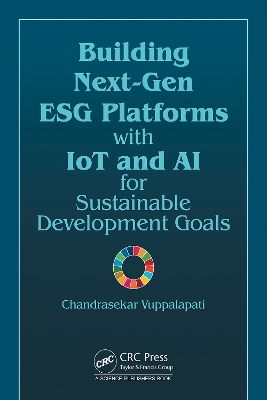
Building Next-Gen ESG Platforms with IoT and AI for Sustainable Development Goals
CRC Press (Verlag)
978-1-032-85607-0 (ISBN)
- Noch nicht erschienen (ca. März 2026)
- Versandkostenfrei
- Auch auf Rechnung
- Artikel merken
The book offers a comprehensive blueprint for using AI, IoT, and advanced analytics to achieve measurable sustainability outcomes across industries. It begins with a deep dive into AI basics, including machine learning, deep learning, generative AI, and large language models such as OpenAI’s GPT, LLaMA, and DistilBERT. The book addresses the challenges of training Environmental, Social, and Governance (ESG)-focused models, introduces fast language models for edge applications, and explores benchmarks like MMLU, GPQA, and MGSM. Step-by-step tutorials guide readers through developing multi-label ESG IoT Edge models, fine-tuning neural networks, and implementing Retrieval-Augmented Generation and Hierarchical Navigable Small World search patterns.
Application oriented chapters highlight IoT-enabled GHG monitoring—including methane and rumination tracking with Class 10 veterinary sensors—feed and water optimization, and AI in disconnected networks for remote agriculture. Real-world case studies cover automation in agriculture and dairy, AI-powered veterinary assistants, market outlook summarization, and agentic AI architectures for ESG intelligence. Combining practical implementation - codes, training pipelines, and deployment guides - with strategic ESG insights, the book provides a cross-disciplinary framework for innovators, policymakers, and business leaders committed to building transparent, scalable, and data-driven ESG platforms aligned with the UN Sustainable Development Goals.
Chandrasekar Vuppalapati is a seasoned Software IT Executive, Entrepreneur, Industrialist, and Educator with expertise in Software Technologies, Enterprise Software Architectures, Cloud Computing, Machine Learning, Data Analytics, the Internet of Things (IoT), and Software Product & Program Management. Beginning his career in 1994, he has built a distinguished record in technology leadership, consulting, and innovation. He holds a master’s degree in software engineering from San Jose State University and an MBA from Santa Clara University, California. Chandra has held Distinguished Principal engineering, architecture, and product leadership roles at Microsoft, GE Healthcare, Cisco Systems, St. Jude Medical, and Lucent Technologies (a Bell Laboratories Company). His consulting and advisory work spans global leaders including Deloitte, PwC, Johnson & Johnson, T-Mobile, State Street Bank, Humana, Shell Oil & Gas, and British Petroleum (BP). Since 2013, he has been teaching graduate courses in Software Engineering, Cloud Technologies, Data Science, and Advanced Data Mining at San Jose State University. He has also provided strategic advisory services to organizations such as Cisco Systems and Lam Research and served as Principal Investigator for the Valley School of Nursing, where he pioneered the use of Virtual Reality to connect nursing educators and students. As an Entrepreneur and Founder of multinational Hanumayamma Innovations and Technologies, Inc., Chandra leads the world’s foremost provider of Agriculture Analytics, Dairy Analytics, Specialty Crops Analytics, and Wearable Veterinary Sensors (CLASS 10), powered by a Data Analytics (DnA) platform for farmers worldwide. An industrialist and manufacturer of advanced IoT sensor systems for animal husbandry and ESG applications, he has grown the company’s global presence. Under his leadership, Hanumayamma earned the prestigious Fast Company Innovation by Design Award and secured USPTO trademarks for its pioneering products. A decorated innovator, Chandra won the US National IEEE Voice Data Challenge 2018 for developing advanced solutions using Machine Learning and Artificial Intelligence. An accomplished author and researcher, he has published over 29 IEEE conference papers and authored books including Building Enterprise IoT Applications, Democratization of Artificial Intelligence for the Future of Humanity, Machine Learning and Artificial Intelligence for Agricultural Economics, Artificial Intelligence and Heuristics for Enhanced Food Security, Assessing Policy Effectiveness using AI and Language Models, Artificial Intelligence and Advanced Analytics for Food Security, Specialty Crops for Climate Change Adaptation, Data Science Inscription of the Jyotirlingas (Volumes 1 & 2), and Divine Feminine Energies in Vedic Anthologies. He has served as editor for major conference proceedings, including ICCCES 2020, ICICI 2021, and ICICV 2022, and chaired global conferences such as IEEE in Oxford, IEEE Big Data Services 2017, Future of Information and Communication Conference 2018, and IHSI 2020 in Italy.
Preface. 1. Artificial Intelligence. 2. IoT and AI Models. 3. Environmental, Social, and Governance (ESG). 4. IoT and Greenhouse Gas (GHG) Emissions Models for Creating Sustainable Communities. 5. AI, IoT, and Business Process Automation for Enhanced Productivity, Economic Sustainability, and Reduced Inequalities. 6. Next-Gen AI Climate Models Revolutionizing Agricultural Inputs and Boosting Biodiversity.
| Erscheint lt. Verlag | 5.3.2026 |
|---|---|
| Zusatzinfo | 28 Tables, black and white; 5 Line drawings, color; 137 Line drawings, black and white; 11 Halftones, color; 39 Halftones, black and white; 16 Illustrations, color; 176 Illustrations, black and white |
| Verlagsort | London |
| Sprache | englisch |
| Maße | 156 x 234 mm |
| Themenwelt | Mathematik / Informatik ► Informatik ► Netzwerke |
| Informatik ► Theorie / Studium ► Künstliche Intelligenz / Robotik | |
| ISBN-10 | 1-032-85607-6 / 1032856076 |
| ISBN-13 | 978-1-032-85607-0 / 9781032856070 |
| Zustand | Neuware |
| Informationen gemäß Produktsicherheitsverordnung (GPSR) | |
| Haben Sie eine Frage zum Produkt? |
aus dem Bereich