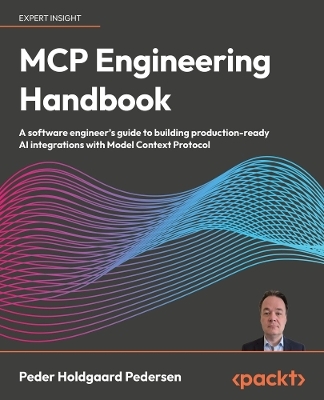
MCP Engineering Handbook
Packt Publishing Limited (Verlag)
978-1-80602-583-1 (ISBN)
- Titel nicht im Sortiment
- Artikel merken
Key Features
Learn MCP fundamentals, including transports and capabilities, from the creator of mcpdotnet
Build intelligent MCP clients and robust servers beyond API wrappers with C#, Python, and TypeScript
Apply the 3-layer model to architect scalable LLM-based systems
Purchase of the print or Kindle book includes a free PDF eBook
Book DescriptionThis book is your complete guide to using MCP for building production-ready AI integrations that go far beyond simple chatbots. You’ll also learn how MCP can serve as the backbone of AI software architecture, treating Resources, Prompts, and Elicitation as cohesive building blocks, not isolated features.
Starting with the fundamentals, you’ll explore MCP’s architecture and how it solves the M×N integration problem through standardization. You’ll establish connections, work with JSON-RPC, and learn capability negotiation. You’ll also use SDKs in C#, Python, and TypeScript to accelerate development and reduce boilerplate. From there, you’ll dive deep into Tools for model-driven actions, Prompts for messaging and control, Resources for flexible data access, Elicitation for UI input, and Sampling to enable the client to act as an LLM provider.
Moving from theory to practice, you’ll build secure MCP servers with proper error handling, logging, and authentication. You’ll implement clients that safely expose capabilities while defending against malicious servers. The book also covers deployment strategies, enterprise patterns, and integration with tools like GitHub Copilot, Claude, and Cursor.
By the end, you’ll be ready to design and operate scalable, agentic systems with MCP at their core. What you will learn
Connect AI models to external systems using MCP
Learn MCP Tools, Prompts, Resources, Elicitation, and Sampling
Build MCP server using SDKs with logging, error handling, and security
Implement secure MCP clients to protect users from malicious servers
Design MCP architectures from simple integrations to multi-agent systems
Integrate MCP with tools like GitHub Copilot, Claude, and Cursor
Manage authentication, deployment, and operations for enterprise use
Apply safeguards to block command injection and prompt attacks
Who this book is forThis book is for software engineers and architects who want to move beyond the hype around MCP and gain deep, practical skills. Whether you’re building AI-powered applications or designing system architectures, you’ll learn to create production-ready integrations between AI models and systems. Readers should have basic familiarity with LLM APIs or SDKs and experience with C#, Python, or TypeScript.
Peder is a Principal Developer at Saxo Bank and creator of mcpdotnet, which became the foundation for the official .NET SDK for Model Context Protocol. His 2024 pivot to AI transformed decades of diverse experience—from AAA games at IO Interactive to fintech and indie development—into expertise at the intersection of human creativity and artificial intelligence. At Saxo Bank, Peder champions AI-assisted development across all levels. Active in Denmark's developer community as a speaker and panelist, he believes the next generation of builders will reshape human-AI interaction. Based in Copenhagen, Peder continues to dream up new concepts—not just games, but innovative ways technology can amplify human creativity and connection.
Table of Contents
MCP Foundations - From Problem to Protocol
Tools and Model-Controlled Context
Prompts and User-Controlled Context
Resources and Application-Controlled Context
Transport and Communication
Building MCP Servers
Implementing MCP Clients
MCP Architectures
SDKs and AI-Assisted Development
Logging, Debugging, and Operations
Security, Governance, and Safety
MCP in the Agentic AI Ecosystem
The Future of MCP
| Erscheinungsdatum | 18.11.2025 |
|---|---|
| Verlagsort | Birmingham |
| Sprache | englisch |
| Maße | 191 x 235 mm |
| Themenwelt | Informatik ► Theorie / Studium ► Künstliche Intelligenz / Robotik |
| ISBN-10 | 1-80602-583-3 / 1806025833 |
| ISBN-13 | 978-1-80602-583-1 / 9781806025831 |
| Zustand | Neuware |
| Informationen gemäß Produktsicherheitsverordnung (GPSR) | |
| Haben Sie eine Frage zum Produkt? |
aus dem Bereich