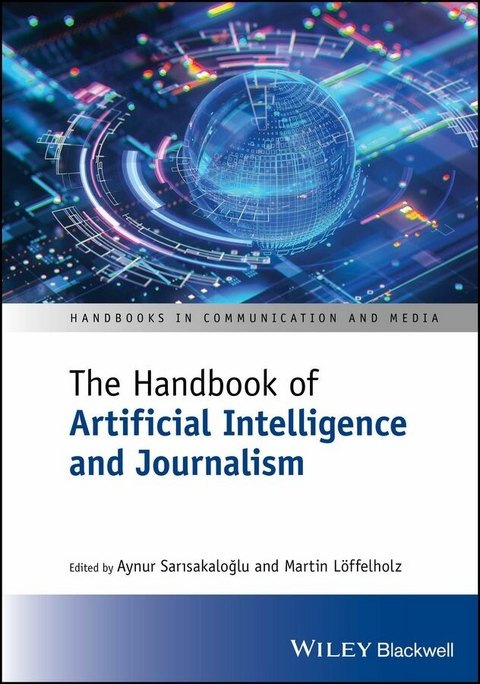
The Handbook of Artificial Intelligence and Journalism (eBook)
451 Seiten
Wiley-Blackwell (Verlag)
978-1-394-25041-7 (ISBN)
Presents a comprehensive global overview of AI-driven journalism and its transformative impact on media practices
As artificial intelligence (AI) continues to reshape the media landscape, The Handbook of Artificial Intelligence and Journalism provides the first comprehensive academic exploration of the intersection between AI technologies and journalism. Edited by Aynur Sarisakaloglu and Martin Löffelholz, this foundational volume brings together 37 leading scholars from six continents to examine how AI is redefining the structures, practices, and epistemologies of journalism.
Organized around key thematic areas, the Handbook investigates the driving forces propelling the algorithmic transformation and unveils emerging trends in journalistic practice and journalism research, moving beyond Western-centric perspectives to incorporate diverse global experiences and knowledge production. Twenty-eight original chapters address systemic shifts such as evolving structures of media organizations, changing roles of actors, transformations in news production routines, and shifting patterns of news consumption. By integrating theoretical, empirical, and practical perspectives, the Handbook sets the stage for a new research agenda for understanding AI-driven journalism on a global scale.
Containing rigorous interdisciplinary scholarship and broad geographical coverage, The Handbook of Artificial Intelligence and Journalism:
- Integrates theoretical foundations, empirical studies, and practical applications in a cohesive structure
- Offers insights into journalism practices across a wide range of geographical contexts and engages with approaches that transcends Western-dominated paradigms, incorporating perspectives from the Global South
- Employs interdisciplinary frameworks to enhance the understanding of AI-driven journalism
- Examines the sociotechnical dynamics of AI, including its potential benefits and challenges for journalism
- Presents forward-looking reflections on the future of journalism research in the AI era
The Handbook of Artificial Intelligence and Journalism is ideal for undergraduate, graduate, and doctoral students in journalism, communication, and media studies programs. It also serves as a vital reference for researchers, educators, media professionals, and policy advisors engaged in digital journalism, journalism research, media innovation, and public communication.
Dr. habil. Aynur Sar?sakalo?lu is a researcher and lecturer at Technische Universität Ilmenau, Germany. Her research focuses on the transformation of journalism through Artificial Intelligence and automation systems, with a particular interest in sociotechnical developments and interdisciplinary frameworks in media and communication studies.
Dr. Martin Löffelholz is Professor of Media Studies at Technische Universität Ilmenau, Germany, and former President of the Swiss German University in Indonesia. He has led numerous research projects and authored or edited 23 books and more than 400 scholarly contributions on communication and journalism.
Presents a comprehensive global overview of AI-driven journalism and its transformative impact on media practices As artificial intelligence (AI) continues to reshape the media landscape, The Handbook of Artificial Intelligence and Journalism provides the first comprehensive academic exploration of the intersection between AI technologies and journalism. Edited by Aynur Sarisakaloglu and Martin L ffelholz, this foundational volume brings together 37 leading scholars from six continents to examine how AI is redefining the structures, practices, and epistemologies of journalism. Organized around key thematic areas, the Handbook investigates the driving forces propelling the algorithmic transformation and unveils emerging trends in journalistic practice and journalism research, moving beyond Western-centric perspectives to incorporate diverse global experiences and knowledge production. Twenty-eight original chapters address systemic shifts such as evolving structures of media organizations, changing roles of actors, transformations in news production routines, and shifting patterns of news consumption. By integrating theoretical, empirical, and practical perspectives, the Handbook sets the stage for a new research agenda for understanding AI-driven journalism on a global scale. Containing rigorous interdisciplinary scholarship and broad geographical coverage, The Handbook of Artificial Intelligence and Journalism: Integrates theoretical foundations, empirical studies, and practical applications in a cohesive structure Offers insights into journalism practices across a wide range of geographical contexts and engages with approaches that transcends Western-dominated paradigms, incorporating perspectives from the Global South Employs interdisciplinary frameworks to enhance the understanding of AI-driven journalism Examines the sociotechnical dynamics of AI, including its potential benefits and challenges for journalism Presents forward-looking reflections on the future of journalism research in the AI era The Handbook of Artificial Intelligence and Journalism is ideal for undergraduate, graduate, and doctoral students in journalism, communication, and media studies programs. It also serves as a vital reference for researchers, educators, media professionals, and policy advisors engaged in digital journalism, journalism research, media innovation, and public communication.
| Erscheint lt. Verlag | 14.11.2025 |
|---|---|
| Reihe/Serie | Handbooks in Communication and Media |
| Sprache | englisch |
| Themenwelt | Mathematik / Informatik ► Informatik ► Theorie / Studium |
| Schlagworte | AI and journalism • AI-driven newsrooms • AI global journalism • AI in journalism research • AI journalism media studies textbook • algorithm-driven journalism • Algorithmic Journalism • artificial intelligence and journalism • Automated Journalism • Media Innovation |
| ISBN-10 | 1-394-25041-X / 139425041X |
| ISBN-13 | 978-1-394-25041-7 / 9781394250417 |
| Informationen gemäß Produktsicherheitsverordnung (GPSR) | |
| Haben Sie eine Frage zum Produkt? |
 PDF (Adobe DRM)
Kopierschutz: Adobe-DRM
Adobe-DRM ist ein Kopierschutz, der das eBook vor Mißbrauch schützen soll. Dabei wird das eBook bereits beim Download auf Ihre persönliche Adobe-ID autorisiert. Lesen können Sie das eBook dann nur auf den Geräten, welche ebenfalls auf Ihre Adobe-ID registriert sind.
Details zum Adobe-DRM
Dateiformat: PDF (Portable Document Format)
Mit einem festen Seitenlayout eignet sich die PDF besonders für Fachbücher mit Spalten, Tabellen und Abbildungen. Eine PDF kann auf fast allen Geräten angezeigt werden, ist aber für kleine Displays (Smartphone, eReader) nur eingeschränkt geeignet.
Systemvoraussetzungen:
PC/Mac: Mit einem PC oder Mac können Sie dieses eBook lesen. Sie benötigen eine
eReader: Dieses eBook kann mit (fast) allen eBook-Readern gelesen werden. Mit dem amazon-Kindle ist es aber nicht kompatibel.
Smartphone/Tablet: Egal ob Apple oder Android, dieses eBook können Sie lesen. Sie benötigen eine
Geräteliste und zusätzliche Hinweise
Buying eBooks from abroad
For tax law reasons we can sell eBooks just within Germany and Switzerland. Regrettably we cannot fulfill eBook-orders from other countries.
aus dem Bereich