


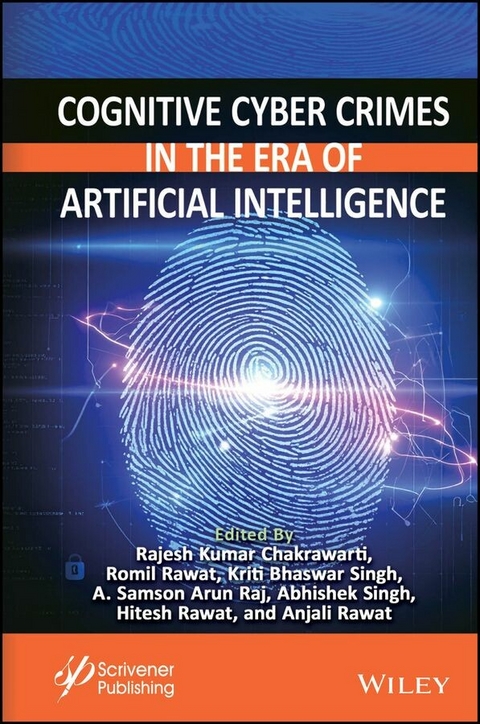
Cognitive Cyber Crimes in the Era of Artificial Intelligence (eBook)
539 Seiten
Wiley (Verlag)
978-1-394-38656-7 (ISBN)
Protect your organization from next-generation threats with this comprehensive analysis of cognitive cybercrimes, addressing future legal, ethical, and policy challenges in the age of AI.
Cognitive Cyber Crimes in the Era of Artificial Intelligence explores the emerging dimension of cybercrime where artificial intelligence, neuroscience, and cryptography intersect. It introduces the concept of neurocryptic forensics, a novel framework for investigating AI-driven psychological manipulations, deepfake-induced fraud, cognitive hacking, and brainwave-targeted cyber-attacks. As digital threats evolve, cybercriminals are shifting from traditional hacking methods to exploiting human cognition. This book provides a comprehensive analysis of cognitive cybercrime techniques and equips readers with methodologies to detect, prevent, and mitigate such threats. It serves as a guide for researchers, cybersecurity professionals, forensic analysts, policymakers, and AI developers who aim to secure both digital infrastructures and human perception against next-generation cyber threats.
Rajesh Kumar Chakrawarti, PhD is a Professor and the Director at the Sushila Devi Bansal College of Technology in the Bansal Group of Institutes, Indore with more than 21 years of academic and industry experience. He has attended more than 100 conferences and published more than 100 research papers, book chapters, and abstracts in national and international journals and conferences. His research areas include compiler design, natural language processing, computational linguistics, machine translation, and word-sense disambiguation.
Romil Rawat is a researcher at the Research Laboratory in Geomatics and Information Systems, part of the National Research Council in Rome and a Professor at Shri Vaishnav Vidyapeeth Vishwavidyalaya. He has published more than 15 research papers in international journals and conferences and more than ten books. His work focuses on the development of state-of-the-art machine learning algorithms aimed at detecting, predicting, and mitigating criminal activities across social networks.
Kriti Bhaswar Singh, PhD is an Associate Professor in the Department of Commerce and Financial Studies in the School of Management Sciences at the Central University of Jharkhand with more than 20 years of teaching and corporate experience. He has published four books and 36 research papers and book chapters on various areas of finance in refereed journals and presented 23 papers in various conferences. His research focuses on the capital market, corporate finance, and valuations.
A. Samson Arun Raj, PhD is an Assistant Professor and Internal Placement Coordinator in the Division of Computer Science and Engineering in the School of Computer Science and Technology at the Karunya Institute of Technology and Sciences. He has published more than 25 articles in international journals and conferences of repute. He is engaged in cutting-edge research for smart city development, focusing on drone networks and energy grid applications.
Abhishek Singh, PhD is the Director of the Rajiv Academy for Technology and Management with more than 22 years of teaching experience. He has published more 22 research papers in international journals and presented an additional 30 at international conferences. His teachings focus on accounting and finance.
Hitesh Rawat is a PhD Research scholar at Shri Vaishnav Vidyapeeth Vishwavidyalaya University with more that eight years of experience. He has chaired international conferences and hosted several research events, including national and international research schools, PhD colloquia, workshops, and training programs. His work focuses on business frameworks for secure communication and cybersecurity.
Anjali Rawat is a PhD Research scholar at Shri Vaishnav Vidyapeeth Vishwavidyalaya University with more than eight years of experience. She has chaired international conferences and hosted several research events, including national and international research schools, PhD colloquia, workshops, and training programs. Her research focuses on cyberthreats in online social networks.
Protect your organization from next-generation threats with this comprehensive analysis of cognitive cybercrimes, addressing future legal, ethical, and policy challenges in the age of AI. Cognitive Cyber Crimes in the Era of Artificial Intelligence explores the emerging dimension of cybercrime where artificial intelligence, neuroscience, and cryptography intersect. It introduces the concept of neurocryptic forensics, a novel framework for investigating AI-driven psychological manipulations, deepfake-induced fraud, cognitive hacking, and brainwave-targeted cyber-attacks. As digital threats evolve, cybercriminals are shifting from traditional hacking methods to exploiting human cognition. This book provides a comprehensive analysis of cognitive cybercrime techniques and equips readers with methodologies to detect, prevent, and mitigate such threats. It serves as a guide for researchers, cybersecurity professionals, forensic analysts, policymakers, and AI developers who aim to secure both digital infrastructures and human perception against next-generation cyber threats.
| Erscheint lt. Verlag | 13.11.2025 |
|---|---|
| Sprache | englisch |
| Themenwelt | Mathematik / Informatik ► Informatik ► Theorie / Studium |
| Schlagworte | Adversarial AI Cyber Threats • AI-Driven Psychological Hacking • Brain-Computer Interface (BCI) Security • Cognitive Cybersecurity • Cryptographic Defense for AI Manipulation • Cybercrime in Human Cognition • Deepfake Forensics • Neural Data Protection • Neurocryptic Forensics • Synthetic Identity Fraud |
| ISBN-10 | 1-394-38656-7 / 1394386567 |
| ISBN-13 | 978-1-394-38656-7 / 9781394386567 |
| Informationen gemäß Produktsicherheitsverordnung (GPSR) | |
| Haben Sie eine Frage zum Produkt? |
 PDF (Adobe DRM)
Kopierschutz: Adobe-DRM
Adobe-DRM ist ein Kopierschutz, der das eBook vor Mißbrauch schützen soll. Dabei wird das eBook bereits beim Download auf Ihre persönliche Adobe-ID autorisiert. Lesen können Sie das eBook dann nur auf den Geräten, welche ebenfalls auf Ihre Adobe-ID registriert sind.
Details zum Adobe-DRM
Dateiformat: PDF (Portable Document Format)
Mit einem festen Seitenlayout eignet sich die PDF besonders für Fachbücher mit Spalten, Tabellen und Abbildungen. Eine PDF kann auf fast allen Geräten angezeigt werden, ist aber für kleine Displays (Smartphone, eReader) nur eingeschränkt geeignet.
Systemvoraussetzungen:
PC/Mac: Mit einem PC oder Mac können Sie dieses eBook lesen. Sie benötigen eine
eReader: Dieses eBook kann mit (fast) allen eBook-Readern gelesen werden. Mit dem amazon-Kindle ist es aber nicht kompatibel.
Smartphone/Tablet: Egal ob Apple oder Android, dieses eBook können Sie lesen. Sie benötigen eine
Geräteliste und zusätzliche Hinweise
Buying eBooks from abroad
For tax law reasons we can sell eBooks just within Germany and Switzerland. Regrettably we cannot fulfill eBook-orders from other countries.
aus dem Bereich


