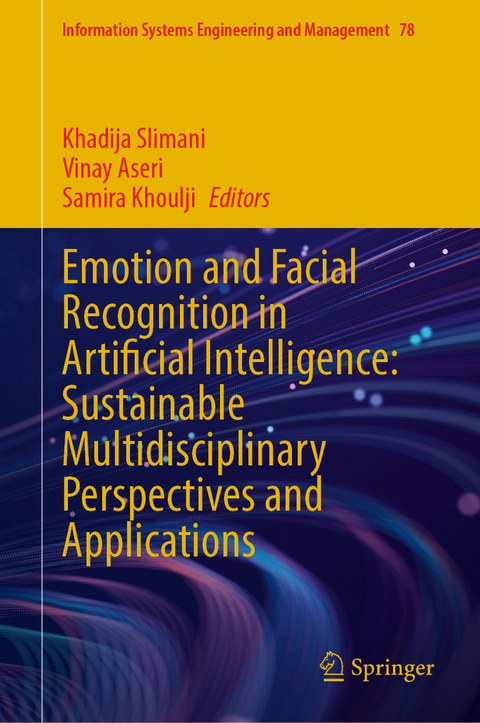
Emotion and Facial Recognition in Artificial Intelligence: Sustainable Multidisciplinary Perspectives and Applications
Springer International Publishing (Verlag)
978-3-032-14777-6 (ISBN)
- Noch nicht erschienen - erscheint am 10.03.2026
- Versandkostenfrei
- Auch auf Rechnung
- Artikel merken
This book explores one of the most transformative frontiers of modern science the intersection of emotion, facial recognition, and artificial intelligence, in an age where machines are evolving from analytical processors to emotionally perceptive entities.
Bringing together leading voices from AI research, psychology, neuroscience, human computer interaction, and policy, this book delivers an in-depth examination of how intelligent systems are learning to understand, interpret, and simulate human emotions. From theoretical foundations to advanced deep learning models, readers gain a panoramic view of how emotional data can reshape education, health care, mental health diagnostics, business intelligence, governance, and law enforcement.
Spanning eighteen comprehensive chapters, the book explores:
Computational models of emotion and facial recognition using cutting-edge AI architectures.
The role of affective computing in sustainable and ethical technology ecosystems.
Applications of emotion AI in mental health, adaptive learning, and personalized education.
Forensic and legal implications of emotion recognition, privacy, and data governance.
The future of emotionally intelligent and human-centric AI systems.
Each contribution in this edited book offers a multidisciplinary and globally relevant perspective, blending empirical research with ethical reflection and sustainable design principles.
A must-read for academicians, researchers, industry professionals, policy experts, and AI practitioners, this book serves as both a scholarly reference and a visionary roadmap toward emotionally aware and ethically responsible AI.
As technology begins to feel, not just think, this book invites readers to explore how the fusion of emotion and intelligence can redefine the future of human machine coexistence
Dr. Khadija Slimani, isa senior member of IEEE, has built a notable career in both academia and research. She earned her Ph.D. through a collaborative program between the University of Ibn Tofail in Morocco and the University of Technology of Belfort Montbéliard (UTBM) in France. This joint supervision highlights her commitment to academic excellence and her skill in integrating cross-cultural research environments. Dr. Slimani s doctoral research covered a broad range of topics, including machine learning, deep learning, pattern recognition, and computer vision, with a specific focus on academic emotion recognition. Her interdisciplinary approach, enriched by experiences in both Moroccan and French academic settings, has contributed significantly to the global perspective of her work. After completing her Ph.D., Dr. Slimani advanced her expertise through a postdoctoral position at the University of Poitiers, France. Her innovative use of AI methodologies aimed to enhance video content filtering for improved security.
Mr. Vinay Aseri is an assistant professor of cybersecurity and digital forensics at the Narnarayan Shastri Institute of Technology Institute of Forensic Sciences & Cyber Security (NSIT-IFSCS), affiliated with the National Forensic Sciences University (NFSU), Ministry of Home Affairs, Government of India. He holds a postgraduate degree in forensic science, a PG diploma in information technology and security, and a diploma in photography in forensic science. He completed his higher education in forensic science from India s pioneering National Security & Police University. Mr. Aseri s research interests focus on digital forensics, cybersecurity, and artificial intelligence for national security. He has also edited eight Scopus-indexed books with reputed publishers, including Elsevier and CRC Press, and is involved in multiple ongoing research projects and international collaborations in the domains of digital forensics and cybersecurity. He served as an assistant researcher with the National Investigation Agency (NIA).
Dr. Samira KHOULJI is a professor in electronics, telecommunications, and computer science at the National School of Applied Sciences in Tetuan (ENSATE) of Morocco, where she also serves as the coordinator for the Telecommunications and Networks Engineering program for engineering students. She holds the position of the director of the Innovative Systems Engineering (ISI) research laboratory. Previously, she was the head of the Department of Statistics and Computer Science at the multidisciplinary faculty in Tétouan, where she was responsible for the professional programs in Tourism and ICT and Management of Information Systems (MSI), as well as the coordinator for the Specialized Master's program in Management of Information Systems and Multimedia (MSIM). Dr. Samira KHOULJI has actively participated in various committees and councils and has coordinated teaching modules in physics, computer science, and telecommunications at the multidisciplinary faculty and ENSAT in Tétouan.
Introduction to Emotion Expression and AI.- Theories of Emotions in Psychology.- Classical Face Recognition: Geometric Models, Subspace Techniques and Local Descriptors.- Integrating Acoustic Feature Extraction And LSTM Models For Emotion Classification In Speech.- Emotion Detection in Human-Machine Interaction Using ML Techniques.- Real Time: 3D Facial Expression Recognition Using Improved Alex-Net Convolutional Network via Deep-Emotion.- Feature Aggregation for Efficient Continual Learning of Complex Facial Expressions.- Advanced Techniques In Facial Landmark Detection And Feature Extraction For Emotion-Aware AI Systems.- Detection of Micro-expressions and Subtle Emotions.- Navigating the Future of Emotion AI: Technical Barriers, Ethical Concerns, and Sustainable Advancements.- Emotion AI in Mental Health.- A Conceptual Framework for Adaptive Student Assessment Using AI-Driven Recommendations and Facial Expression Recognition.- Integrating AI-Driven Facial Emotion Recognition into E-Learning Systems: Sustainable Educational Markets through Interdisciplinary Innovations.- Integrating Positive Emotions to Support Self-Directed Learning.- Emotion AI in Business and Customer Services.- Deep Learning Approaches and Technical Challenges in Facial Emotion Recognition (FER).- Emotion Recognition and the Law: Bridging Technology and Human Rights.- Emotion AI: Challenges and Future Directions.
| Erscheint lt. Verlag | 10.3.2026 |
|---|---|
| Reihe/Serie | Information Systems Engineering and Management |
| Zusatzinfo | Approx. 320 p. |
| Verlagsort | Cham |
| Sprache | englisch |
| Maße | 155 x 235 mm |
| Themenwelt | Informatik ► Theorie / Studium ► Künstliche Intelligenz / Robotik |
| Technik | |
| Schlagworte | Artificial Intelligence • Computational Intelligence • computer vision • Deep learning • Emotion expression • Facial Recognition |
| ISBN-10 | 3-032-14777-8 / 3032147778 |
| ISBN-13 | 978-3-032-14777-6 / 9783032147776 |
| Zustand | Neuware |
| Informationen gemäß Produktsicherheitsverordnung (GPSR) | |
| Haben Sie eine Frage zum Produkt? |
aus dem Bereich