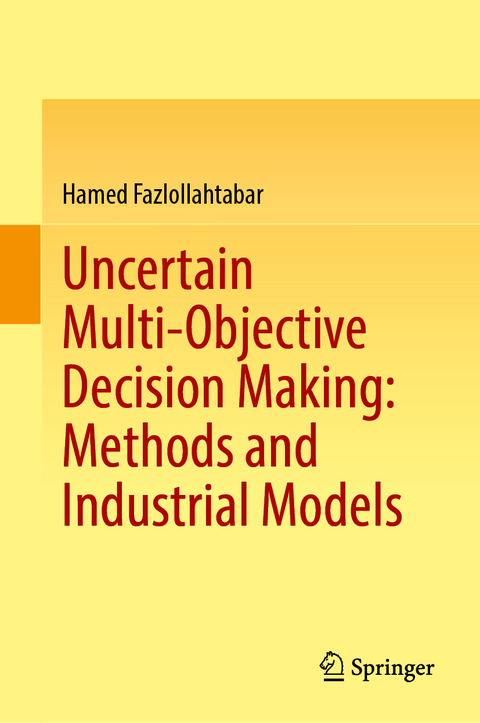
Uncertain Multi-Objective Decision Making: Methods and Industrial Models
Springer Verlag, Singapore
978-981-95-6034-9 (ISBN)
- Titel nicht im Sortiment
- Artikel merken
Hamed Fazlollahtabar earned a BSc and an MSc in industrial engineering from Mazandaran University of Science and Technology, Babol, Iran, in 2008 and 2010, respectively. He received his Ph.D. in Industrial and Systems Engineering from the Iran University of Science and Technology, Tehran, Iran, in 2015 and has completed a postdoctoral research fellowship at Sharif University of Technology, Tehran, Iran, in the area of reliability engineering for complex systems from October 2016 to March 2017. He joined the Department of Industrial Engineering at Damghan University, Damghan, Iran, in June 2017, and currently is working as an Associate Professor. He is a member of Iran Elites foundation. He has been chosen as Exemplary Researcher of Iran in all Engineering Diciplines, 2022 and Distinguished Young Industrial Engineering Researcher, Iran Academy of Science. 2023. He has been listed as world top 2% scientists in 2021, 2022, 2023 and 2024. His research interests are in uncertain decision making and analytics, industry 4.0+ production systems, reliability engineering, and sustainable supply chain planning.
Fuzzy Multi-Objective Optimization by α-cut method.- Fuzzy Multi-Objective Optimization by utility-based maximum technique.- Integrated Fuzzy PROMETHEE and Fuzzy linear Multi-Objective Program.- Fuzzy Multi-Objective AHP-TOPSIS Method.- Fuzzy Multi-Objective Mathematical Programming using Ranking Method.- Vague Multi-Objective Optimization by Branch and Bound method.- Possible Vague Multi-Objective Optimization in Queue System.- Possible Vague Multi-Objective Optimization in Queue System.- Rough Multi-Objective Optimization using Best-Worst method.- Multi-Objective Possibility Theory.- Bayesian Multi-Objective Optimization.- Stochastic Multi-Objective Optimization.- Artificial Intelligence Application for Multi-Objective Optimization.
| Erscheint lt. Verlag | 10.5.2026 |
|---|---|
| Zusatzinfo | 33 Illustrations, color; 14 Illustrations, black and white |
| Verlagsort | Singapore |
| Sprache | englisch |
| Maße | 155 x 235 mm |
| Themenwelt | Mathematik / Informatik ► Mathematik ► Angewandte Mathematik |
| Mathematik / Informatik ► Mathematik ► Finanz- / Wirtschaftsmathematik | |
| Mathematik / Informatik ► Mathematik ► Logik / Mengenlehre | |
| Schlagworte | ant colony optimization • Bayesian theory • full fuzzy linear program • fuzzy probabilistic • Fuzzy PROMETHEE • Genetic Algorithm (GA) • Multi Objective Optimization • Multiple Objective Decision Making • particle swarm optimization (PSO) • Possibility Theory • possible vague • robust ranking technique • rough set • stochastic parameters • vagueness |
| ISBN-10 | 981-95-6034-9 / 9819560349 |
| ISBN-13 | 978-981-95-6034-9 / 9789819560349 |
| Zustand | Neuware |
| Informationen gemäß Produktsicherheitsverordnung (GPSR) | |
| Haben Sie eine Frage zum Produkt? |
aus dem Bereich