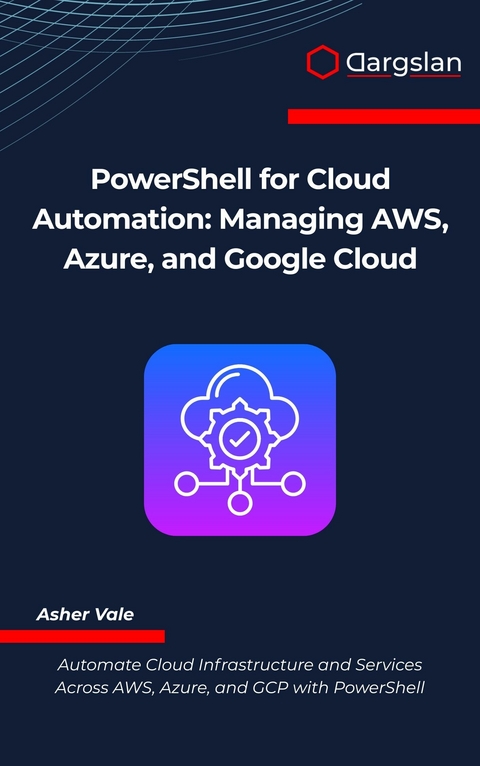
PowerShell for Cloud Automation (eBook)
400 Seiten
Dargslan s.r.o. (Verlag)
978-0-00-110115-9 (ISBN)
Master Multi-Cloud Automation with PowerShell-Your Complete Guide to Managing AWS, Azure, and Google Cloud
In today's multi-cloud world, IT professionals need efficient tools to manage infrastructure across different platforms. PowerShell for Cloud Automation delivers a comprehensive, practical guide to using PowerShell as your unified automation solution for Amazon Web Services, Microsoft Azure, and Google Cloud Platform.
What Makes This Book Essential:
PowerShell's cross-platform capabilities and object-oriented design make it the ideal tool for cloud automation. This book teaches you how to leverage a single, powerful scripting language to manage all your cloud resources, eliminating the complexity of learning multiple platform-specific tools.
What You'll Learn:
Master PowerShell fundamentals specifically for cloud environments
Install and configure cloud-specific PowerShell modules for AWS, Azure, and GCP
Automate resource provisioning, configuration, and management across all three platforms
Implement Infrastructure as Code (IaC) using PowerShell DSC and ARM templates
Build robust error handling, logging, and reporting into your automation scripts
Schedule and orchestrate cloud automation workflows
Secure your automation scripts following enterprise best practices
Create cross-cloud automation solutions for complex multi-cloud scenarios
Troubleshoot common PowerShell cloud automation challenges
Inside the Book:
Starting with PowerShell fundamentals in cloud contexts, you'll progress through dedicated chapters on each major cloud provider. Deep-dive chapters cover AWS Tools for PowerShell, Azure PowerShell modules, and Google Cloud PowerShell cmdlets. Advanced sections explore Infrastructure as Code implementation, automation scheduling, comprehensive logging strategies, and enterprise-grade error handling.
Real-world use cases demonstrate practical applications including automated backup solutions, resource lifecycle management, cost optimization scripts, and disaster recovery automation. Cross-platform chapters show how to leverage PowerShell Core for automation across Windows, Linux, and macOS environments.
Extensive Reference Materials:
Five comprehensive appendices provide ongoing value as reference materials: complete PowerShell cloud module documentation, essential cmdlet quick references, ready-to-use sample scripts organized by cloud provider, detailed troubleshooting guides, and security best practices for cloud automation.
Who This Book Is For:
System administrators managing multi-cloud infrastructure
DevOps engineers implementing automation pipelines
Cloud architects designing scalable cloud solutions
IT managers seeking operational efficiency
Anyone wanting to master PowerShell for cloud automation
Whether you're new to PowerShell or an experienced user expanding into cloud automation, this book provides the knowledge and practical examples you need to become proficient in multi-cloud PowerShell automation.
Start automating your cloud infrastructure today with PowerShell!
Introduction
The Evolution of Cloud Infrastructure Management
In the rapidly evolving landscape of modern IT infrastructure, cloud computing has fundamentally transformed how organizations deploy, manage, and scale their technological resources. The shift from traditional on-premises data centers to cloud-based solutions has created unprecedented opportunities for businesses to achieve greater flexibility, scalability, and cost-effectiveness. However, this transformation has also introduced new complexities in managing multi-cloud environments, where organizations leverage services from multiple cloud providers to optimize their infrastructure strategy.
The emergence of multi-cloud architectures has become a defining characteristic of enterprise IT strategy. Organizations no longer rely on a single cloud provider but instead distribute their workloads across Amazon Web Services (AWS), Microsoft Azure, and Google Cloud Platform (GCP) to leverage the unique strengths of each platform. This approach provides numerous benefits, including avoiding vendor lock-in, optimizing costs through competitive pricing, ensuring high availability through geographic distribution, and accessing specialized services that may be superior on one platform versus another.
The Challenge of Multi-Cloud Management
Managing infrastructure across multiple cloud platforms presents significant challenges that traditional IT management approaches cannot adequately address. Each cloud provider offers its own set of APIs, command-line interfaces, management consoles, and service architectures. This heterogeneity creates complexity in several key areas:
Operational Consistency: Maintaining consistent operational procedures across different cloud platforms becomes increasingly difficult when each provider requires different tools, commands, and workflows. System administrators and DevOps engineers must master multiple interfaces and remember platform-specific syntax and procedures.
Resource Visibility: Gaining comprehensive visibility into resources deployed across multiple cloud platforms requires aggregating information from disparate sources. Traditional monitoring and management tools often lack the capability to provide unified views across different cloud providers.
Security and Compliance: Ensuring consistent security policies and compliance requirements across multiple cloud environments requires careful coordination and standardized approaches that can be applied uniformly regardless of the underlying platform.
Cost Management: Optimizing costs across multiple cloud providers requires sophisticated analysis and comparison of pricing models, usage patterns, and service alternatives that span different platforms.
Automation Complexity: Implementing automation workflows that operate seamlessly across multiple cloud platforms requires tools and frameworks capable of abstracting away platform-specific differences while maintaining full functionality.
PowerShell as the Universal Cloud Management Solution
PowerShell emerges as a powerful solution to address these multi-cloud management challenges. Originally developed by Microsoft as a task automation and configuration management framework, PowerShell has evolved into a cross-platform, open-source tool that provides consistent interfaces for managing diverse cloud environments. The combination of PowerShell's object-oriented approach, extensive cmdlet library, and robust scripting capabilities makes it an ideal choice for cloud automation across AWS, Azure, and GCP.
Core Advantages of PowerShell for Cloud Management
Cross-Platform Compatibility: Modern PowerShell (PowerShell Core) runs natively on Windows, Linux, and macOS, ensuring that cloud management scripts and tools can be executed consistently across different operating systems and environments.
Object-Oriented Pipeline: PowerShell's unique object-oriented pipeline allows for sophisticated data manipulation and transformation, making it possible to process cloud resource information in ways that traditional text-based tools cannot match.
Extensive Module Ecosystem: The PowerShell Gallery provides access to thousands of modules, including official modules from AWS, Microsoft, and Google, as well as community-contributed modules that extend functionality for specific use cases.
Consistent Syntax and Patterns: PowerShell's verb-noun cmdlet naming convention and consistent parameter patterns create a familiar experience when working with different cloud providers, reducing the learning curve for managing multiple platforms.
Rich Error Handling: PowerShell's comprehensive error handling capabilities enable robust automation scripts that can gracefully handle failures and provide detailed diagnostic information.
Understanding the Three Major Cloud Platforms
Before delving into PowerShell-based automation techniques, it's essential to understand the unique characteristics and strengths of each major cloud platform.
Amazon Web Services (AWS)
AWS, launched in 2006, is the pioneer and current market leader in cloud computing services. With over 200 fully featured services, AWS provides the most comprehensive and broadly adopted cloud platform globally. Key characteristics include:
Service Breadth: AWS offers the widest range of services, from basic compute and storage to advanced machine learning, IoT, and blockchain services.
Global Infrastructure: AWS operates in 25 geographic regions worldwide, with 80 Availability Zones, providing extensive options for global deployment.
Mature Ecosystem: As the oldest major cloud platform, AWS has the most mature ecosystem of third-party tools, integrations, and community resources.
Pricing Complexity: AWS's extensive service catalog comes with complex pricing models that require careful analysis and optimization.
Microsoft Azure
Microsoft Azure leverages Microsoft's extensive enterprise relationships and integrates seamlessly with existing Microsoft technologies. Key characteristics include:
Enterprise Integration: Azure provides exceptional integration with Microsoft's enterprise software stack, including Active Directory, Office 365, and SQL Server.
Hybrid Cloud Focus: Azure's hybrid cloud capabilities allow organizations to seamlessly extend on-premises infrastructure to the cloud.
Developer Tools: Strong integration with Microsoft's development tools and Visual Studio ecosystem makes Azure attractive for .NET developers.
Regional Coverage: Azure operates in 60 regions worldwide, providing broad geographic coverage for compliance and performance requirements.
Google Cloud Platform (GCP)
Google Cloud Platform leverages Google's expertise in large-scale distributed systems and data analytics. Key characteristics include:
Data and Analytics: GCP excels in big data processing, machine learning, and analytics services, leveraging Google's internal technologies.
Kubernetes Leadership: As the original developer of Kubernetes, Google provides industry-leading container orchestration capabilities.
Network Performance: Google's global network infrastructure provides exceptional performance and low-latency connectivity.
Innovation Focus: GCP often introduces cutting-edge services and technologies first, making it attractive for organizations seeking the latest innovations.
PowerShell Module Architecture for Cloud Management
PowerShell's modular architecture enables seamless integration with cloud services through provider-specific modules. Understanding this architecture is crucial for effective cloud automation.
AWS PowerShell Module (AWS.Tools)
The AWS Tools for PowerShell provides comprehensive access to AWS services through a collection of modular PowerShell cmdlets. The module architecture includes:
# Install specific AWS service modules
Install-Module -Name AWS.Tools.EC2
Install-Module -Name AWS.Tools.S3
Install-Module -Name AWS.Tools.IAM
# Or install the complete AWS Tools suite
Install-Module -Name AWS.Tools.Installer
Install-AWSToolsModule -Name AWS.Tools.Common,AWS.Tools.EC2,AWS.Tools.S3
Note: The AWS.Tools modules are modular, allowing installation of only required services to minimize memory footprint and improve performance.
Azure PowerShell Module (Az)
The Azure PowerShell module provides cmdlets for managing Azure resources and services:
# Install the complete Azure PowerShell module
Install-Module -Name Az -AllowClobber -Force
# Or install specific Azure service modules
Install-Module -Name Az.Accounts
Install-Module -Name Az.Compute
Install-Module -Name Az.Storage
Note: The Az module replaced the older AzureRM module and provides improved performance and functionality.
Google Cloud PowerShell Module (GoogleCloud)
The Google Cloud...
| Erscheint lt. Verlag | 11.11.2025 |
|---|---|
| Sprache | englisch |
| Themenwelt | Mathematik / Informatik ► Informatik ► Betriebssysteme / Server |
| ISBN-10 | 0-00-110115-3 / 0001101153 |
| ISBN-13 | 978-0-00-110115-9 / 9780001101159 |
| Informationen gemäß Produktsicherheitsverordnung (GPSR) | |
| Haben Sie eine Frage zum Produkt? |
 EPUB (Adobe DRM)
Größe: 1,1 MB
Kopierschutz: Adobe-DRM
Adobe-DRM ist ein Kopierschutz, der das eBook vor Mißbrauch schützen soll. Dabei wird das eBook bereits beim Download auf Ihre persönliche Adobe-ID autorisiert. Lesen können Sie das eBook dann nur auf den Geräten, welche ebenfalls auf Ihre Adobe-ID registriert sind.
Details zum Adobe-DRM
Dateiformat: EPUB (Electronic Publication)
EPUB ist ein offener Standard für eBooks und eignet sich besonders zur Darstellung von Belletristik und Sachbüchern. Der Fließtext wird dynamisch an die Display- und Schriftgröße angepasst. Auch für mobile Lesegeräte ist EPUB daher gut geeignet.
Systemvoraussetzungen:
PC/Mac: Mit einem PC oder Mac können Sie dieses eBook lesen. Sie benötigen eine
eReader: Dieses eBook kann mit (fast) allen eBook-Readern gelesen werden. Mit dem amazon-Kindle ist es aber nicht kompatibel.
Smartphone/Tablet: Egal ob Apple oder Android, dieses eBook können Sie lesen. Sie benötigen eine
Geräteliste und zusätzliche Hinweise
Buying eBooks from abroad
For tax law reasons we can sell eBooks just within Germany and Switzerland. Regrettably we cannot fulfill eBook-orders from other countries.
aus dem Bereich