Learning Zig (eBook)
502 Seiten
Packt Publishing (Verlag)
978-1-83508-449-6 (ISBN)
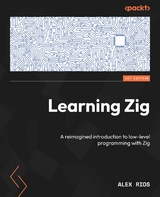
System programming has long forced developers to choose between safety and performance, but Zig changes the game with its no hidden control flow philosophy and explicit resource management. If you've struggled with memory leaks, undefined behavior, or cryptic compiler errors, Zig offers an alternative that puts you back in control.
Alex Rios, a seasoned software engineer with experience building high-throughput systems across fintech, telecom, and gaming industries, brings his unconventional system design approach and offers insight into Zig, as someone who's seen the limitations of existing languages firsthand.
You'll get to grips with Zig's safety-centric design fundamentals, which will guide you through setting up your app development environment and writing your first programs. You'll then explore Zig's distinctive features in depth, such as explicit error handling, manual memory management, and compile-time execution. The book tackles each topic with a blend of technical depth and wit, ensuring you grasp not just the how but also the why behind Zig's design decisions.
By the end of this book, you'll be ready to build a complete application that interacts with the OS, third-party libraries, and C dependencies, as well as engage with Zig's growing community and contribute to its ecosystem.
1
Safety First
Hey there! Ready to dive into Zig, a systems programming language that’s not only powerful but also surprisingly friendly? This first chapter introduces some of the coolest things Zig has to offer. It’s like getting a first taste of what makes Zig the new kid on the block that everyone’s talking about.
We’ll kick things off by exploring the current landscape of systems programming and why a fresh language such as Zig is exactly what developers need. Common headaches faced with mainstream languages will be uncovered, followed by a look at how Zig tackles these issues head-on. The basics of learning Zig will be covered, including its approach to syntax, memory management, and standout features such as compile-time metaprogramming. Additionally, Zig’s philosophy of avoiding unnecessary complexity will be highlighted, ensuring that what’s seen in the code is exactly what’s happening.
Understanding these choices is super important because they’ll help you write code that’s efficient, reliable, and easy to maintain—whether you’re building for embedded systems, operating systems, or cross-platform apps. By the end of this chapter, you’ll not only see why Zig is a strong alternative to other languages, but you’ll also have your starter kit for thinking in the Zig way. You’ll walk away with a solid understanding of how Zig’s design makes it perfect for modern systems programming.
In this chapter, we’re going to cover the following main topics:
- Training your brain to think in Zig
- Systems programming reimagined
- Maintain with Zig
- A new era begins
Getting the most out of this book – get to know your free benefits
Unlock exclusive free benefits that come with your purchase, thoughtfully crafted to supercharge your learning journey and help you learn without limits.
Here’s a quick overview of what you get with this book:
Next-gen reader
| Figure 1.1 – Illustration of the next-gen Packt Reader’s features | Our web-based reader, designed to help you learn effectively, comes with the following features: Multi-device progress sync: Learn from any device with seamless progress sync. Highlighting and notetaking: Turn your reading into lasting knowledge. Bookmarking: Revisit your most important learnings anytime. Dark mode: Focus with minimal eye strain by switching to dark or sepia mode. |
Interactive AI assistant (beta)
| Figure 1.2 – Illustration of Packt’s AI assistant | Our interactive AI assistant has been trained on the content of this book, to maximize your learning experience. It comes with the following features: Summarize it: Summarize key sections or an entire chapter. AI code explainers: In the next-gen Packt Reader, click the Explain button above each code block for AI-powered code explanations. Note: The AI assistant is part of next-gen Packt Reader and is still in beta. |
DRM-free PDF or ePub version
| Figure 1.3 – Free PDF and ePub | Learn without limits with the following perks included with your purchase: Learn from anywhere with a DRM-free PDF copy of this book. Use your favorite e-reader to learn using a DRM-free ePub version of this book. |
Unlock this book’s exclusive benefits nowScan this QR code or go to https://packtpub.com/unlock, then search for this book by name. Ensure it’s the correct edition. |
| Note: Keep your purchase invoice ready before you start. |
Training your brain to think in Zig
Learning a new programming language is no walk in the park, especially when it’s a systems programming language such as Zig. You might be tempted to blame your brain, thinking it just isn’t wired to absorb all this low-level, technical stuff.
But the truth is, your brain isn’t the problem—it’s how you’re feeding it. Your brain thrives on novelty. It’s always on the lookout for something new, something interesting. That’s how it’s designed, to keep you alert and, quite literally, alive. When faced with the routine, the ordinary, or the dull, your brain tunes it out, pushing it to the background so that it can focus on what really matters.
But how does your brain decide what’s important? Imagine you’re coding away, deep in thought, and suddenly your computer starts overheating, the fans roaring like a jet engine. Your brain immediately kicks into high gear: neurons fire, emotions spike, and adrenaline pumps. That’s how your brain knows something crucial is happening. It’s all about survival, and yes, in coding, survival means keeping your machine—and your code—running smoothly. And trust me, by the end of this journey, you’ll see that learning Zig isn’t as hard as it might seem right now.
Alright, let’s get something straight. This isn’t one of those “read and repeat” gigs where you zone out after the second paragraph. No, we’re going to do something revolutionary: make you think. Shocking, I know. We’ll poke at that brain of yours with reflexive questions—because who doesn’t love a little self-doubt in the middle of their learning process?—and throw in quizzes that, if nothing else, will keep you awake. And then, just when you think you’ve got it, we’ll slap you with some hands-on exercises to make sure you’re not just nodding along like a bobblehead.
Each chapter is a cleverly disguised trap—I mean, step—that builds on the last one. The complexity ramps up, but don’t worry; it’s all part of the master plan. You’ll revisit those “core concepts” in new and exciting ways because, apparently, repetition is how the brain learns. Who knew?
We’ll kick things off with the basics. Yes, basics—because you’ve got to learn to crawl before you can faceplant trying to run. You’ll get a taste of Zig’s syntax and features, which will undoubtedly leave you wondering why you didn’t pick up a more “mainstream” language. But stick with it. You’ll be solving problems, answering questions, and doing exercises that—believe it or not—are designed to be relevant to the real world.
By the time we’re done with you, Zig won’t just be another language in your toolbelt—it’ll be the chainsaw you reach for when you need to get serious work done. So, buckle up, buttercup. We’re about to take you on a wild, sarcastic, and surprisingly effective journey through Zig programming!
Systems programming reimagined
When you venture into the tangled mess of systems programming, it doesn’t take long before you stumble upon the usual suspects. You’ve got the classics—C and C++—those old rock bands that refuse to retire. Then, there are the hipsters, D and Odin, who are so niche that just knowing they exist feels like an insider secret. And, of course, the cool kids swell in with Rust and Go, showing off their shiny features and acting like they’ve reinvented the wheel.
But here’s the kicker—despite all this variety, none of these heavyweights entirely manage to strike that elusive balance between simplicity, transparency, and portability. That is, until Zig crashes the party, making it clear that it’s here to show everyone how it’s really done. Zig doesn’t just aim for the sweet spot; it plants its flag there and dares anyone to do better.
Language X versus language Y
Throughout this chapter, you’ll notice some comparisons to other programming languages such as C, Go, and Rust. Don’t worry if you’re not familiar with these languages—these comparisons are simply meant to resonate with those who are. They help highlight where Zig stands out or takes a different approach. If any of these references don’t ring a bell, that’s perfectly fine. The goal is to give you a broader perspective, but you’ll still get all the insights you need to understand Zig on its own terms.
The genesis of Zig – fixing what’s broken
Figure 1.4 – The frustrated systems programmer’s dilemma
Fed up with the endless landmines that C and C++ scatter across your path, Andrew Kelley decided enough was enough. So, he set out on a mission to create Zig—a language that...
| Erscheint lt. Verlag | 7.11.2025 |
|---|---|
| Sprache | englisch |
| Themenwelt | Mathematik / Informatik ► Informatik ► Programmiersprachen / -werkzeuge |
| ISBN-10 | 1-83508-449-4 / 1835084494 |
| ISBN-13 | 978-1-83508-449-6 / 9781835084496 |
| Informationen gemäß Produktsicherheitsverordnung (GPSR) | |
| Haben Sie eine Frage zum Produkt? |
 EPUB (Ohne DRM)
Digital Rights Management: ohne DRM
Dieses eBook enthält kein DRM oder Kopierschutz. Eine Weitergabe an Dritte ist jedoch rechtlich nicht zulässig, weil Sie beim Kauf nur die Rechte an der persönlichen Nutzung erwerben.
Dateiformat: EPUB (Electronic Publication)
EPUB ist ein offener Standard für eBooks und eignet sich besonders zur Darstellung von Belletristik und Sachbüchern. Der Fließtext wird dynamisch an die Display- und Schriftgröße angepasst. Auch für mobile Lesegeräte ist EPUB daher gut geeignet.
Systemvoraussetzungen:
PC/Mac: Mit einem PC oder Mac können Sie dieses eBook lesen. Sie benötigen dafür die kostenlose Software Adobe Digital Editions.
eReader: Dieses eBook kann mit (fast) allen eBook-Readern gelesen werden. Mit dem amazon-Kindle ist es aber nicht kompatibel.
Smartphone/Tablet: Egal ob Apple oder Android, dieses eBook können Sie lesen. Sie benötigen dafür eine kostenlose App.
Geräteliste und zusätzliche Hinweise
Buying eBooks from abroad
For tax law reasons we can sell eBooks just within Germany and Switzerland. Regrettably we cannot fulfill eBook-orders from other countries.
aus dem Bereich