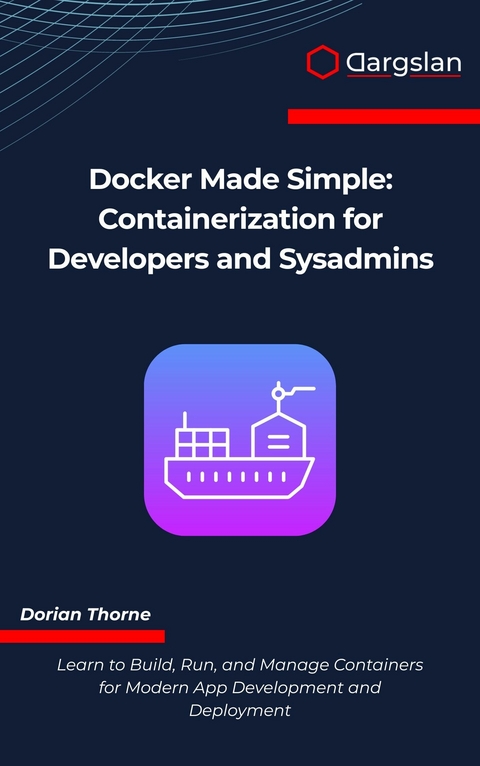
Docker Made Simple (eBook)
319 Seiten
Dargslan s.r.o. (Verlag)
978-0-00-110030-5 (ISBN)
Master Docker Containerization with Confidence - From First Container to Production Deployment
Transform your development and deployment workflow with Docker, the revolutionary containerization technology that has become essential for modern software development. 'Docker Made Simple' is your comprehensive guide to building, running, and managing containers, whether you're a developer streamlining your workflow or a system administrator modernizing deployment practices.
What Makes This Book Different
Most Docker resources are either too basic or overwhelmingly technical. This book bridges that gap, providing clear explanations and practical examples that take you from Docker fundamentals to production-ready deployments. Every concept is accompanied by real-world scenarios and best practices you can immediately apply.
What You'll Learn
Understand Docker's architecture and how containerization revolutionizes application deployment
Create optimized Docker images using Dockerfiles and best practices
Manage persistent data with Docker volumes and bind mounts
Configure container networking for single-host and multi-host scenarios
Orchestrate multi-container applications with Docker Compose
Implement security best practices to protect your containerized applications
Deploy and scale Docker containers in production environments
Troubleshoot common Docker issues with proven strategies
Use Docker to create consistent development environments across teams
Hands-On Learning Approach
This book emphasizes practical application over theory. Each chapter includes actionable examples, commands you can run immediately, and real-world scenarios based on years of Docker implementation experience. You'll understand not just how to use Docker, but when and why to apply specific strategies.
Comprehensive Reference Materials
Beyond the core chapters, you'll gain access to invaluable appendices including:
Docker CLI command cheat sheet for quick reference
Sample Dockerfiles for popular programming languages
Docker Compose templates for common application stacks
Production readiness checklist to ensure deployment confidence
Learning path for advancing to Kubernetes and container orchestration
Perfect For
Developers wanting to containerize applications and streamline workflows
System administrators modernizing deployment infrastructure
DevOps engineers implementing containerization strategies
IT professionals preparing for Docker certification
Teams seeking to standardize development environments
Anyone wanting to understand the technology powering modern cloud applications
Progressive Skill Building
Start with Docker basics and progressively advance through intermediate networking and volumes, then master Docker Compose for multi-container applications. Build confidence with development workflows before tackling security essentials and production deployment strategies. The structured approach ensures you build a solid foundation before advancing to complex topics.
Practical Production Focus
Unlike tutorials that stop at 'hello world,' this book prepares you for real-world Docker usage. You'll learn health checks, logging strategies, resource limits, secrets management, and deployment patterns that ensure your containers run reliably in production environments.
Start Your Docker Journey Today
Stop struggling with inconsistent environments, complex deployment procedures, and 'works on my machine' problems. Embrace the containerization revolution with confidence.
Introduction to Docker and Containerization
Understanding the Container Revolution
In the rapidly evolving landscape of software development and deployment, containerization has emerged as one of the most transformative technologies of the past decade. Docker, the platform that popularized containerization, has fundamentally changed how developers build, ship, and run applications across diverse computing environments.
To understand the significance of Docker, imagine a scenario where a developer creates an application on their local machine using specific libraries, dependencies, and system configurations. When this application needs to be deployed to a testing environment, staging server, or production system, the infamous "it works on my machine" problem often surfaces. Different operating systems, library versions, and system configurations can cause applications to behave unpredictably or fail entirely.
Docker solves this challenge by packaging applications and their entire runtime environment into lightweight, portable containers. These containers include everything needed to run the application: code, runtime, system tools, libraries, and settings. This approach ensures that applications run consistently across different environments, from a developer's laptop to production servers in the cloud.
What is Docker?
Docker is an open-source platform that automates the deployment, scaling, and management of applications using containerization technology. At its core, Docker provides a way to package applications into containers—standardized units of software that include everything needed to run an application reliably in any computing environment.
The Docker platform consists of several key components:
The Container Concept
A container is a lightweight, standalone package that includes an application and all its dependencies. Unlike virtual machines, which virtualize entire operating systems, containers share the host operating system's kernel while maintaining isolation between applications. This approach results in significantly reduced resource overhead and faster startup times.
Consider the following comparison between traditional deployment methods and containerized deployment:
Aspect
Traditional Deployment
Virtual Machines
Docker Containers
Resource Usage
High (bare metal)
Very High (full OS per app)
Low (shared kernel)
Startup Time
Minutes
Minutes
Seconds
Isolation
Process-level
Complete
Process and filesystem
Portability
Environment-dependent
Limited by hypervisor
High (runs anywhere)
Scalability
Manual configuration
Resource-intensive
Rapid and efficient
Maintenance
Complex dependencies
Multiple OS updates
Single image updates
The Evolution of Application Deployment
Traditional Deployment Challenges
Before containerization, application deployment involved numerous challenges that consumed significant time and resources. System administrators had to manually configure servers, install dependencies, and manage complex deployment scripts. Each environment required careful setup to match production configurations, leading to inconsistencies and deployment failures.
The traditional deployment process typically involved:
- Manual Server Configuration: Installing operating systems, configuring network settings, and setting up security protocols
- Dependency Management: Installing specific versions of programming languages, libraries, and frameworks
- Application Installation: Copying application files, configuring databases, and setting environment variables
- Testing and Validation: Ensuring applications work correctly in each environment
- Maintenance and Updates: Managing security patches, dependency updates, and configuration changes
The Rise of Virtualization
Virtual machines (VMs) addressed some deployment challenges by providing isolated environments that could be replicated across different hardware. However, VMs introduced their own complexities:
The Container Solution
Containers revolutionized application deployment by providing lightweight virtualization at the operating system level. This approach offers several advantages:
Efficiency: Containers share the host operating system kernel, reducing resource consumption and enabling higher density deployments.
Speed: Container startup times are measured in seconds rather than minutes, enabling rapid scaling and deployment.
Consistency: Applications run identically across development, testing, and production environments.
Portability: Containers can run on any system that supports the container runtime, regardless of underlying infrastructure.
Docker Architecture and Core Components
Docker Engine
Docker Engine serves as the heart of the Docker platform, providing the runtime environment for containers. The engine consists of three main components:
- Docker Daemon (dockerd): A persistent background process that manages Docker objects such as images, containers, networks, and volumes
- Docker REST API: An interface that programs can use to communicate with the Docker daemon
- Docker CLI (docker): A command-line interface that uses the Docker REST API to control or interact with the Docker daemon
The Docker Engine follows a client-server architecture where the Docker CLI acts as the client, communicating with the Docker daemon through REST API calls. This design allows for flexible deployment scenarios where the client and daemon can run on the same system or communicate over a network.
Docker Images and Layers
Docker images are read-only templates that contain the application code, runtime, libraries, and dependencies needed to create containers. Images are built using a layered architecture that promotes efficiency and reusability.
Each layer in a Docker image represents a specific change or addition to the filesystem. When you build an image, Docker creates a new layer for each instruction in the Dockerfile. This layered approach provides several benefits:
Docker Containers
Containers are running instances of Docker images. When you start a container, Docker creates a writable layer on top of the read-only image layers. This writable layer captures all changes made during the container's lifecycle, including file modifications, new files, and deleted files.
Key characteristics of Docker containers include:
Docker Registry
Docker Registry is a service that stores and distributes Docker images. The most popular public registry is Docker Hub, which hosts millions of images from the community and official software vendors. Organizations can also deploy private registries to store proprietary images securely.
Registry operations include:
Benefits of Docker for Developers
Development Environment Consistency
Docker eliminates the "works on my machine" problem by ensuring that applications run consistently across all environments. Developers can define their application's runtime environment in a...
| Erscheint lt. Verlag | 9.11.2025 |
|---|---|
| Sprache | englisch |
| Themenwelt | Mathematik / Informatik ► Informatik ► Betriebssysteme / Server |
| ISBN-10 | 0-00-110030-0 / 0001100300 |
| ISBN-13 | 978-0-00-110030-5 / 9780001100305 |
| Informationen gemäß Produktsicherheitsverordnung (GPSR) | |
| Haben Sie eine Frage zum Produkt? |
 EPUB (Adobe DRM)
Größe: 994 KB
Kopierschutz: Adobe-DRM
Adobe-DRM ist ein Kopierschutz, der das eBook vor Mißbrauch schützen soll. Dabei wird das eBook bereits beim Download auf Ihre persönliche Adobe-ID autorisiert. Lesen können Sie das eBook dann nur auf den Geräten, welche ebenfalls auf Ihre Adobe-ID registriert sind.
Details zum Adobe-DRM
Dateiformat: EPUB (Electronic Publication)
EPUB ist ein offener Standard für eBooks und eignet sich besonders zur Darstellung von Belletristik und Sachbüchern. Der Fließtext wird dynamisch an die Display- und Schriftgröße angepasst. Auch für mobile Lesegeräte ist EPUB daher gut geeignet.
Systemvoraussetzungen:
PC/Mac: Mit einem PC oder Mac können Sie dieses eBook lesen. Sie benötigen eine
eReader: Dieses eBook kann mit (fast) allen eBook-Readern gelesen werden. Mit dem amazon-Kindle ist es aber nicht kompatibel.
Smartphone/Tablet: Egal ob Apple oder Android, dieses eBook können Sie lesen. Sie benötigen eine
Geräteliste und zusätzliche Hinweise
Buying eBooks from abroad
For tax law reasons we can sell eBooks just within Germany and Switzerland. Regrettably we cannot fulfill eBook-orders from other countries.
aus dem Bereich