


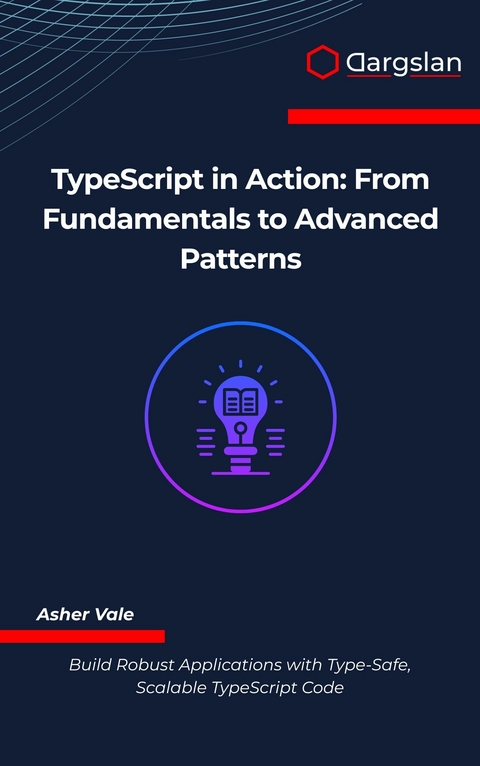
TypeScript in Action (eBook)
484 Seiten
Dargslan s.r.o. (Verlag)
978-0-00-109943-2 (ISBN)
Master TypeScript and Build Production-Ready Applications with Confidence
TypeScript has revolutionized modern web development, transforming how developers write JavaScript by adding powerful type safety, enhanced tooling, and enterprise-grade scalability. Whether you're building your first TypeScript project or architecting complex applications, this comprehensive guide provides everything you need to write robust, maintainable code.
From Fundamentals to Production
TypeScript in Action takes you on a structured journey from basic concepts to advanced implementation patterns. You'll start with the essentials-understanding TypeScript's type system, configuring projects, and working with functions and classes. Then progress to sophisticated topics including generics, decorators, advanced type patterns, and real-world application architecture.
What You'll Learn:
Set up and configure TypeScript projects with optimal compiler settings
Master TypeScript's type system, from primitives to advanced utility types
Write type-safe functions with proper parameter and return type annotations
Implement object-oriented patterns using classes, interfaces, and inheritance
Leverage advanced types including union types, intersection types, and conditional types
Create reusable, generic components that maintain type safety across your application
Manipulate the DOM with full type safety and autocomplete support
Integrate with REST APIs and handle JSON data with proper typing
Apply decorators and metadata for elegant, declarative code
Organize large-scale projects using monorepo strategies
Implement comprehensive testing strategies for TypeScript applications
Build full-stack applications with end-to-end type safety
Deploy TypeScript projects with CI/CD pipelines that enforce type checking
Real-World Focus
Every chapter includes practical examples and patterns you'll actually use in production. Learn how companies like Airbnb, Slack, and Microsoft leverage TypeScript to build scalable applications. Understand not just the 'how' but the 'why' behind TypeScript's design decisions.
Beyond Basic Tutorials
This isn't another introductory guide that leaves you unprepared for real projects. You'll explore advanced patterns including dependency injection, the repository pattern, sophisticated type guards, and complex generic constraints. Learn to think in types and design APIs that are both flexible and type-safe.
Comprehensive Reference Materials
Five detailed appendices provide ongoing value: a complete TypeScript cheatsheet, tsconfig.json reference guide, compiler error troubleshooting, recommended tools and extensions, and progressive type challenges to test your skills.
Perfect For:
JavaScript developers transitioning to TypeScript
Frontend engineers building React, Angular, or Vue applications
Backend developers exploring Node.js with type safety
Team leads establishing TypeScript best practices
Anyone serious about writing maintainable, scalable code
Start Writing Better Code Today
TypeScript isn't just about catching errors-it's about building with confidence, creating self-documenting code, and enabling fearless refactoring. Transform your development experience and join the thousands of developers who have made TypeScript their language of choice.
Introduction
The Evolution of Modern Development Architecture
In the rapidly evolving landscape of software development, the need for robust, scalable, and maintainable systems has never been more critical. As applications grow in complexity and user expectations soar, developers find themselves at the intersection of multiple paradigms, frameworks, and architectural patterns. This convergence has given birth to sophisticated approaches that combine the power of Model-Context-Protocol (MCP) server architecture with the type safety and scalability of TypeScript.
The modern development ecosystem presents unique challenges that traditional monolithic architectures struggle to address. Applications must handle increasing loads, integrate with multiple services, maintain data consistency across distributed systems, and provide real-time responsiveness while ensuring type safety and code maintainability. These requirements have pushed the boundaries of what single-language, single-paradigm solutions can achieve.
Understanding MCP Server Architecture
Foundational Concepts
Model-Context-Protocol (MCP) server architecture represents a paradigm shift in how we structure and organize server-side applications. Unlike traditional three-tier architectures that separate presentation, business logic, and data access into distinct layers, MCP architecture introduces a more nuanced approach that emphasizes context-aware processing and protocol-driven communication.
The Model component in MCP architecture serves as the foundation for data representation and business logic encapsulation. It goes beyond simple data structures to include behavioral patterns, validation rules, and state management mechanisms. Models in MCP architecture are designed to be self-contained units that understand their own constraints and capabilities.
# Example directory structure for MCP architecture
mkdir -p mcp-server/{models,contexts,protocols,utils,tests}
cd mcp-server
# Initialize the project structure
touch models/index.ts
touch contexts/index.ts
touch protocols/index.ts
touch utils/index.ts
touch tests/index.ts
Note: The directory structure above establishes the foundational organization for an MCP-based TypeScript project, separating concerns into logical modules that can be developed and tested independently.
The Context component provides the environmental and situational awareness that traditional architectures often lack. Context encompasses not just the immediate request context, but also user context, system state, temporal context, and business context. This contextual information enables the system to make intelligent decisions about how to process requests, which resources to allocate, and how to optimize performance.
The Protocol component defines the communication patterns and interaction rules between different parts of the system. Unlike rigid API contracts, protocols in MCP architecture are designed to be adaptive and context-aware, allowing for dynamic behavior based on current system conditions and requirements.
Architectural Benefits
The MCP architecture offers several compelling advantages over traditional approaches:
Contextual Intelligence: By embedding context awareness into the core architecture, systems can make more informed decisions about resource allocation, caching strategies, and response optimization. This leads to better performance characteristics and more intuitive user experiences.
Protocol Flexibility: The protocol-driven approach allows for dynamic adaptation to changing requirements without requiring extensive system modifications. New communication patterns can be introduced incrementally, and existing protocols can evolve without breaking backward compatibility.
Model Autonomy: Models in MCP architecture are designed to be autonomous entities that can validate themselves, manage their own state, and interact with other models through well-defined interfaces. This autonomy reduces coupling and improves testability.
TypeScript: The Foundation of Type-Safe Development
The TypeScript Advantage
TypeScript has emerged as the de facto standard for building large-scale JavaScript applications, and its role in MCP server architecture cannot be overstated. The language provides static typing capabilities that catch errors at compile time, reducing runtime failures and improving overall system reliability.
The type system in TypeScript goes far beyond simple primitive type checking. It includes advanced features such as union types, intersection types, conditional types, and mapped types that enable developers to express complex business rules and constraints directly in the type system.
// Advanced TypeScript type definitions for MCP architecture
interface ModelBase<T> {
id: string;
version: number;
validate(): Promise<ValidationResult>;
serialize(): T;
}
interface ContextProvider<C extends Record<string, any>> {
getContext(): Promise<C>;
updateContext(updates: Partial<C>): Promise<void>;
}
interface Protocol<Request, Response> {
name: string;
version: string;
handle(request: Request, context: any): Promise<Response>;
}
Command Explanation: The TypeScript interfaces above demonstrate the use of generics and advanced type constraints to create flexible, reusable components that maintain type safety across the MCP architecture layers.
Type Safety in Distributed Systems
One of the most significant challenges in distributed systems is maintaining type consistency across service boundaries. Traditional approaches often rely on runtime validation and documentation to ensure data integrity, but these methods are prone to errors and inconsistencies.
TypeScript's type system, when properly leveraged, can provide compile-time guarantees about data structure consistency across distributed components. This is particularly valuable in MCP architectures where models, contexts, and protocols must interact seamlessly across different services and deployment boundaries.
The following table illustrates the key TypeScript features that enhance MCP server development:
Feature
Description
MCP Application
Benefits
Interface Definitions
Contract specifications for objects and classes
Defining model, context, and protocol contracts
Compile-time validation, clear API boundaries
Generic Types
Parameterized types for reusable components
Creating flexible model and protocol definitions
Type safety with flexibility, code reuse
Union Types
Types that can be one of several specified types
Handling different context states or protocol variants
Precise type modeling, exhaustive checking
Mapped Types
Types derived from existing types through transformation
Creating derived models or context transformations
DRY principle, consistent type evolution
Conditional Types
Types that depend on conditions
Dynamic protocol selection based on context
Adaptive behavior with type safety
Utility Types
Built-in helper types for common transformations
Model updates, partial contexts, protocol responses
Reduced boilerplate, consistent patterns
Advanced TypeScript Patterns
Modern TypeScript development leverages sophisticated patterns that go beyond basic type annotations. These patterns are particularly relevant in MCP server architecture where complex interactions between components require precise type modeling.
Discriminated Unions: These allow for type-safe handling of different variants...
| Erscheint lt. Verlag | 8.11.2025 |
|---|---|
| Sprache | englisch |
| Themenwelt | Mathematik / Informatik ► Informatik ► Programmiersprachen / -werkzeuge |
| ISBN-10 | 0-00-109943-4 / 0001099434 |
| ISBN-13 | 978-0-00-109943-2 / 9780001099432 |
| Informationen gemäß Produktsicherheitsverordnung (GPSR) | |
| Haben Sie eine Frage zum Produkt? |
 EPUB (Adobe DRM)
Größe: 1,0 MB
Kopierschutz: Adobe-DRM
Adobe-DRM ist ein Kopierschutz, der das eBook vor Mißbrauch schützen soll. Dabei wird das eBook bereits beim Download auf Ihre persönliche Adobe-ID autorisiert. Lesen können Sie das eBook dann nur auf den Geräten, welche ebenfalls auf Ihre Adobe-ID registriert sind.
Details zum Adobe-DRM
Dateiformat: EPUB (Electronic Publication)
EPUB ist ein offener Standard für eBooks und eignet sich besonders zur Darstellung von Belletristik und Sachbüchern. Der Fließtext wird dynamisch an die Display- und Schriftgröße angepasst. Auch für mobile Lesegeräte ist EPUB daher gut geeignet.
Systemvoraussetzungen:
PC/Mac: Mit einem PC oder Mac können Sie dieses eBook lesen. Sie benötigen eine
eReader: Dieses eBook kann mit (fast) allen eBook-Readern gelesen werden. Mit dem amazon-Kindle ist es aber nicht kompatibel.
Smartphone/Tablet: Egal ob Apple oder Android, dieses eBook können Sie lesen. Sie benötigen eine
Geräteliste und zusätzliche Hinweise
Buying eBooks from abroad
For tax law reasons we can sell eBooks just within Germany and Switzerland. Regrettably we cannot fulfill eBook-orders from other countries.
aus dem Bereich


