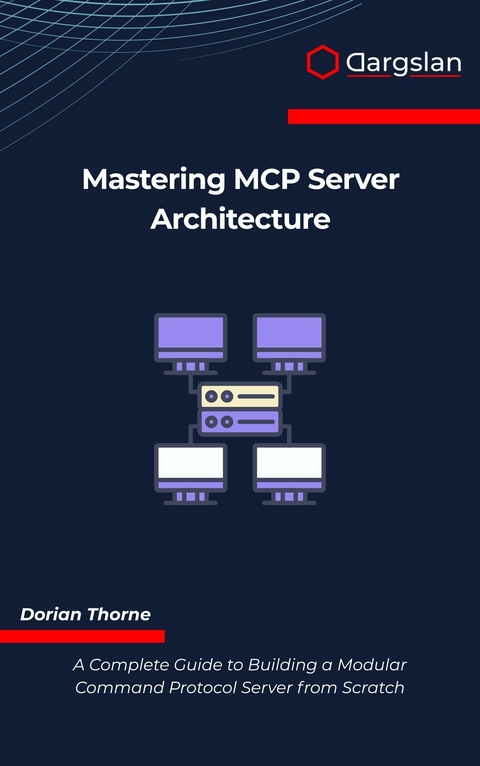
Mastering MCP Server Architecture (eBook)
688 Seiten
Dargslan s.r.o. (Verlag)
978-0-00-109935-7 (ISBN)
Build Production-Ready Modular Command Protocol Servers with Confidence
Are you ready to master the art of building scalable, maintainable server architectures that can adapt to evolving business requirements? 'Mastering MCP Server Architecture' is your comprehensive guide to designing and implementing robust Modular Command Protocol servers from the ground up.
What You'll Learn:
This hands-on guide takes you on a complete journey through MCP server development, covering everything from foundational concepts to advanced production deployment strategies. You'll gain practical experience building real-world systems while mastering the architectural principles that separate good implementations from great ones.
Inside This Book:
Foundational Knowledge: Understand core MCP concepts, server architecture principles, and planning strategies that set you up for success
Hands-On Development: Build a complete MCP server step-by-step, from environment setup through core server creation and command structure design
Modular Architecture: Master the art of building flexible, maintainable systems with modular command dispatchers and custom module development
Security & Authentication: Implement robust authentication systems and session management that protect your infrastructure
Production Readiness: Learn essential logging, monitoring, debugging, and testing strategies for reliable server operations
Scalability: Discover patterns and practices for scaling your MCP server to handle growing demands
Data Persistence: Implement effective data storage and retrieval strategies
Advanced Features: Explore optional web admin panels, advanced command patterns, and enterprise-grade capabilities
Real-World Projects: Apply your knowledge through practical projects that demonstrate production-ready implementations
Comprehensive Resources:
Six detailed appendices provide invaluable reference materials including command references, configuration templates, syntax grammar, terminology glossary, open-source project listings, and complete client simulator code in both Python and Node.js.
Who This Book Is For:
Software developers building distributed systems
System architects designing modular server architectures
Backend engineers seeking to expand their architectural knowledge
DevOps professionals implementing scalable infrastructure
Technical leads evaluating server architecture patterns
Why This Book Stands Out:
Unlike purely theoretical texts, this book emphasizes both the 'how' and the 'why' of MCP architecture. Each chapter builds progressively on previous knowledge, ensuring you develop deep understanding alongside practical skills. Code examples, real-world scenarios, and production-focused guidance provide the complete picture you need to confidently build and deploy MCP servers.
Your Journey Begins Here:
Whether you're building your first modular server or refining existing architectures, this book provides the comprehensive foundation and advanced techniques you need. Master the patterns, practices, and principles that will serve you throughout your career in distributed systems development.
Start building better servers today.
Chapter 1: Introduction to MCP Server Concepts
Understanding the Foundation of Modular Command Protocol Servers
In the rapidly evolving landscape of distributed systems and microservices architecture, the need for efficient, scalable, and maintainable communication protocols has never been more critical. The Modular Command Protocol (MCP) server represents a paradigm shift in how we approach server-side command processing, offering a robust framework that combines modularity, extensibility, and performance into a cohesive architectural pattern.
The MCP server architecture emerges from the recognition that traditional monolithic command processing systems often struggle with the demands of modern applications. As systems grow in complexity and scale, the limitations of tightly coupled command handlers become apparent: difficult maintenance, challenging testing procedures, and inflexible deployment strategies. The MCP server addresses these challenges by introducing a modular approach that separates concerns while maintaining high performance and reliability.
At its core, an MCP server is designed around the principle of command segregation and responsibility isolation. Each command type is handled by a dedicated module, creating a clear separation of concerns that enhances both maintainability and testability. This architectural approach allows developers to focus on specific command logic without being overwhelmed by the complexity of the entire system.
Core Architecture Principles
The foundation of MCP server architecture rests on several fundamental principles that distinguish it from traditional server implementations. Understanding these principles is essential for anyone seeking to master the art of building robust, scalable command processing systems.
Modularity and Separation of Concerns
The first and most crucial principle is modularity. In an MCP server, each command or group of related commands is encapsulated within its own module. This modular approach provides several significant advantages:
Isolation of Functionality: Each module operates independently, reducing the risk of cascading failures and making it easier to identify and resolve issues when they arise. When a specific command module encounters a problem, it doesn't necessarily affect the operation of other modules within the system.
Independent Development: Development teams can work on different modules simultaneously without interfering with each other's work. This parallel development approach significantly reduces development time and allows for specialized expertise to be applied to specific command types.
Targeted Testing: Individual modules can be tested in isolation, making it easier to create comprehensive test suites and identify edge cases specific to particular command types. This granular testing approach leads to higher code quality and more reliable systems.
Scalability Through Design
The MCP server architecture is inherently designed for scalability. Unlike monolithic systems that require scaling the entire application, MCP servers allow for selective scaling of individual modules based on demand patterns.
Horizontal Module Scaling: High-demand command types can be scaled independently by deploying additional instances of specific modules. This targeted scaling approach is more resource-efficient than scaling an entire monolithic application.
Load Distribution: The modular architecture naturally supports load distribution strategies, allowing different modules to be deployed across different servers or containers based on their resource requirements and usage patterns.
Resource Optimization: Each module can be optimized for its specific workload characteristics, whether that involves CPU-intensive processing, memory-heavy operations, or I/O-bound tasks.
Extensibility and Plugin Architecture
The MCP server framework is designed with extensibility as a core feature. New command types can be added to the system without modifying existing code, following the open-closed principle of software design.
Dynamic Module Loading: The server can dynamically load and unload modules at runtime, allowing for hot deployment of new features and bug fixes without system downtime.
Standardized Interfaces: All modules implement standardized interfaces, ensuring consistency across the system and making it easy to integrate new modules developed by different teams or external vendors.
Configuration-Driven Behavior: Module behavior can be modified through configuration changes rather than code modifications, providing flexibility in deployment and operation.
Command Processing Flow
Understanding the command processing flow in an MCP server is crucial for appreciating how the various components work together to deliver efficient and reliable command execution.
Request Reception and Parsing
The journey of a command through an MCP server begins with request reception. The server's network layer receives incoming requests, which can arrive through various protocols such as HTTP, TCP, or message queues. The flexibility in protocol support is one of the key advantages of the MCP architecture.
# Example of server startup script showing protocol configuration
#!/bin/bash
# MCP Server startup configuration
SERVER_PORT=8080
PROTOCOL_TYPE="http"
MAX_CONNECTIONS=1000
THREAD_POOL_SIZE=50
# Start the MCP server with specified configuration
./mcp-server /
--port=$SERVER_PORT /
--protocol=$PROTOCOL_TYPE /
--max-connections=$MAX_CONNECTIONS /
--thread-pool-size=$THREAD_POOL_SIZE /
--config-file=/etc/mcp/server.conf
Once a request is received, the parsing layer extracts the command information from the request payload. This parsing process is protocol-agnostic, meaning the same command can be processed regardless of whether it arrives via HTTP POST, TCP socket, or message queue.
Command Routing and Module Selection
After parsing, the server's routing engine determines which module should handle the specific command. This routing decision is based on command type, version, and potentially other factors such as load balancing requirements or user permissions.
The routing engine maintains a registry of available modules and their capabilities. This registry is dynamically updated as modules are loaded or unloaded, ensuring that routing decisions are always based on current system state.
# Module registration example
#!/bin/bash
# Register a new command module
register_module() {
local module_name=$1
local module_path=$2
local command_types=$3
echo "Registering module: $module_name"
echo "Module path: $module_path"
echo "Supported commands: $command_types"
# Add module to registry
echo "$module_name:$module_path:$command_types" >> /etc/mcp/modules.registry
# Signal server to reload module registry
kill -SIGUSR1 $(cat /var/run/mcp-server.pid)
}
# Example module registration
register_module "user_management" "/opt/mcp/modules/user_mgmt.so" "create_user,delete_user,update_user"
Module Execution and Response Generation
Once the appropriate module is selected, the command is dispatched to that module for execution. The module processes the command according to its internal logic, which may involve database operations, external API calls, file system operations, or complex business logic calculations.
The modular architecture ensures that each module operates in its own execution context, preventing interference between different command types. This isolation is crucial for maintaining system stability and security.
Module Architecture Deep Dive
The internal architecture of MCP modules follows a consistent pattern that promotes code reusability and maintainability. Understanding this pattern is essential for developing effective modules.
Module Interface Standardization
Every MCP module must implement a standardized interface that defines how the module interacts with the server framework. This interface includes methods for initialization, command processing, error handling, and cleanup.
Interface Method
Purpose
Parameters
Return...
| Erscheint lt. Verlag | 8.11.2025 |
|---|---|
| Sprache | englisch |
| Themenwelt | Mathematik / Informatik ► Informatik ► Betriebssysteme / Server |
| ISBN-10 | 0-00-109935-3 / 0001099353 |
| ISBN-13 | 978-0-00-109935-7 / 9780001099357 |
| Informationen gemäß Produktsicherheitsverordnung (GPSR) | |
| Haben Sie eine Frage zum Produkt? |
 EPUB (Adobe DRM)
Größe: 1,0 MB
Kopierschutz: Adobe-DRM
Adobe-DRM ist ein Kopierschutz, der das eBook vor Mißbrauch schützen soll. Dabei wird das eBook bereits beim Download auf Ihre persönliche Adobe-ID autorisiert. Lesen können Sie das eBook dann nur auf den Geräten, welche ebenfalls auf Ihre Adobe-ID registriert sind.
Details zum Adobe-DRM
Dateiformat: EPUB (Electronic Publication)
EPUB ist ein offener Standard für eBooks und eignet sich besonders zur Darstellung von Belletristik und Sachbüchern. Der Fließtext wird dynamisch an die Display- und Schriftgröße angepasst. Auch für mobile Lesegeräte ist EPUB daher gut geeignet.
Systemvoraussetzungen:
PC/Mac: Mit einem PC oder Mac können Sie dieses eBook lesen. Sie benötigen eine
eReader: Dieses eBook kann mit (fast) allen eBook-Readern gelesen werden. Mit dem amazon-Kindle ist es aber nicht kompatibel.
Smartphone/Tablet: Egal ob Apple oder Android, dieses eBook können Sie lesen. Sie benötigen eine
Geräteliste und zusätzliche Hinweise
Buying eBooks from abroad
For tax law reasons we can sell eBooks just within Germany and Switzerland. Regrettably we cannot fulfill eBook-orders from other countries.
aus dem Bereich