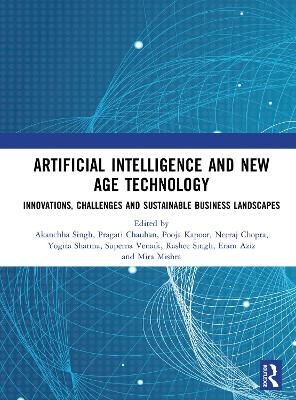
Artificial Intelligence and New Age Technology
Routledge (Verlag)
978-1-041-24079-2 (ISBN)
- Noch nicht erschienen (ca. Februar 2026)
- Versandkostenfrei
- Auch auf Rechnung
- Artikel merken
Dr. Akanchha Singh - Assistant Professor at Manav Rachna University, holds a Ph.D. from Khwaja Moinuddin Chishti Language University, Lucknow. With over six years of academic experience, she specializes in Human Resource Management and Organizational Behaviour. She has authored two books and published more than 20 papers in Scopus, ABDC, and Web of Science-indexed journals. She has presented over 20 research papers at national and international conferences, received Best Paper Awards, and serves as a reviewer for reputed international journals. Dr. Pragati Chauhan - Professor at Manav Rachna University, is a certified Entrepreneurship Educator (NEN), Business Simulation Coach, and certified Innovation Ambassador from Ministry of Education. Her research and teaching areas include entrepreneurship, institutional social responsibility, economics, and organizational behaviour. She has led AICTE- and DST-funded projects, mentored start-ups at national and international platforms, served as jury member for global business idea competitions and also heads the University Entrepreneurship cell. Dr. Pooja Kapoor - Professor at Manav Rachna University, holds expertise in finance, taxation, and business management. She has extensive teaching and research experience, guided Ph.D. scholars, and published in reputed journals. Her research interests include financial literacy, entrepreneurship, and AI-driven innovations, with patents to her credit. She actively contributes to curriculum development, institutional growth, and global academic forums, while mentoring future business leaders through conferences and workshops. Mr. Neeraj Chopra - Assistant Professor at Manav Rachna University, has over 23 years of academic experience. He holds an MBA, MCA, M.Tech (IT), and M.Phil in Computer Science, and is currently pursuing a Ph.D. in Management from J.C. Bose University, YMCA, Faridabad. His research focuses on management and IT, with several publications in Scopus-indexed journals. He has also presented papers at various national and international conferences. Dr. Yogita Sharma - Professor at Manav Rachna University, heads Entrepreneurship, Incubation, and Start-up initiatives. With 17 years of academic and 10 years of industry experience, she mentors start-ups under NIESBUD, MENTORx, and MSME incubators. Certified as an Entrepreneurship Trainer by DST, NEN, and NIESBUD, she has received government grants, authored books and research papers, and contributed to SWAYAM. Her research interests include entrepreneurship, consumer behaviour, sustainability, and marketing. Dr. Superna Venaik - Associate Professor at Manav Rachna University, holds a Ph.D. in Law from Mewar University with specialization in ecotourism and sustainable development. She has also earned diplomas in Human Rights and Environmental Law and an MBA in HR. With teaching experience since 2010, she has presented at international conferences, judged moot courts, and edited books on gender and sustainability. Her expertise spans diverse legal subjects and academic leadership. Dr. Rashee Singh - Professor at Manav Rachna University, holds over 15 years of experience in Teacher Education. Her research interests include educational psychology, pedagogical practices, and adolescent issues. She has authored 25 publications in reputed journals, developed UNESCO OERs, and contributed to NIOS and SWAYAM. She has supervised five Ph.D. scholars and authored a book on adolescence. She is actively involved with professional teacher-educator associations. Dr. Eram Aziz - Assistant Professor at Manav Rachna University, specializes in Science Education, ICT in Education, and Inclusive Education. With more than 14 years of teaching experience, she has published in peer-reviewed journals and presented at national and international conferences. She is the author of Embracing Diversity: A Handbook on Inclusive Education. Actively engaged in OER development, FDPs, and curriculum innovation, her research emphasizes ICT integration and 21st-century pedagogies. Dr. Mira Mishra - Assistant Professor at Manav Rachna University, holds a Ph.D. in Education and postgradu>ate degrees in Education and Environmental Science. A UGC-NET qualified scholar, she has 13 years of expe>rience in higher education and K–12 sectors. She has authored 20 research papers in Scopus and UGC Care journals, contributed to books, and recorded lectures for NIOS and NCERT. Her expertise includes curriculum design, educational philosophy, and psychology.
Chapter 1 Revolutionizing education with AI: Personalization, creativity, and equity in arts and literature
Ajit Kumar, Nibedita Hazarika and Vrinda Goel
Chapter 2 Reflection of women in global and digital perspectives: A critical study of Virginia Woolf’s a room of one’s own
Aradhna Rawat and Akhilesh Kumar Dwivedi
Chapter 3 Empowering inclusive education in online teaching with AI supported tools: Views of special education teachers
Bhawna Mathur, Neetu Mishra Shukla and Indu Kumar
Chapter 4 Leveraging artificial intelligence in inclusive education: A study of transforming learning and promoting educators’ professional development for CWSN support
Harshita Panjani, Sheena Thomas and Alka Mudgal
Chapter 5 Reconstructing historical silences: Image AI and the forgotten women of Croker’s in old Madras
Manisha Mendiratta and Akhilesh Kumar Dwivedi
Chapter 6 AI ethics in educational domain: An exploration from stakeholders’ perspective
Meenal Rawat, Eram Aziz, Yamya Tiwari, Khushi Sharma, Mira Mishra and Bushra Sumaiya
Chapter 7 Artificial intelligence driven curriculum and global competitiveness: A study on the internationalization of Indian higher education
Prachya Prerna
Chapter 8 Investigating the opportunities and challenges of AI tools for inclusive education among school teachers in Delhi, NCR
Sanskriti Rawat and Robert Linton Tavis Ashton-Bell
Chapter 9 From ‘being creative’ to ‘being created by’: Looking at the role of AI in redefining literature studies
Ushita Banerjee and Chhavi Kulshrestha
Chapter 10 Cultivating sustainable mindsets: An exploration of art-based pedagogy through an eco-criticism and literary lens Vrinda Goel, Akhilesh Kumar Dwivedi and Ajit Kumar
Chapter 11 Algorithm bias in AI driven technology vis a vis racial profiling and other forms of discrimination
Aditya Verma and Aastha Thakur
Chapter 12 Digital divides and human touch: The quest for inclusive education in age of artificial intelligence
Apala Vatsa, Sunny Kumar and Aditi Gupta
Chapter 13 AI and robotics in legal proceedings: Global perspectives and India’s path towards access to justice
Garima Pahwa, Ghazala Abidin and Medha Tiwari
Chapter 14 Legal intersections of artificial intelligence, legal personality and robots
Tarun Pratap Yadav, Harshita Singh and Aarya Arora
Chapter 15 Human rights and COVID 19 pandemic: Protection of sovereignty in era of AI
Kanwal D. P. Singh and Sheetal Gahlot
Chapter 16 AI and international arbitration: Paving the way for sustainability
Misha Bahmani
Chapter 17 Global digital labor by artificial intelligence: Tranquility in labor, employment and technological transformation
Payal Jain
Chapter 18 Marking the contours of general-purpose artificial intelligence and its impact on public opinion in the post-truth era
Shivang Tripathi and Neha Singh
Chapter 19 Cyber adjudication in the age of artificial intelligence – A conflict of jurisdiction
Asha Verma, Ruchi Lal, Superna Venaik and Anubha Srivastava
Chapter 20 Integrating AI in the criminal justice system for prevention of crime: A holistic approach
Swati Kaushal, Neha, Menka Rai and Superna Venaik
Chapter 21 The role of workplace spirituality in teachers retention: Moderating effect of AI acceptance
Kritika Pallvi and Parul Jhajharia
Chapter 22 The confluence of AI and e-learning: Shaping higher education for future workforce demands
Mona Chaudhary and Sunil Kadyan
Chapter 23 Unlocking the power of artificial intelligence for supercharged performance measurement in human resource management 200
Nisha Rani, Akanchha Singh and Shagun Chahal
Chapter 24 Systematic review on artificial intelligence (AI) implications in mental health
Nisha Wadhawan and Ritika
Chapter 25 How does a customer-centric approach to sustainable packaging influence purchasing behavior in the food and beverage sector
Boonrapee Siriketboon and Najla Shafighi
Chapter 26 AI-driven human-centered practices and their impact on employee satisfaction in industry 5.0
Chenar Bodaghi, Najla Shafighi and Pragati Chauhan
Chapter 27 Digital communities and expatriate’s cross cultural adjustment: A netnography study
Sahiba Sharma, Ruchi Dixit and Ruchika Yadav
Chapter 28 Adoption of AI in Indian banking: Barriers, enablers, and strategic roadmap for digital transformation
Hemant Kothari, Anil Jain, Shivoham Singh, Aman Agarwal, Raj Kothari and Surya Prakash Vaishnav
Chapter 29 From scroll to sale: A comprehensive review of the behavioral impact of social media advertising on consumers
Hemant Kothari, Apurva Jain, Shloka Agarwal, Kirti Mangal, Ankita Pathak and Divya Hiran
Chapter 30 Leveraging artificial intelligence, machine learning, and big data in enhancing consumer decision-making in health insurance: A comprehensive review
Dhrub Ranjan, Sunil Kadyan and Manish Sharma
Chapter 31 The future of management: harnessing artificial intelligence for strategic leadership and business transformation
Aryan Sharma, Akanchha Singh and Sunil Kunar Roy
| Erscheint lt. Verlag | 19.2.2026 |
|---|---|
| Verlagsort | London |
| Sprache | englisch |
| Maße | 210 x 280 mm |
| Themenwelt | Informatik ► Theorie / Studium ► Künstliche Intelligenz / Robotik |
| Wirtschaft ► Betriebswirtschaft / Management ► Marketing / Vertrieb | |
| Wirtschaft ► Betriebswirtschaft / Management ► Unternehmensführung / Management | |
| ISBN-10 | 1-041-24079-1 / 1041240791 |
| ISBN-13 | 978-1-041-24079-2 / 9781041240792 |
| Zustand | Neuware |
| Informationen gemäß Produktsicherheitsverordnung (GPSR) | |
| Haben Sie eine Frage zum Produkt? |
aus dem Bereich