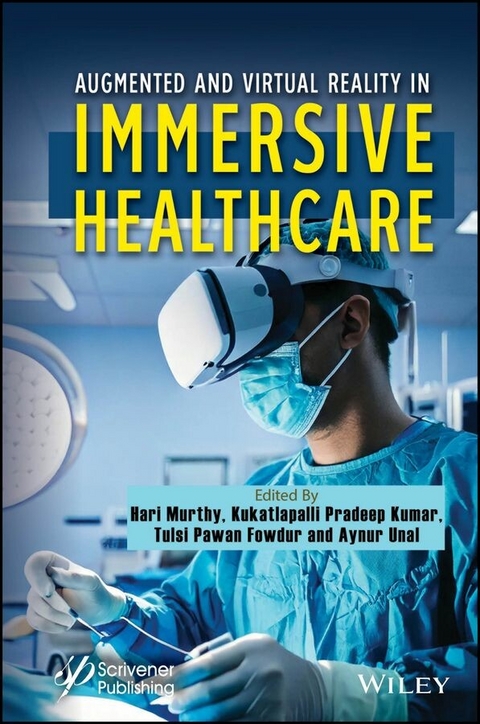
Augmented and Virtual Reality in Immersive Healthcare (eBook)
814 Seiten
Wiley-Scrivener (Verlag)
978-1-394-30284-0 (ISBN)
Future-proof your medical expertise with this indispensable guide that offers a comprehensive, expert-led exploration of how Augmented and Virtual Reality (AR/VR) are revolutionizing healthcare.
Augmented reality (AR) and virtual reality (VR) have profoundly impacted the healthcare sector, introducing ground-breaking applications ranging from surgical simulations and pain management to mental health therapies and patient education. This book delves into the various applications of AR and VR, including deep learning, surgical training, teleconsultation, and patient rehabilitation. By blending theoretical insights with practical case studies, it provides a deeper understanding of how these technologies are being integrated into medical practices to improve outcomes, enhance patient care, and train healthcare professionals. It also explores cutting-edge developments, such as AI-powered AR systems and VR-based mental health treatments, highlighting the future of healthcare innovation. With contributions from leading experts in healthcare, technology, and academia, this book offers a multidimensional perspective on the challenges and opportunities associated with AR and VR in the medical field. Through its accessible language and detailed illustrations, this book is an indispensable guide for anyone interested in the intersection of technology and medicine.
Readers will find the volume:
- Provides a comprehensive exploration of how immersive technology is unlocking new possibilities in healthcare, education, and rehabilitation;
- Offers insights from top researchers and practitioners in the field, providing authoritative perspectives on the latest technologies, applications, and trends shaping the future of XR;
- Offers practical guidance and actionable insights to help you harness the power of AR and VR, accelerating innovation and driving real-world impacts;
- Uncovers the diverse range of applications empowered by the convergence of healthcare and gamification, revolutionizing healthcare delivery and improving patient outcomes.
Audience
Healthcare professionals, medical educators and students, engineers, developers, researchers, and policymakers looking for cutting-edge technologies to enhance patient care and treatment outcomes.
Hari Murthy, PhD is an Assistant Professor in the Department of Electronics and Communication Engineering at Christ University, Bangalore, India. He has edited three books and published papers in international journals and conferences. His research interests include data engineering and material science.
Kukatlapalli Pradeep Kumar, PhD is an Associate Professor at Christ University, Bangalore, India. with more than 12 years of experience. He is a certified CISCO and Microsoft trainer in the Data Analytics domain. His areas of interest include data science, information security, computer forensics, data provenance, software engineering, and multiparty secret sharing.
Tulsi Pawan Fowdur, PhD is an Associate Professor in the Department of Electrical and Electronic Engineering of the University of Mauritius, Moka, Mauritius. He has published several papers on his research interests in mobile and wireless communications, multimedia communications, networking and security, telecommunications applications development, Internet of Things, and AI.
Aynur Unal, PhD is based in Stanford Medical School, Global Health Innovation Center, Palo Alto, CA, USA. She has a strong engineering design and manufacturing background and is credited with developing the Acoustics Institute in conjunction with the NASA-AMES research fellowships. Now, her work revolves around social entrepreneurial projects benefitting needy children and the elderly.
Future-proof your medical expertise with this indispensable guide that offers a comprehensive, expert-led exploration of how Augmented and Virtual Reality (AR/VR) are revolutionizing healthcare. Augmented reality (AR) and virtual reality (VR) have profoundly impacted the healthcare sector, introducing ground-breaking applications ranging from surgical simulations and pain management to mental health therapies and patient education. This book delves into the various applications of AR and VR, including deep learning, surgical training, teleconsultation, and patient rehabilitation. By blending theoretical insights with practical case studies, it provides a deeper understanding of how these technologies are being integrated into medical practices to improve outcomes, enhance patient care, and train healthcare professionals. It also explores cutting-edge developments, such as AI-powered AR systems and VR-based mental health treatments, highlighting the future of healthcare innovation. With contributions from leading experts in healthcare, technology, and academia, this book offers a multidimensional perspective on the challenges and opportunities associated with AR and VR in the medical field. Through its accessible language and detailed illustrations, this book is an indispensable guide for anyone interested in the intersection of technology and medicine. Readers will find the volume: Provides a comprehensive exploration of how immersive technology is unlocking new possibilities in healthcare, education, and rehabilitation; Offers insights from top researchers and practitioners in the field, providing authoritative perspectives on the latest technologies, applications, and trends shaping the future of XR; Offers practical guidance and actionable insights to help you harness the power of AR and VR, accelerating innovation and driving real-world impacts; Uncovers the diverse range of applications empowered by the convergence of healthcare and gamification, revolutionizing healthcare delivery and improving patient outcomes. Audience Healthcare professionals, medical educators and students, engineers, developers, researchers, and policymakers looking for cutting-edge technologies to enhance patient care and treatment outcomes.
1
Revolutionizing Patient Care: Augmented and Virtual Reality Applications in Healthcare
M. Mary Adline Priya
Saveetha Engineering College, Chennai, India
Abstract
This chapter investigates the significant role that augmented reality (AR) and virtual reality (VR) technologies are playing in transforming healthcare. These immersive technologies are reshaping traditional methods in areas like patient care, medical education, and therapeutic treatments, offering an enhanced and interactive approach. The chapter outlines how AR/VR is being leveraged in healthcare, including its use in advanced surgical simulations, real-time medical training, patient rehabilitation, and mental health therapies. By enabling lifelike simulations, these technologies provide healthcare professionals with unprecedented opportunities to hone their skills in a risk-free environment, while patients benefit from more personalized, engaging, and effective treatments.
The chapter also examines the current landscape of AR/VR adoption in healthcare, acknowledging that, although these technologies offer enormous promise, they come with certain challenges, such as cost, accessibility, and the need for technical expertise. It addresses both the potential advantages, including improved patient outcomes, and more efficient training processes, as well as the barriers to widespread implementation, such as regulatory issues and the integration with existing medical infrastructures.
Furthermore, the chapter highlights future trends and emerging developments in AR/VR applications that could further revolutionize healthcare. From improving diagnostic accuracy to creating more immersive therapeutic environments, the impact of AR/VR is poised to grow, making it a critical area for ongoing research and development. This chapter serves as a valuable resource for healthcare professionals, educators, and researchers who are interested in exploring how these technologies can be harnessed to create a more efficient and effective healthcare system. The insights provided offer a deeper understanding of how AR/VR can reshape the future of medicine and patient care, making it a crucial area of focus for anyone looking to stay at the forefront of technological innovation in healthcare.
Keywords: Patient care, augmented reality, virtual reality, XR, healthcare, chronic disease
1.1 Introduction: The Rise of XR in Healthcare
The healthcare industry is on the cusp of a revolution driven by the emergence of extended reality (XR) technologies. This chapter delves into the exciting world of AR (augmented reality) and VR (virtual reality) and their transformative impact on patient care.
1.1.1 Demystifying XR
Before we explore the applications, let us establish a common understanding of these terms:
- Augmented reality (AR): AR overlays digital information onto the real world, creating an interactive and enhanced experience. Imagine a surgeon seeing a patient’s vital signs or a three-dimensional (3D) model of their anatomy superimposed on their actual body during surgery.
- Virtual reality (VR): VR immerses users in a completely computer-generated environment. VR simulations can transport medical students into a virtual operating room or patients with phobias into a safe virtual space for exposure therapy.
1.1.2 The Rise of a New Era
Traditionally associated with gaming and entertainment, XR technologies are rapidly making inroads into healthcare. This surge is fuelled by several factors:
- Technological advancements: Advancements in hardware and software have made AR and VR headsets lighter, more affordable, and offer higher-fidelity experiences.
- Improved user experience: AR and VR applications offer engaging and interactive experiences, promoting better learning and treatment outcomes.
- Increased accessibility: The availability of mobile-based AR solutions and lower-cost VR devices is expanding access to AR and VR technologies.
1.1.3 A Glimpse Into the Future
The integration of XR has the potential to revolutionize healthcare across various domains, from medical education to patient care. Imagine a future where:
- Doctors collaborate remotely using AR overlays for realtime surgical guidance.
- Patients experience personalized VR therapy programs for chronic pain management.
- Medical students practice complex procedures in immersive virtual environments.
This is just the beginning. As XR technologies continue to evolve, their impact on healthcare will be profound, fostering a future of personalized, efficient, and empowering patient care. Figure 1.1 illustrates the application of augmented reality in healthcare.
Figure 1.1 Augmented reality in healthcare.
This introduction sets the stage for the rest of the chapter, piquing the reader’s interest and providing a foundational understanding of XR in healthcare. The following sections will delve deeper into specific applications and the transformative potential of this technology.
A doctor is using AR glasses to view information about a patient’s medical history.
Virtual reality may have the potential to become a regular part of your treatment plan. The latest tool to help reduce chronic pain sounds like it belongs in your grandkids’ video game collection. It is called VR—a computer-generated 3D environment you can see with special goggles—and it is gaining traction as a promising therapy.
In November of 2021, the FDA authorized the marketing of a prescription home-use VR device to help reduce chronic low back pain and Harvard-affiliated Spaulding Rehabilitation Hospital has been studying VR for a few years now to see if the approach has the potential to manage any type of chronic pain.
“In the past, a lot of providers were using opioids as a way to treat chronic pain. As has become clear in recent years, opioids have many downsides, and providers are thirsty for alternative treatments. That is why there is increasing interest in this technology, and that is why we are studying it,” says Dr. David Binder, a physiatrist and director of innovation at Spaulding Rehabilitation Hospital. Figure 1.2 shows how virtual reality is being used for chronic pain relief.
Figure 1.2 Virtual reality in healthcare: Virtual reality for chronic pain relief.
AR vs. VR in Healthcare
| Feature | Augmented reality (AR) | Virtual reality (VR) |
|---|
| Technology | Overlays digital information onto the real world | Creates a completely immersive and virtual environment |
| Equipment | AR glasses, tablets, and smartphones | VR headsets and controllers |
| Applications in Healthcare |
|
|
| Benefits |
|
|
| Limitations |
|
|
| Focus | Enhances the real world with digital information | Creates a completely virtual world |
1.1.4 VR for Chronic Pain
For chronic pain reduction, VR is not intended to excite you but to calm you. The virtual environments are serene nature settings, such as a grassy field with a brilliant blue sky and a rolling stream nearby. You might hear sounds such as birds chirping and water gently bubbling along rocks, and the environments are not always computer-generated. The system Spaulding Rehab experts are studying uses video of real places.
VR devices for chronic pain reduction incorporate other features as well, such as a narrator’s voice guiding the wearer to take in the virtual surroundings, do breathing exercises, redirect negative thoughts about pain, or learn about pain responses.
The device Dr. Binder’s team is developing is accompanied by additional education. “Patients view the content in four sessions and use a workbook. And if they hear things in the educational content about pain that they do not understand, they have a trusted clinician right there to talk about it and reinforce the concepts,” says Lorna Brown, a physical therapist and lead clinical researcher for Spaulding’s innovation team.
1.2 Transforming Medical Education and Training
The integration of AR and VR is transforming traditional medical education, moving beyond textbooks and cadaver-based learning. These technologies offer immersive, interactive experiences that enhance both theoretical understanding and...
| Erscheint lt. Verlag | 7.11.2025 |
|---|---|
| Sprache | englisch |
| Themenwelt | Informatik ► Office Programme ► Outlook |
| ISBN-10 | 1-394-30284-3 / 1394302843 |
| ISBN-13 | 978-1-394-30284-0 / 9781394302840 |
| Informationen gemäß Produktsicherheitsverordnung (GPSR) | |
| Haben Sie eine Frage zum Produkt? |
 EPUB (Adobe DRM)
Kopierschutz: Adobe-DRM
Adobe-DRM ist ein Kopierschutz, der das eBook vor Mißbrauch schützen soll. Dabei wird das eBook bereits beim Download auf Ihre persönliche Adobe-ID autorisiert. Lesen können Sie das eBook dann nur auf den Geräten, welche ebenfalls auf Ihre Adobe-ID registriert sind.
Details zum Adobe-DRM
Dateiformat: EPUB (Electronic Publication)
EPUB ist ein offener Standard für eBooks und eignet sich besonders zur Darstellung von Belletristik und Sachbüchern. Der Fließtext wird dynamisch an die Display- und Schriftgröße angepasst. Auch für mobile Lesegeräte ist EPUB daher gut geeignet.
Systemvoraussetzungen:
PC/Mac: Mit einem PC oder Mac können Sie dieses eBook lesen. Sie benötigen eine
eReader: Dieses eBook kann mit (fast) allen eBook-Readern gelesen werden. Mit dem amazon-Kindle ist es aber nicht kompatibel.
Smartphone/Tablet: Egal ob Apple oder Android, dieses eBook können Sie lesen. Sie benötigen eine
Geräteliste und zusätzliche Hinweise
Buying eBooks from abroad
For tax law reasons we can sell eBooks just within Germany and Switzerland. Regrettably we cannot fulfill eBook-orders from other countries.
aus dem Bereich