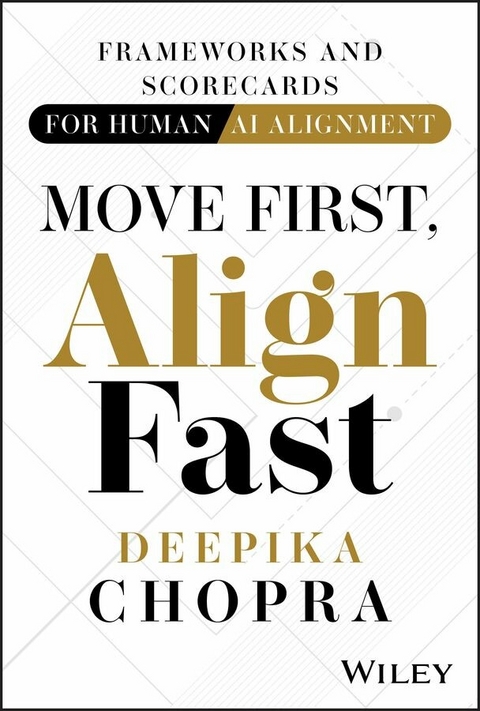
Move First, Align Fast (eBook)
399 Seiten
Wiley (Verlag)
978-1-394-39254-4 (ISBN)
A start-to-finish manual for aligning your organization's teams with the latest AI technologies
In Move First, Align Fast: Frameworks and Scorecards for Human-AI Alignment, seasoned technology and transformation leader Deepika Chopra delivers a comprehensive toolkit and guide for the people side of AI implementation. This is a step-by-step walkthrough for the human beings who will lead and participate in your organization's AI transformation. It's also an expansive collection of frameworks, scorecards, measurement tools, and interpretation guides for company leaders who want to keep their change initiatives on track and on schedule.
Chopra offers you practical resources, including the ACT Framework, ACT+M? Scorecard, and the Human-AI Alignment Score (HAAS?), that she developed and refined through her decades-long career advising organizations like Citi, AIG, Siemens, and LPL. You'll use them to ensure that you're able to translate your strategy, tools, and your teams' technical skills into a firm with powerful new capabilities.
Inside the book:
- Detailed walkthroughs for leaders who want to build new, AI-enabled organizations defined by trust, alignment, and a culture of innovation
- Effective strategies suited to both high-growth startup environments and large enterprises seeking to implement foundational changes to the way they use AI
- Detailed discussions of the Align, Cultivate, and Transform (ACT) Framework and the tools you need to measure your progress as you implement it across your teams
Virtually every organization in every industry can easily access powerful AI technologies with the potential to transform the way they do business. It's become increasingly clear that the bottleneck is almost always cultivating teams that effectively deploy and integrate those technologies in a way that executes on the strategic vision of their leaders.
Move First, Align Fast is the roadmap that business and technology leaders have been waiting for to help them implement new technical capabilities into their companies in ways that ensure they'll actually be used to their fullest potential. It's an expert guide to aligning your human resources with the latest AI tools that will prove invaluable to managers, executives, entrepreneurs, and founders everywhere.
DEEPIKA CHOPRA is a seasoned technology leader who has spent the last two decades leading enterprise-wide digital and AI transformations in highly regulated industries. She is the creator of several effective change management frameworks, including the ACT Framework, ACT+M? Scorecard, and the Human-AI Alignment Score.
A start-to-finish manual for aligning your organization s teams with the latest AI technologies In Move First, Align Fast: Frameworks and Scorecards for Human-AI Alignment, seasoned technology and transformation leader Deepika Chopra delivers a comprehensive toolkit and guide for the people side of AI implementation. This is a step-by-step walkthrough for the human beings who will lead and participate in your organization s AI transformation. It s also an expansive collection of frameworks, scorecards, measurement tools, and interpretation guides for company leaders who want to keep their change initiatives on track and on schedule. Chopra offers you practical resources, including the ACT Framework, ACT+M Scorecard, and the Human-AI Alignment Score (HAAS ), that she developed and refined through her decades-long career advising organizations like Citi, AIG, Siemens, and LPL. You ll use them to ensure that you re able to translate your strategy, tools, and your teams technical skills into a firm with powerful new capabilities. Inside the book: Detailed walkthroughs for leaders who want to build new, AI-enabled organizations defined by trust, alignment, and a culture of innovation Effective strategies suited to both high-growth startup environments and large enterprises seeking to implement foundational changes to the way they use AI Detailed discussions of the Align, Cultivate, and Transform (ACT) Framework and the tools you need to measure your progress as you implement it across your teams Virtually every organization in every industry can easily access powerful AI technologies with the potential to transform the way they do business. It s become increasingly clear that the bottleneck is almost always cultivating teams that effectively deploy and integrate those technologies in a way that executes on the strategic vision of their leaders. Move First, Align Fast is the roadmap that business and technology leaders have been waiting for to help them implement new technical capabilities into their companies in ways that ensure they ll actually be used to their fullest potential. It s an expert guide to aligning your human resources with the latest AI tools that will prove invaluable to managers, executives, entrepreneurs, and founders everywhere.
Introduction: The Human Imperative in the Age of AI
“Technology alone is not enough. It’s technology married with liberal arts, married with the humanities, that yields us the results that make our hearts sing.”
—Steve Jobs
One hundred and eighty million dollars. Eighteen months of development. Twelve percent adoption. This is the arithmetic of artificial intelligence (AI) transformation failure—and it's happening right now in boardrooms across North America.
At one of North America's largest financial services companies, the technology worked flawlessly. The models were accurate. The infrastructure was robust. Yet middle managers were reverting to Excel spreadsheets. Teams were creating manual workarounds. The most sophisticated AI recommendation engine in their industry was being systematically ignored by the very people it was designed to help.
This isn't an isolated incident. It's a pattern I've observed across every industry, in every geography, at every scale. The pattern has a name: the Alignment Gap.
The Trillion-Dollar Misalignment
Global enterprises are investing at unprecedented levels in artificial intelligence initiatives. Industry analysis suggests annual AI spending exceeds $200 billion globally, with projections reaching more than $600 billion by 2028.[1] Yet for all this investment, organizations are facing what industry observers estimate to be trillions in unrealized value from AI transformations that fail to achieve their intended impact. (See Figure I.1.)
According to industry analysis, 87% of AI transformation projects fail to meet their objectives within 18 months.[2] This is not because the models are inaccurate but because humans don't act on them. Teams spend millions on sophisticated AI systems only to watch frontline managers revert to Excel. Boardrooms celebrate pilot metrics while the real work remains unchanged, mired in what we call the Execution Theater: impressive dashboards that never move the needle.
The failure isn't technological. Modern AI systems achieve remarkable technical benchmarks. Machine learning models demonstrate 94% accuracy in fraud detection. Natural language processing systems understand context with human-like precision. Computer vision applications identify patterns invisible to human analysis.
FIGURE I.1 The Alignment Gap—where billions are lost
Source: Modified from[1]
Intelligence doesn't drive impact. People do.
On my first day leading Fortune 500 financial services company, every leader was handed John Doerr’s Measure What Matters to anchor execution in OKRs, and NPS was set as the single north star for customer experience. OKRs made execution measurable. NPS made loyalty measurable. That experience convinced me that alignment needed the same rigor—an idea this book develops through ACT+M™ and HAAS™.
The Alignment Gap: The chasm between what AI systems can do and what people will actually do with them represents the single greatest barrier to realizing AI's transformative potential in enterprise settings.
This book doesn't ask you to believe in a new culture model or overhaul your org chart. It's not about psychology or persuasion. It's about giving leaders a lens to spot what's already happening—but often ignored. The tools in this book—ACT, ACT+M™, and HAAS™—aren't programs to adopt. They're visibility tools. They help leaders surface friction early, read trust signals fast, and make decisions with more confidence and less guesswork.
When a middle manager receives an AI recommendation to restructure their team, reduce inventory by 30%, or pivot market strategy, they experience a moment of hesitation. That microsecond pause—multiplied across thousands of decisions, hundreds of managers, and dozens of business units—transforms AI from a competitive advantage to expensive reporting infrastructure.
Research from leading business schools indicates that while 91% of enterprise AI deployments achieve technical functionality, only 13% drive measurable behavioral change.[3] The technology works perfectly in isolation. The humans don't work with it in practice.
Why Smart Companies Make This Mistake
The most sophisticated organizations in the world—companies with PhD-level data science teams, billion-dollar technology budgets, and decades of change management experience—consistently underestimate the human complexity of AI adoption. They approach AI transformation through a technology lens when they should be approaching it through a psychology lens.
Consider the most prominent consulting methodologies such as McKinsey's AI Maturity Model, Accenture's MELDS, and BCG's AI Factory. They excel at diagnosing systems and architecture. But they often overlook the critical human factors—people readiness, narrative trust, and cultural alignment—that ultimately determine whether the technology is adopted or abandoned. Yet in study after study, organizations that implement them still suffer from the same fatal gap: they know how to build but fail to get people to use the solution as designed.
The best AI system in the world is worthless if people don’t trust it, understand it, or know how to make decisions with it.
Based on Wharton's analysis of more than 1,200 enterprise transformations, companies with identical technical capabilities can see up to 340% variance in value realization—driven entirely by differences in human alignment.[4],[5] The organizations that succeed aren't necessarily those with the most advanced algorithms. They're the ones that solve for human psychology first.
In the coming chapters, we'll delve deeper into how cultural blind spots, execution theater, and compounding misalignment spiral into full-scale AI transformation failures.
The Immutable Law of AI Transformation
Across every successful AI transformation I've studied—from JPMorgan Chase's fraud detection systems to Netflix's recommendation algorithms to Amazon's supply chain optimization—one principle holds universally true:
Alignment must precede automation.
This represents a fundamental business principle we've observed consistently. If people don't believe the recommendation, they won't act on it. If they don't know who owns the decision, they'll defer. If they fear the consequences, they'll undermine the system or work around it entirely.
Organizations that violate this sequence join the 87% who fail. Those who honor it build lasting competitive advantages that cannot be easily replicated.
The Pattern Recognition
This gap between AI capability and human adoption isn't abstract—it's playing out in your organization right now. The symptoms vary by role, but the pattern is consistent:
- If you're a chief technology officer: Your AI models achieve 94% accuracy in fraud detection, yet investigation teams still manually review every flagged transaction because they “don't trust the machine.” Your recommendation engine drives 40% of potential revenue, but product managers override its suggestions based on “experience and intuition.” The technology works perfectly—in isolation.
- If you're a chief information officer: You've deployed enterprise AI platforms across multiple business units, but usage analytics reveal that 73% of licensed seats remain inactive after six months. Department heads attend your AI governance meetings but return to their teams with instructions to “keep doing things the old way until we're sure.” Your infrastructure investment is sound—your adoption metrics aren't.
- If you're leading digital transformation: Your AI pilot programs consistently demonstrate 30–50% efficiency improvements, yet scaling beyond proof-of-concept stalls indefinitely. Middle management nods enthusiastically in transformation workshops and then quietly instructs their teams to maintain parallel manual processes “just in case.” Your change management follows industry best practices—except for the human psychology of AI trust.
Anatomy of Failures: Five Critical Patterns
Before we dissect the anatomy of failure, it's crucial to understand that these symptoms—trust decay, accountability vacuum, regulatory collision, analysis paralysis, and incentive misalignment—are fundamentally cultural and psychological, not technical.
The Five Critical Failure Modes of AI Transformation
McKinsey research identifies the most common negative consequences from AI implementation, which align with five recurring breakdown patterns I've observed across transformations:
- Trust decay: Inaccuracy issues (experienced by 24% of organizations) that erode confidence when AI recommendations conflict with experience
- Accountability vacuum: Paralysis when AI suggests high-stakes decisions without clear human ownership protocols
- Regulatory collision: Cybersecurity and explainability challenges (affecting significant percentages of adopters)...
| Erscheint lt. Verlag | 5.11.2025 |
|---|---|
| Sprache | englisch |
| Themenwelt | Mathematik / Informatik ► Informatik ► Theorie / Studium |
| Schlagworte | AI implementation • ai implementation book • ai implementation strategy • ai implementation tools • AI transformation • ai transformation book • ai transformation strategies • ai transformation tips • ai transformation tools • human-centric AI |
| ISBN-10 | 1-394-39254-0 / 1394392540 |
| ISBN-13 | 978-1-394-39254-4 / 9781394392544 |
| Informationen gemäß Produktsicherheitsverordnung (GPSR) | |
| Haben Sie eine Frage zum Produkt? |
 EPUB (Adobe DRM)
Kopierschutz: Adobe-DRM
Adobe-DRM ist ein Kopierschutz, der das eBook vor Mißbrauch schützen soll. Dabei wird das eBook bereits beim Download auf Ihre persönliche Adobe-ID autorisiert. Lesen können Sie das eBook dann nur auf den Geräten, welche ebenfalls auf Ihre Adobe-ID registriert sind.
Details zum Adobe-DRM
Dateiformat: EPUB (Electronic Publication)
EPUB ist ein offener Standard für eBooks und eignet sich besonders zur Darstellung von Belletristik und Sachbüchern. Der Fließtext wird dynamisch an die Display- und Schriftgröße angepasst. Auch für mobile Lesegeräte ist EPUB daher gut geeignet.
Systemvoraussetzungen:
PC/Mac: Mit einem PC oder Mac können Sie dieses eBook lesen. Sie benötigen eine
eReader: Dieses eBook kann mit (fast) allen eBook-Readern gelesen werden. Mit dem amazon-Kindle ist es aber nicht kompatibel.
Smartphone/Tablet: Egal ob Apple oder Android, dieses eBook können Sie lesen. Sie benötigen eine
Geräteliste und zusätzliche Hinweise
Buying eBooks from abroad
For tax law reasons we can sell eBooks just within Germany and Switzerland. Regrettably we cannot fulfill eBook-orders from other countries.
aus dem Bereich