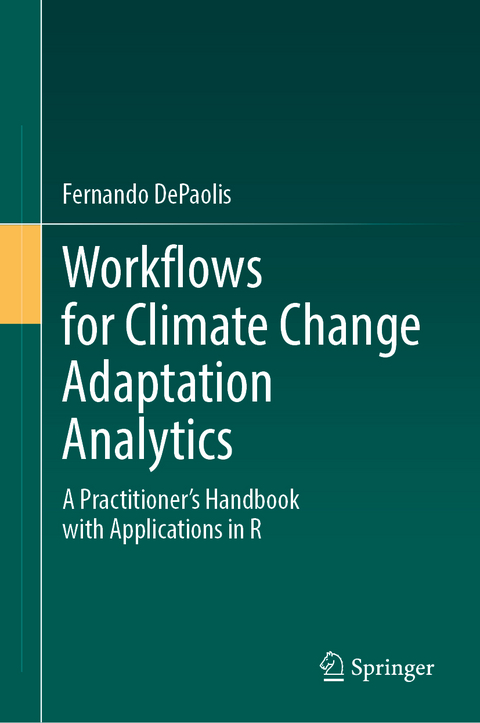
Workflows for Climate Change Adaptation Analytics
Springer International Publishing (Verlag)
978-3-032-14003-6 (ISBN)
- Noch nicht erschienen - erscheint am 20.03.2026
- Versandkostenfrei
- Auch auf Rechnung
- Artikel merken
Humanity is confronting the global climate crisis through two main approaches: mitigation and adaptation. Mitigation refers to actions aimed at reducing the root causes of climate change, primarily global warming. The primary mitigation strategy involves decreasing greenhouse gas (GHG) emissions. Adaptation, on the other hand, encompasses existing and proposed initiatives that aim to minimize the adverse effects of current climate change manifestations. Examples of adaptation actions already in place include coastal armoring (e.g., seawalls), retreat from flood-prone areas, increasing urban shade, and decarbonizing transportation networks and food systems.
While international organizations like the UN have spearheaded mitigation efforts through agreements with national governments and international NGOs, adaptation is primarily the responsibility of a diverse range of entities, including local, regional, and national government agencies, local and regional non-governmental organizations, a limited number of private corporations, and increasingly, individual citizens.
Consequently, adaptation involves a wide range of specialized professional practices. Professionals such as agronomists, foresters, landscape architects, urban planners, geographers, economists, and engineers are now engaged in studying, programming, designing, constructing, and assessing adaptation policies and their implementation.
Given the shared analytical tools and frameworks among many of these professions, consolidating them into a single volume can be beneficial. This volume will be based on the widely used computer language ("R") and will include readily transferable examples, various data sources, and methods for accessing those datasets.
Each chapter follows a common format. In the first section, we present a problem related to climate change and to the policy challenges related to adapting to it. Then we offer a dataset that is relevant to that issue. Each chapter will show a distinct source, or method to obtaining the data, organizing it and getting it ready for processing. For example, some chapters use APIs, others download datasets directly from a source, while others show how to create simulated datasets.
Dr. Fernando DePaolis is a professor at the Middlebury Institute of International Studies in Monterey, California, where he teaches advanced graduate courses in environmental analysis and management. He holds a doctorate in Urban Planning from UCLA and brings extensive research experience to his academic work.
Dr. DePaolis has served as a consultant for government agencies and organizations at the local, regional, and national levels, providing expertise in environmental planning and policy analysis. His specialization in quantitative analysis from an applied perspective bridges the gap between academic theory and professional practice, offering students and colleagues valuable insights into real-world applications across diverse fields.
Through his combined experience in academia, research, and consulting, Dr. DePaolis contributes a unique practitioner's perspective to the study of environmental management and urban planning challenges.
1 Descriptive Statistics.- 2 Visualization.- 3 Hedonic Estimation Models.- 4 Logistic Regression.- 5 Introduction to Time Series.- 6 ARIMA Models.- 7 Bayesian Models.- 8 Spatial Analysis.- 9 Introduction to Non-parametric Methods.
| Erscheint lt. Verlag | 30.4.2026 |
|---|---|
| Zusatzinfo | X, 187 p. 53 illus., 48 illus. in color. |
| Verlagsort | Cham |
| Sprache | englisch |
| Maße | 155 x 235 mm |
| Themenwelt | Mathematik / Informatik ► Informatik ► Datenbanken |
| Naturwissenschaften ► Geowissenschaften ► Meteorologie / Klimatologie | |
| Schlagworte | Analytical tools in climate adaptation analysis • climate change adaptation • Climate change datasets • Data acquisition • R |
| ISBN-10 | 3-032-14003-X / 303214003X |
| ISBN-13 | 978-3-032-14003-6 / 9783032140036 |
| Zustand | Neuware |
| Informationen gemäß Produktsicherheitsverordnung (GPSR) | |
| Haben Sie eine Frage zum Produkt? |
aus dem Bereich