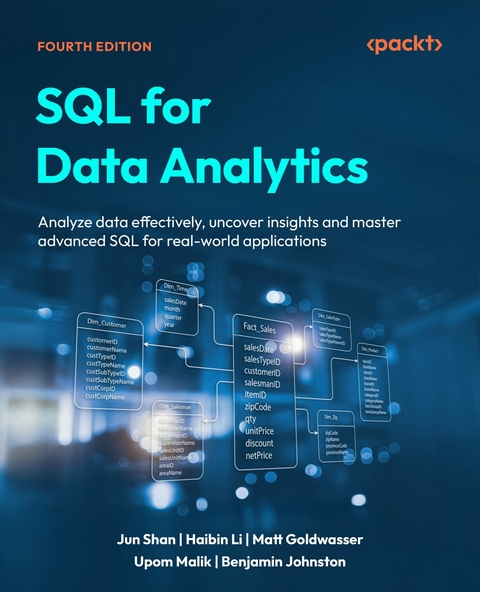
SQL for Data Analytics (eBook)
336 Seiten
Packt Publishing (Verlag)
978-1-83664-624-2 (ISBN)
SQL remains one of the most essential tools for modern data analysis and mastering it can set you apart in a competitive data landscape. This book helps you go beyond basic query writing to develop a deep, practical understanding of how SQL powers real-world decision-making.
SQL for Data Analytics, Fourth Edition, is for anyone who wants to go beyond basic SQL syntax and confidently analyze real-world data. Whether you're trying to make sense of production data for the first time or upgrading your analytics toolkit, this book gives you the skills to turn data into actionable outcomes.
You'll start by creating and managing structured databases before advancing to data retrieval, transformation, and summarization. From there, you'll take on more complex tasks such as window functions, statistical operations, and analyzing geospatial, time-series, and text data. With hands-on exercises, case studies, and detailed guidance throughout, this book prepares you to apply SQL in everyday business contexts, whether you're cleaning data, building dashboards, or presenting findings to stakeholders. By the end, you'll have a powerful SQL toolkit that translates directly to the work analysts do every day.
Turn SQL into your competitive edge for uncovering patterns and accelerating data-driven business decisionsKey FeaturesSolve real business problems with advanced SQL techniquesWork with time-series, geospatial, and text data using PostgreSQLBuild job-ready analytics skills with hands-on SQL projectsPurchase of the print or Kindle book includes a free PDF eBookBook DescriptionSQL remains one of the most powerful tools in modern data analytics, helping you turn data into decisions. This book shows you how to go beyond writing queries to deliver insights that matter. SQL for Data Analytics, Fourth Edition, is for anyone who wants to move past basic SQL syntax and use it to interpret real-world data with confidence. Whether you're trying to make sense of production data for the first time or upgrading your analytics toolkit, this book gives you the skills to turn data into actionable outcomes. You'll start by creating and managing structured databases before advancing to data retrieval, transformation, and summarization. From there, you ll take on more complex tasks such as window functions, statistical operations, and analyzing geospatial, time-series, and text data. With hands-on exercises, case studies, and detailed guidance throughout, this book prepares you to apply SQL in everyday business contexts whether you're cleaning data, building dashboards, or presenting findings to stakeholders. By the end, you'll have a powerful SQL toolkit that translates directly to the work analysts do every day.What you will learnWrite queries to analyze and summarize structured dataUse JOINs, subqueries, views, and CTEs effectivelyApply window functions to identify patterns and trendsPerform statistical analysis and hypothesis testing in SQLAnalyze JSON, arrays, geospatial, and time-series dataImprove SQL performance using indexes and query plansLoad data with Python and automate analytics workflowsComplete a case study to experience solving real-world analytics problemsWho this book is forThis book is for aspiring data engineers, backend developers, analysts, and students who want to use SQL for real-world data analytics. You should have basic SQL and college-level math knowledge, and along with the desire to advance your skills in data transformation, pattern recognition, and business insight delivery.]]>
Preface
The Structured Query Language, better known as SQL, has been the main workhorse for data professionals over the past five decades. It is one of the most sought-after skills in the job market and is frequently tested in various job interviews. It is widely taught in colleges around the world, from computer science majors to business/statistics schools, and from undergraduate studies to doctoral programs. Yet, as popular as it is, there is a common complaint that the teaching and studying of SQL are isolated from the actual usage patterns in the real world. The authors have personally heard many new grads complaining that although they learned SQL in school, they still don’t know how to start writing SQL statements when they are assigned to their first projects at work. The traditional way of teaching is very well structured and detail-oriented but focuses on functionalities instead of the purpose and usage scenarios, creating a disconnect for beginners.
This disconnect is exactly why this book is here. From the very first edition, this book has focused on one goal: to help beginners understand not only what is in SQL, but also when and how to use it. With this in mind, the contents of this book have been arranged based on the natural flow of everyday data usage, instead of following the semantic definitions of relational databases. The book also utilizes a combination of discussions, hands-on exercises, and exploratory activities, with GitHub-based sample code, to get you more involved in the learning process. Based on the overwhelmingly (thankfully!) positive feedback we have received, this goal has been well achieved.
As positive as the response has been, ever since the third edition of this book, we have also noticed opportunities to improve. During the 2020 pandemic, the authors were engaged in several semesters of remote teaching of SQL, and had the opportunity to test different arrangements of SQL content and learning activities. It was observed that while students benefit from a mixture of lectures and hands-on exercises, the most welcomed approach is to have hands-on exercises immediately following lectures, and then have a related activity shortly after the exercises. As such, in this fourth edition, we have adjusted the topics to follow a learning path that is more natural for beginners, which was derived from our experience in remote teaching. We have added hands-on exercises right after each topic. Finally, as the chapters wrap up, we offer activities without step-by-step instructions for you to practice the skills you just obtained. We hope this new format makes the learning process easier.
SQL is already 55 years old, even older than the authors! Yet it is still evolving, and still dominating the data management practices. The authors, having been in the data management field for so long, are also actively learning and adapting. This book is also a part of this learning/adapting process. We would like to invite you to join us in this journey, and welcome your feedback so that this book can evolve too. Bon voyage!
Who this book is for
This book is primarily for beginners who would like to teach themselves how to use SQL for data analytics, but could also be useful for analytics professionals who would like to learn specific features and functionalities of SQL.
What this book covers
Chapter 1, Introduction to Data Management Systems, introduces how to represent real-world objects using data and provides a foundational understanding of relational databases and SQL. It also guides you through setting up a PostgreSQL database on your machine to store, organize, and analyze data effectively.
Chapter 2, Creating Tables with Solid Structures, introduces the fundamentals of working with relational data using SQL, including creating tables, inserting data, and performing CRUD operations. It also covers defining data types, creating tables from existing datasets, and deleting tables, giving you a solid foundation for managing the full life cycle of relational data.
Chapter 3, Exchanging Data Using COPY, introduces how to export data from and import data into a PostgreSQL database. These skills enable you to transfer data between PostgreSQL and external filesystems for tasks such as backup, migration, and integration.
Chapter 4, Manipulating Data with Python, introduces the basics of getting started with Python and using it to manage data. You will learn how to set up a Python environment, connect to a relational database, and perform data manipulation tasks within the database.
Chapter 5, Presenting Data with SELECT, introduces how to use SQL SELECT expressions to retrieve data from a database. It also covers filtering query results, enabling you to extract specific subsets of data based on defined conditions.
Chapter 6, Transforming and Updating Data, introduces how to modify existing data and table structures in a database to reflect changes in real-world scenarios. It also covers applying data transformation functions and creating user-defined functions for more advanced and customized data processing.
Chapter 7, Defining Datasets from Existing Datasets, introduces techniques for creating derived datasets, joining multiple tables, and performing set operations in SQL. These skills enable you to analyze complex relationships and combine data from various sources to support advanced data exploration and research.
Chapter 8, Aggregating Data with GROUP BY, introduces how to aggregate data in SQL to summarize and extract key insights from raw datasets. It covers the use of GROUP BY and HAVING clauses to organize and filter aggregated results, helping you understand overall patterns and trends in your data.
Chapter 9, Inter-Row Operation with Window Functions, introduces window functions in SQL, which allow you to perform calculations across rows related to the current row without collapsing the result set. It also covers advanced window definitions, enabling you to analyze row positions and relationships within partitions of your dataset.
Chapter 10, Performant SQL, introduces how PostgreSQL scans databases and indexes to retrieve data efficiently. Understanding these mechanisms will help you write optimized queries that improve database performance.
Chapter 11, Processing JSON and Arrays, introduces JSON and array data types in PostgreSQL. You will learn how to parse and work with these complex types, expanding your ability to manage data beyond traditional relational formats.
Chapter 12, Advanced Data Types: Date, Text, and Geospatial, introduces how to work with specialized data types such as date and time, text, and geospatial data in PostgreSQL. By mastering their unique processing rules, you’ll enhance your ability to analyze complex real-world scenarios within a relational database.
Chapter 13, Inferential Statistics Using SQL, introduces key inferential statistical concepts, including hypothesis testing, confidence intervals, and regression analysis. It covers how to use SQL for data processing alongside statistical knowledge to gain insights and support data-informed decisions.
Chapter 14, A Case Study for Analytics Using SQL, introduces the fundamentals of data analytical systems and how to apply SQL for data analysis. You will learn how to connect your SQL skills with a real-world case study and gain an overview of the modern data management workflow.
To get the most out of this book
To get the most out of this book, do the following:
- Combine the concepts you learn in this book with real-world examples that you run into at school or work
- Access the SQL code in the GitHub repository of this book
Download the example code files
The code bundle for the book is hosted on GitHub at https://github.com/PacktPublishing/SQL-for-Data-Analytics-Fourth-Edition. We also have other code bundles from our rich catalog of books and videos available at https://github.com/PacktPublishing. Check them out!
Download the color images
We also provide a PDF file that has color images of the screenshots/diagrams used in this book. You can download it here: https://packt.link/gbp/9781836646259.
Conventions used
There are a number of text conventions used throughout this book.
CodeInText: Indicates code words in text, database table names, folder names, filenames, file extensions, pathnames, dummy URLs, user input, and Twitter handles. For example: “Here is an example of using the /COPY command to copy rows into a table from a file on the local machine.”
A block of code is set as follows:
SELECT product_id, model, base_msrp FROM products; Any command-line input or output is written as follows:
product_name | discount | discounted_price -----------------------+----------+------------------ Lemon | 0.9 | 359.991 Lemon Limited Edition | 0.9 | 719.991 Lemon | 0.9 | 449.991 ...| Erscheint lt. Verlag | 21.11.2025 |
|---|---|
| Sprache | englisch |
| Themenwelt | Informatik ► Datenbanken ► Data Warehouse / Data Mining |
| Mathematik / Informatik ► Informatik ► Programmiersprachen / -werkzeuge | |
| ISBN-10 | 1-83664-624-0 / 1836646240 |
| ISBN-13 | 978-1-83664-624-2 / 9781836646242 |
| Informationen gemäß Produktsicherheitsverordnung (GPSR) | |
| Haben Sie eine Frage zum Produkt? |
 EPUB (Ohne DRM)
Digital Rights Management: ohne DRM
Dieses eBook enthält kein DRM oder Kopierschutz. Eine Weitergabe an Dritte ist jedoch rechtlich nicht zulässig, weil Sie beim Kauf nur die Rechte an der persönlichen Nutzung erwerben.
Dateiformat: EPUB (Electronic Publication)
EPUB ist ein offener Standard für eBooks und eignet sich besonders zur Darstellung von Belletristik und Sachbüchern. Der Fließtext wird dynamisch an die Display- und Schriftgröße angepasst. Auch für mobile Lesegeräte ist EPUB daher gut geeignet.
Systemvoraussetzungen:
PC/Mac: Mit einem PC oder Mac können Sie dieses eBook lesen. Sie benötigen dafür die kostenlose Software Adobe Digital Editions.
eReader: Dieses eBook kann mit (fast) allen eBook-Readern gelesen werden. Mit dem amazon-Kindle ist es aber nicht kompatibel.
Smartphone/Tablet: Egal ob Apple oder Android, dieses eBook können Sie lesen. Sie benötigen dafür eine kostenlose App.
Geräteliste und zusätzliche Hinweise
Buying eBooks from abroad
For tax law reasons we can sell eBooks just within Germany and Switzerland. Regrettably we cannot fulfill eBook-orders from other countries.
aus dem Bereich