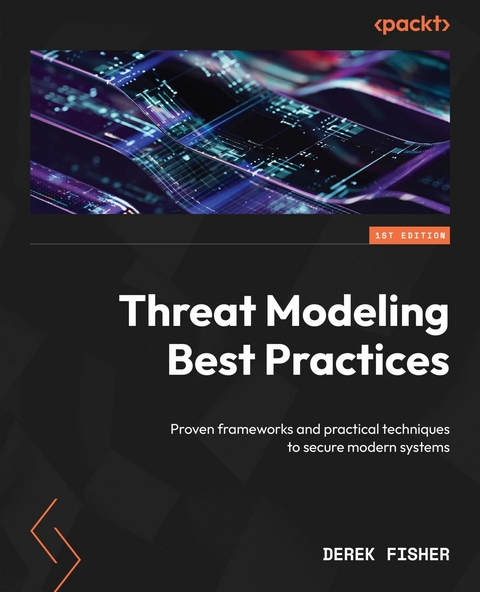
Threat Modeling Best Practices (eBook)
322 Seiten
Packt Publishing (Verlag)
978-1-80512-919-6 (ISBN)
Threat modeling has become a cornerstone of modern cybersecurity, yet it is often overlooked, leaving security gaps that attackers can exploit. With the rise in system complexity, cloud adoption, AI-driven threats, and stricter compliance requirements, security teams need a structured approach to proactively spot and stop risks before attackers do. This book delivers exactly that, offering actionable insights for applying industry best practices and emerging technologies to secure systems. It breaks down the fundamentals of threat modeling and walks you through key frameworks and tools such as STRIDE, MITRE ATT&CK, PyTM, and Attack Paths, helping you choose the right model and create a roadmap tailored to your business. You'll learn how to use leading threat modeling tools, identify and prioritize potential threats, and integrate these practices into the software development life cycle to detect risks early. The book also examines how AI can enhance analysis and streamline security decision-making for faster, stronger defenses.
By the end, you'll have everything you need to build systems that anticipate and withstand evolving threats, keeping your organization secure in an ever-changing digital landscape.
*Email sign-up and proof of purchase required
Build threat modeling skills with practical advanced techniques to enhance risk analysis, optimize security measures, and stay ahead of emerging threats in the complex cybersecurity landscapeFree with your book: DRM-free PDF version + access to Packt's next-gen Reader*Key FeaturesIdentify and mitigate security threats across software, cloud, mobile, IoT, and supply chains using STRIDE, PASTA, and MITRE ATT&CKLearn from real-world case studies showing practical threat modeling applications across industriesBuild threat modeling programs with the right team, tools, SDLC integration, and continuous improvementBook DescriptionThreat modeling has become a cornerstone of modern cybersecurity, yet it is often overlooked, leaving security gaps that attackers can exploit. With the rise in system complexity, cloud adoption, AI-driven threats, and stricter compliance requirements, security teams need a structured approach to proactively spot and stop risks before attackers do. This book delivers exactly that, offering actionable insights for applying industry best practices and emerging technologies to secure systems. It breaks down the fundamentals of threat modeling and walks you through key frameworks and tools such as STRIDE, MITRE ATT&CK, PyTM, and Attack Paths, helping you choose the right model and create a roadmap tailored to your business. You'll learn how to use leading threat modeling tools, identify and prioritize potential threats, and integrate these practices into the software development life cycle to detect risks early. The book also examines how AI can enhance analysis and streamline security decision-making for faster, stronger defenses. By the end, you'll have everything you need to build systems that anticipate and withstand evolving threats, keeping your organization secure in an ever-changing digital landscape.What you will learnCreate foundational threat modeling artifacts like Data Flow Diagrams and security architecture diagrams to visualize system threatsUnderstand the relationship between vulnerabilities (exploitable weaknesses) and threats (sources of harm)Analyze real-world case studies to see how threat modeling is applied in industry incidentsEvaluate and compare popular threat modeling tools, both open source and commercialExplore advanced topics, including threat modeling for cloud environments and integrating with DevSecOpsWho this book is forThis book is for cybersecurity professionals, security consultants, penetration testers, and compliance managers seeking to integrate threat modeling into their assessment methodologies and client engagements. It s also ideal for software architects, DevOps engineers, risk managers, and organizational leaders responsible for identifying, assessing, and mitigating security risks in their technological environments. Whether you re new to threat modeling or looking to enhance your existing expertise, this book helps you with foundational knowledge as well as advanced techniques.]]>
1
Threat Modeling Methodologies
Threat modeling is a critical practice for organizations looking to get ahead of potential risks in their applications and systems. It's not just about identifying vulnerabilities, but about doing so early and making it part of the process, before those weaknesses become real problems. In this chapter, we'll discuss the fundamentals of threat modeling and explore how it fits into the product development life cycle, and why it's such an important piece of the larger security puzzle for any organization.
We'll start by walking through the core concepts that are essential to threat modeling: how to identify and classify assets, threats, vulnerabilities, and risks. These are the building blocks for constructing a solid threat model. You'll also learn how to define the scope of a model, document critical assumptions, and ensure that nothing slips through the cracks. Along the way, we'll discuss best practices such as engaging cross-functional teams, using Data Flow Diagrams (DFDs) to map out your system’s architecture, and regularly updating models to keep pace with evolving threats and changes in your system.
The goal of this chapter is to arm you with practical knowledge based on best practices in the industry. By the time you’re done, you’ll know how to identify and mitigate risks early in the development process, document your threat models effectively, and use proven methodologies that make a real difference. We’ll also cover how to avoid the most common mistakes that can derail threat modeling efforts and how to make it an ongoing, iterative part of your security practices. To wrap things up, we’ll look at an example to show how these concepts work in action, giving you a roadmap for integrating threat modeling into your organization’s overall security strategy.
In this chapter, we’re going to cover the following main topics:
- Understanding threat modeling
- Essential elements of threat modeling
- Scope and assumptions in threat modeling
- Best practices in performing threat modeling
- Avoiding mistakes while threat modeling
- Example: Threat modeling financial system workflow
Free Benefits with Your BookYour purchase includes a free PDF copy of this book along with other exclusive benefits. Check the Free Benefits with Your Book section in the Preface to unlock them instantly and maximize your learning experience. |
Understanding threat modeling
I’ve worked in many organizations over the years and have been involved with the delivery of some threat modeling process or program at most of these organizations. And I’m here to tell you that many of them failed. Not because there was no willingness or need for them, but simply because driving a threat modeling process in an organization can be daunting. It can be no less challenging than rolling out a new security tool, with all the integrations, arm-twisting, and repeated meetings to justify its needs. Threat modeling is a foundation, some may even say a table stake, to delivering secure architecture in an organization. Whether it’s a new product for clients, a new third-party system integration, or a new, recently established technology, threat modeling is crucial to the identification of potential threats to an organization.
So, why do so many organizations find it either challenging or impossible to integrate threat modeling? Well, we haven’t exactly made it easy, and it is very difficult to scale. Conventional wisdom tells you, and I will too, that a proper threat model takes time, effort, a lot of understanding of the system, and time. Did I mention time? We’ve become accustomed to drift detection and automation, infrastructure as code, DevOps, and code pipelines that deliver code in minutes. When the security wizard comes down from the ivory tower and says that they need several weeks, a mountain of documentation, and the time of the best technological people in the team, they’re going to get pushed away.
But security has evolved along with technology, at least in many areas. We can identify threats in newer, faster ways, and even integrate identification into existing processes. This book will hopefully provide some good guidance on how to achieve threat identification using the best practices that balance speed and thoroughness.
What is threat modeling?
If you had to provide an elevator pitch of what threat modeling is, it may go something like this:
Imagine building a shed outside your house. You’ve assembled all the workers and the materials, and you’ve plotted out the timeline for how long it will take. You’ve determined how the electricity will run to the shed. The lights, windows, doors, and all the materials have been delivered. You have all the parts you need. You and the workers begin to assemble the shed. You make some cuts in the materials, you place them together, you drive in the screws, and you nail the shingles on the roof. You and your workers stand back and look at the shed with pride. It works, and it’s standing tall! You begin to move in your yard equipment and tools. It’s now a working, usable shed.
Great, so what’s wrong with that? Aside from it being too close to dead trees, built on top of unstable ground, and using hazardous material, nothing. If only you had the ability to know these things before you placed the first order for materials and drove in the first screw. The best part? You could have.
At its core, threat modeling is a systematic and structured approach aimed at identifying, assessing, and mitigating security threats and vulnerabilities within systems and processes. This methodology serves as a comprehensive process that enables organizations to understand the security landscape surrounding their assets, thereby facilitating the development of informed security strategies. In essence, threat modeling involves an examination of a system’s design and architecture to identify potential threats, evaluate their impact, and determine the appropriate countermeasures.
Put plainly, threat modeling is a way of identifying threats, identifying countermeasures, and determining whether the countermeasures work in an architecture.
When threat modeling, we typically ask these four basic questions:
- What are we building?
- What can go wrong?
- What are we going to do about it?
- Did we do a good job?
These questions, first introduced more than a decade ago by Adam Shostack, an industry expert on threat modeling, are designed to be simple yet powerful, enabling teams to apply threat modeling across any phase of a system’s life cycle. And to be clear, we do this daily in our lives. Whether we are choosing our commute to work, deciding where to go for an outing, or building a shed, our minds ask these questions regularly and usually subliminally.
But deciding where to go for dinner can be far less complex than building technical architecture that consumes and maintains sensitive data from users while also transmitting it to third parties while hosting the data in an adversarial nation state, or a system that observes critical telemetry from instrumentation in a cyberphysical system.
Why do we threat model?
Threat modeling is more than just a checkbox exercise. Many organizations threat model because there is a contractual or regulatory requirement to do so. Thus, it is a check-the-box activity where the threat model is created and never sees the light of day unless requested by an auditor or client. However, at its best, a threat model is a living, breathing part of the system development ecosystem and processes. For the engineering teams, it provides some level of confidence that their design is secure and provides a map of the security implications integrated into our design choices. Additionally, it becomes an essential part of the system-level technical documentation that evolves with the application rather than an addendum that gathers dust.
Threat models benefit teams that depend on shared components too.
Shared components, such as logging libraries or data collection sensors, are often built by third parties and implemented across a sprawling system.
If you think that your system doesn’t use shared components, you’re wrong. I don’t even know your system, but I know that’s wrong. You can write your own RTOS running inside your own designed system, and you still will need to rely on silicon and hardware that is not yours. Our technical world today is a tapestry of interconnected parts, some or many of which are black boxes to us.
The benefit of threat models that identify threats in shared components is that teams can leverage the findings in the threat model to address issues across a sprawling system, essentially utilizing someone else’s map to gauge their own exposure. Penetration testers will have a head start in their efforts. While penetration testers utilize automated tools, scripts, and intuition, a threat model can provide a quick view of the potential “hot spots” in the design, allowing them to focus their efforts where vulnerabilities are most likely prevalent.
Clients may ask for a high-level report of your threat...
| Erscheint lt. Verlag | 31.10.2025 |
|---|---|
| Sprache | englisch |
| Themenwelt | Informatik ► Netzwerke ► Sicherheit / Firewall |
| Mathematik / Informatik ► Informatik ► Theorie / Studium | |
| Mathematik / Informatik ► Informatik ► Web / Internet | |
| ISBN-10 | 1-80512-919-8 / 1805129198 |
| ISBN-13 | 978-1-80512-919-6 / 9781805129196 |
| Informationen gemäß Produktsicherheitsverordnung (GPSR) | |
| Haben Sie eine Frage zum Produkt? |
 EPUB (Ohne DRM)
Digital Rights Management: ohne DRM
Dieses eBook enthält kein DRM oder Kopierschutz. Eine Weitergabe an Dritte ist jedoch rechtlich nicht zulässig, weil Sie beim Kauf nur die Rechte an der persönlichen Nutzung erwerben.
Dateiformat: EPUB (Electronic Publication)
EPUB ist ein offener Standard für eBooks und eignet sich besonders zur Darstellung von Belletristik und Sachbüchern. Der Fließtext wird dynamisch an die Display- und Schriftgröße angepasst. Auch für mobile Lesegeräte ist EPUB daher gut geeignet.
Systemvoraussetzungen:
PC/Mac: Mit einem PC oder Mac können Sie dieses eBook lesen. Sie benötigen dafür die kostenlose Software Adobe Digital Editions.
eReader: Dieses eBook kann mit (fast) allen eBook-Readern gelesen werden. Mit dem amazon-Kindle ist es aber nicht kompatibel.
Smartphone/Tablet: Egal ob Apple oder Android, dieses eBook können Sie lesen. Sie benötigen dafür eine kostenlose App.
Geräteliste und zusätzliche Hinweise
Buying eBooks from abroad
For tax law reasons we can sell eBooks just within Germany and Switzerland. Regrettably we cannot fulfill eBook-orders from other countries.
aus dem Bereich