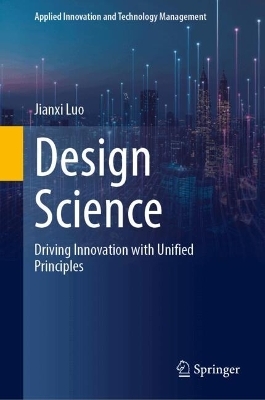
Design Science
Springer International Publishing (Verlag)
978-3-032-13352-6 (ISBN)
- Noch nicht erschienen - erscheint am 30.01.2026
- Versandkostenfrei
- Auch auf Rechnung
- Artikel merken
This book presents a coherent, interdisciplinary account of how design works and how to do it better. Framed by the Artifacts Actions Actors (3A) lens, it integrates classic and contemporary foundations (ontologies, theories, methods, and tools) in design science and bridges the gap between theory and practice with unified design principles applied across diverse, real-world scenarios. It also treats AI as both material and partner in design, showing how generative and agentic systems widen search and tighten iteration when grounded in verification and governance. Drawing on insights from engineering, architecture, management, psychology, and the social sciences, the book offers principles, methods, and representations that travel across domains from products and software to services, systems, organizations, and ecosystems. It equips researchers, practitioners, leaders, and students with a teachable, auditable, and improvable toolkit for addressing complex design challenges and shaping innovation responsibly.
Jianxi Luo is a Professor of Systems Engineering at the City University of Hong Kong. He holds a Ph.D. in Engineering Systems and an M.S. in Technology Policy from Massachusetts Institute of Technology, and M.S. and B.E. degrees from Tsinghua University. His research centers on design theory and methodology, with a recent focus on generative AI for design. His broader interests span design science, complex systems, AI, entrepreneurship, leadership, and innovation policy. Luo s work helped establish the Data-Driven Innovation (DDI) paradigm developing foundational theories, methods, and tools and has received many awards from organizations such as the Design Society, ASME, and INFORMS. He previously held faculty roles at New York University, the Singapore University of Technology and Design, and Tsinghua University, and visiting positions at the University of Cambridge and Columbia University. He served as Chair of the INFORMS Technology Innovation Management and Entrepreneurship Section and on the executive committee of the Council of Engineering Systems Universities (CESUN). He sits on multiple design-journal editorial boards and is Editor-in-Chief of Research in Engineering Design.
Chap 1:Design Science: What is It?.- Chap 2:Design for Innovation.- Chap 3:Design Process.- Chap 4:Design Ontology.- Chap 5:Design Creativity.- Chap 6:Design Empathy.- Chap 7:Design Heuristics.- Chap 8:Design Prototyping.- Chap 9:Design Flexibility.- Chap 10:Design Convergence.- Chap 11:Design Complexity.- Chap 12:Design and AI.- Chap 13:Design for X.- Chap 14:Designing the Future.
| Erscheint lt. Verlag | 30.1.2026 |
|---|---|
| Reihe/Serie | Applied Innovation and Technology Management |
| Zusatzinfo | XIII, 141 p. 36 illus., 1 illus. in color. |
| Verlagsort | Cham |
| Sprache | englisch |
| Maße | 155 x 235 mm |
| Themenwelt | Informatik ► Theorie / Studium ► Künstliche Intelligenz / Robotik |
| Wirtschaft ► Betriebswirtschaft / Management ► Unternehmensführung / Management | |
| Wirtschaft ► Volkswirtschaftslehre | |
| Schlagworte | Artificial Intelligence and Design Science • Design Ecosystems • Design Innovation • design thinking • Entrepreneurship and Design Science • Human-Centered Design Innovation • Machine Learning and Design Science • Manufacturing and Design Science |
| ISBN-10 | 3-032-13352-1 / 3032133521 |
| ISBN-13 | 978-3-032-13352-6 / 9783032133526 |
| Zustand | Neuware |
| Informationen gemäß Produktsicherheitsverordnung (GPSR) | |
| Haben Sie eine Frage zum Produkt? |
aus dem Bereich