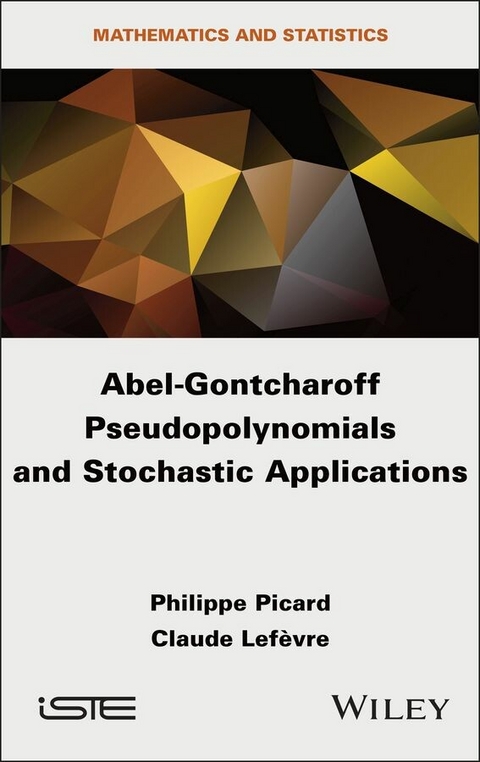
Abel-Gontcharoff Pseudopolynomials and Stochastic Applications (eBook)
413 Seiten
Wiley-Iste (Verlag)
978-1-394-41797-1 (ISBN)

Abel-Gontcharoff Pseudopolynomials and Stochastic Applications starts by presenting an in-depth presentation of the general theory, and then moves onto stochastic applications of this theory, especially in biomathematics. Univariate and multivariate versions of the A-G pseudopolynomials, as well as extensions with randomized parameters, are discussed and illustrated for modeling, notably by highlighting families of martingales and using stopping time theorems. This book concludes by paving the way to a nonhomogeneous theory for first crossing problems.
Philippe Picard is a mathematician and probabilist, and was Professor at the Université de Lyon, France (retired in 2000), where he was responsible for the training of actuaries. His research focuses on mathematical tools in genetics, epidemics and risk theory, such as martingales and polynomials.
Claude Lefèvre is a probabilist and statistician, and is Professor Emeritus at the Université Libre de Bruxelles, Belgium. His research focuses on applied probability models, in particular those related to epidemics, reliability, queueing and actuarial science.
1
Historical Abel-Gontcharoff Polynomials
1.1. Abel identity
In 1826, Niels Henrik Abel (1802–1829)1 published, in the first volume of Crelle’s Journal, the following identity:
where x, α, β are real numbers. A similar formula, less compact but analytically equivalent, is also found, through many other formulas, in a memoir by Augustin-Louis Cauchy (1789–1857)2.
Note that there is a strange asymmetry between x and α in the right part (r.h.s.) of [1.1], whereas on the contrary its left part (l.h.s.) is perfectly symmetrical. It is obvious that β corresponds only to a parameter but there remains an ambiguity between x and α. Indeed, which one, chosen as a variable, will play the main role, when the other will be reduced to being only a simple parameter? Abel made no comment on this issue and simply presented [1.1] as a natural generalization of the binomial formula.
The recursive proof given by Abel for his formula does not shed light on its hidden algebraic structure. Nevertheless, some information about [1.1] can be found in a posthumous document which gives the following formula for an infinitely differentiable function ϕ:
Here, ϕ(n) denotes the nth derivative of ϕ. Clearly, [1.2] gives [1.1] when . Not having obtained a correct proof for this remarkable formula, Abel did not publish it and only made public the particular case of the binomial for which he possessed a proof. Dying at a young age, he did not have time to complete the general case [1.2].
Today, it is the algebraic structure of the r.h.s. in [1.2], which holds our attention. In the 19th century – where it was called the “Abel series” – mathematicians were only interested in its possible convergence (or not) and by the equality (or not) between the two members of the formula. These topics were discussed by Halphen (1881)3 and Jensen (1902)4. Even Pólya and Szegő (1972)5 spent a few pages on these problems in their famous book. All proofs were based on Lagrange expansions that are effective in attacking convergence problems but are not very illuminating for our purpose of understanding.
1.2. Abel polynomials and expansions
The formula [1.2] has a certain similarity with the classical Taylor expansion. The relation is even more meaningful if we first perform an exchange between x and α, which gives:
after putting
Since the r.h.s. is also
can be expanded as:
where we used the definition recalled below of the Abel polynomials.
DEFINITION 1.1.–
For of the affine form [1.3], the Abel polynomials are given by:
when β = 0, they reduce to the monomials .
The expansion [1.4] is written more compactly:
hence the following accompanying standard definition.
DEFINITION 1.2.–
The Abel expansion of the function is given by:
1.3. Gontcharoff contribution
For a long time, analysts only paid attention to the Abel series [1.6] and ignored the Abel polynomials that could be found inside these series.
The situation changed when Gontcharoff (1930)6, (1937)7, sometimes written Gontcharov or Gončarov, introduced the family of polynomials of degree n in x, denoted , which depend on n real parameters u0, …, un−1 and are characterized by the functional property:
where denotes the mth derivative of Pn and δm,n, the classic Kronecker symbol. Note that our notation differs slightly from that of Gontcharoff in which the ui in particular are considered complex.
From [1.7], we see that these polynomials can be expressed in the multiple integral form:
which implies:
Alternative equivalent expressions of Pn exist, notably in terms of determinants, but these are not very convenient in practice.
As noticed by Gontcharoff, in the special case , each Pn given by [1.8] has the simple explicit expression:
that is, referring to [1.5]:
REMARK.–
The identity between [1.10] and [1.7] can be checked as follows. Let us write:
so that by differentiating m (≤ n) times:
For x = α + βm, this gives:
which reduces to δm,n as desired.
Because of this particular case, we choose to call Abel–Gontcharoff (A–G) polynomials, the polynomials defined by [1.7] with arbitrary parameters.
1.3.1. A digression to the Appell polynomials
At first glance, there seems to be a great similarity between the Gontcharoff polynomials in multiple integral form [1.8] and the well-known Appell polynomials8. Denoting them , these Appell polynomials indeed have the multiple integral representation:
Observe that [1.11] gives by differentiation the remarkable relation .
In fact, it is possible to go from the formulas [1.8]–[1.11] and vice versa, simply by taking:
However, such identification is more confusing than effective, for at least four reasons:
- This possibility of identification is only local, that is, for any finite polynomial families, but it does not work for infinite families.
- The family of A–G polynomials [1.8] existentially depends on all un: without explicit reference to these parameters, it is quite impossible to work with the polynomials. On the contrary, the family of Appell polynomials [1.11] is essentially based on the functional relation : thus, the vn have here only an anecdotal role and are generally ignored in the notation.
- In an A–G family, all the polynomials vanish at the same value x = u0. We will see that many interesting results rely on this simple collective property. The situation differs with an Appell family where each polynomial has its own roots, these often being undetermined.
- By using a family of A–G polynomials, it is possible to write Abel-like expansions (i.e. similar to [1.6]) that are extremely robust, even more so than Taylor expansions. This is not true with an Appell family.
In summary, the families of Appell and A–G polynomials, even if they locally admit a common integral representation, are far from being twin copies of each other.
1.3.2. Back to the A–G polynomials
Let us summarize the key points recalled. From now on, it will be convenient to rewrite the A–G polynomials as:
where U is the family of reals:
which is an infinite sequence because it serves to build the whole family of polynomials.
DEFINITION 1.3.–
By virtue of [1.7]:
In particular, , n ≥ 1, all have a common root at the point x = u0 Moreover, from [1.9]:
where EmU represents the shifted family
In the affine case [1.3], they reduce to the Abel polynomials, that is,
For a function , its Abel–Gontcharoff expansion is given by:
The convergence of the sum [1.15] and its ability to reconstruct ϕ have been a major concern in the work of Abel and Gontcharoff. This subject is not the main focus of this book. Nevertheless, a basic result that will be useful to us is when ϕ is a polynomial.
PROPOSITION 1.1.–
Any polynomial is the sum of its A–G expansion, whatever family U is chosen.
Proof. A polynomial of degree l can always be expressed as with appropriate coefficients cn. So, by differentiating m (≤ l) times and then choosing x = um, we get, thanks to [1.12]:
so that after substitution:
This is precisely the expansion [1.15] of .
Finally, let us mention that an affine transform of U, of the form α + βU, has a simple effect on the A–G polynomials since by [1.8]:
1.4. Increased recognition
Reference to Gontcharoff remained confined to the mathematical theory of interpolation until H.E. Daniels,...
| Erscheint lt. Verlag | 27.10.2025 |
|---|---|
| Reihe/Serie | ISTE Invoiced |
| Sprache | englisch |
| Themenwelt | Mathematik / Informatik ► Mathematik ► Statistik |
| Mathematik / Informatik ► Mathematik ► Wahrscheinlichkeit / Kombinatorik | |
| Schlagworte | Abel-Gontcharoff (A-G) expansions • Abel-Gontcharoff (A-G) pseudopolynomials • applied probability • Biomathematics • mathematical methodology • randomized parameters • Stochastic Applications • stochastic models • Taylor Formula |
| ISBN-10 | 1-394-41797-7 / 1394417977 |
| ISBN-13 | 978-1-394-41797-1 / 9781394417971 |
| Informationen gemäß Produktsicherheitsverordnung (GPSR) | |
| Haben Sie eine Frage zum Produkt? |
 EPUB (Adobe DRM)
Kopierschutz: Adobe-DRM
Adobe-DRM ist ein Kopierschutz, der das eBook vor Mißbrauch schützen soll. Dabei wird das eBook bereits beim Download auf Ihre persönliche Adobe-ID autorisiert. Lesen können Sie das eBook dann nur auf den Geräten, welche ebenfalls auf Ihre Adobe-ID registriert sind.
Details zum Adobe-DRM
Dateiformat: EPUB (Electronic Publication)
EPUB ist ein offener Standard für eBooks und eignet sich besonders zur Darstellung von Belletristik und Sachbüchern. Der Fließtext wird dynamisch an die Display- und Schriftgröße angepasst. Auch für mobile Lesegeräte ist EPUB daher gut geeignet.
Systemvoraussetzungen:
PC/Mac: Mit einem PC oder Mac können Sie dieses eBook lesen. Sie benötigen eine
eReader: Dieses eBook kann mit (fast) allen eBook-Readern gelesen werden. Mit dem amazon-Kindle ist es aber nicht kompatibel.
Smartphone/Tablet: Egal ob Apple oder Android, dieses eBook können Sie lesen. Sie benötigen eine
Geräteliste und zusätzliche Hinweise
Buying eBooks from abroad
For tax law reasons we can sell eBooks just within Germany and Switzerland. Regrettably we cannot fulfill eBook-orders from other countries.
aus dem Bereich