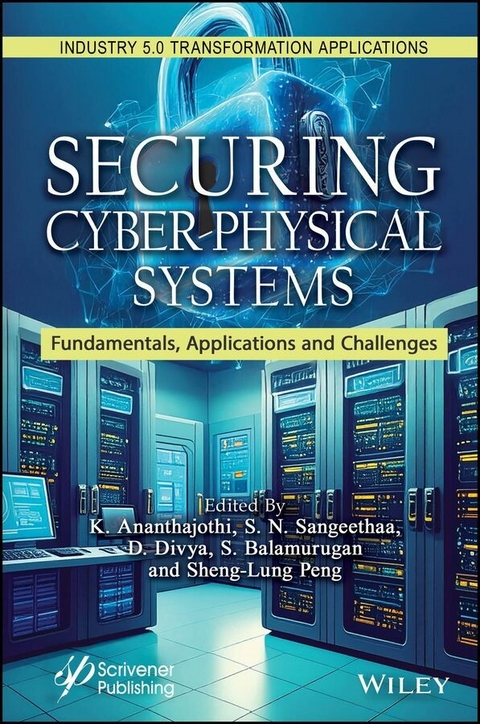
Securing Cyber-Physical Systems (eBook)
556 Seiten
Wiley-Scrivener (Verlag)
978-1-394-28774-1 (ISBN)
Protect critical infrastructure from emerging threats with this essential guide, providing an in-depth exploration of innovative defense strategies and practical solutions for securing cyber-physical systems.
As industries increasingly rely on the convergence of digital and physical infrastructures, the need for robust cybersecurity solutions has grown. This book addresses the key challenges posed by integrating digital technologies into critical physical systems across various sectors, including energy, healthcare, and manufacturing. Focusing on innovative defence strategies and practical solutions, this book provides an in-depth exploration of the vulnerabilities and defence mechanisms essential to securing cyber-physical systems. The book is designed to equip researchers, cybersecurity professionals, and industry leaders with the knowledge to protect critical infrastructure from emerging digital threats. From understanding complex vulnerabilities to implementing secure system designs, this volume offers a comprehensive guide to fortifying and securing the systems that shape our modern, interconnected world.
Readers will find the volume:
- Explores the evolving threat landscape, encompassing potential attacks on critical infrastructure, industrial systems, and interconnected devices;
- Examines vulnerabilities inherent in cyber-physical systems, such as weak access controls, insecure communication channels, and the susceptibility of physical components to digital manipulation;
- Uses real-world case studies to introduce strategies for assessing and quantifying the cybersecurity risks associated with cyber-physical systems, considering the potential consequences of system breaches;
- Provides an overview of cybersecurity measures and defense mechanisms designed to fortify cyber-physical systems against digital threats, including intrusion detection systems, encryption, and security best practices;
- Discusses existing and emerging regulatory frameworks aimed at enhancing cybersecurity in critical infrastructure and physical systems.
Audience
Researchers, cybersecurity professionals, information technologists and industry leaders innovating infrastructure to protect against digital threats.
K. Ananthajothi, PhD is a Professor in the Department of Computer Science and Engineering at Rajalakshmi Engineering College, Chennai, India. He has published one book, two patents, and several research papers in international journals and conferences. His research focuses on machine learning and deep learning.
S. N. Sangeethaa, PhD is a Professor in the Department of Computer Science and Engineering at the Bannari Amman Institute of Technology, Sathyamangalam, Tamil Nadu, India. She has published seven books, more than 25 research articles in reputable journals, and more than 50 papers in national and international conferences. Her research interests include artificial intelligence, machine learning, and image processing.
D. Divya, PhD is an Assistant Professor in the Department of Computer Science and Engineering at Misrimal Navajee Munoth Jain Engineering College, Chennai, India. She has published several papers in international journals. Her research focuses on data mining and machine learning.
S. Balamurugan, PhD is the Director of Albert Einstein Engineering and Research Labs and the Vice-Chairman of the Renewable Energy Society of India. He has published more than 60 books, 300 articles in national and international journals and conferences, and 200 patents. His research interests include artificial intelligence, augmented reality, Internet of Things, big data analytics, cloud computing, and wearable computing.
Sheng-Lung Peng, PhD is a Professor and the Director of the Department of Creative Technologies and Product Design at the National Taipei University of Business, Taiwan. He has published more than 100 research papers in addition to his role as a visiting professor and board member for several international universities and academic groups. His research interests include designing and analyzing algorithms for bioinformatics, combinatorics, data mining, and networks.
1
Enhancing Safety and Security in Autonomous Connected Vehicles: Fusion of Optimal Control With Multi-Armed Bandit Learning
K.T. Meena Abarna*, A. Punitha and S. Sathiya
Department of Computer Science and Engineering, Annamalai University, Annamalainagar, Chidambaram, India
Abstract
Communication between vehicles as well as intra-vehicle sensors that include radar and cameras are some of the components that are necessary for autonomous connected vehicles (ACVs) to function properly. This paves ways for both physical as well as cyberattacks, where by an adversary can physically control the ACVs by manipulating the sensor readings. This study proposes a complete control and learning system to protect ACV networks from the physical and the cyberattacks. It has been established that the proposed controller is resistant to physical assaults meant to cause instability in ACV systems. As driverless vehicles become more common, it is crucial to make sure that safety procedures and security safeguards are resilient. The proposed framework makes use of the best control techniques to steer cars through challenging situations while maximizing efficiency and safety. Furthermore, adaptive decision-making in unpredictable and dynamic scenarios—taking into account safety and security restrictions—is made possible by multi-armed bandit learning. The framework attempts to create robust systems that can mitigate cyber-physical threats and guarantee the safe operation of ACVs in a variety of contexts by incorporating various strategies.
Keywords: Autonomous connected vehicles, cognitive cyber-physical systems, cybersecurity, adaptive control, network security, sensor fusion, vulnerability assessment, dynamic environments
1.1 Background
Traditional manual driving entails using the vehicle’s pedals and steering, which can result in dangerous actions in a complex traffic environment and this leads to a variety of accidents related to driving. Reaction time, distractibility, and lack of experience are a few instances of these human flaws. Furthermore, a lot of drivers have a lots of bad driving habits, which adds to the unpredictable driving behaviors that cause traffic jams/congestions and thereby a decline in the traffic system’s overall efficiency [1]. In contrast, it is expected that autonomous vehicles (AVs) would either increase the efficiency of roadways or completely reduce accidents that result from human actions or behavior or inactions. Simultaneously, the notion “internet of vehicles” since has gained support for improving the getting together of AVs. Automobiles can exchange a range of datasets through the internet of vehicles, such as sensory inputs, information on locations, and their sensing of their environmental surroundings [2].
Keeping the roads safe has always been of utmost importance. In area of AVs and human-driven vehicles adoption, determining the most effective strategy to lower vehicle-related traffic accidents in today’s environment is one of the most actively researched issues. In situations where different factors (such the weather) are constantly changing, AVs are required to make necessary decisions [3]. To minimize the likelihood of collisions, an automobile needs to be able to predict adjacent cars’ or objects’ actions with sufficient accuracy. All vehicles in a typical traffic scenario are operated by people, and, because of their knowledge and expertise, the people are able to predict with accuracy what other vehicles or nearby objects are likely to do next. Based on this evaluation, everyone who drives instantly modifies their behavior to enhance safety and ensure a free traffic flow [4]. However, in a mixed traffic situation, AVs have to anticipate actions of the human driver upon their perspectives of the road. While driving, the vehicles are allowed through communications such as vehicle-to-infrastructure (V2I) and vehicle-to-vehicle (V2V) to get information regarding the objects that are present in the road. Additionally, by enabling information sharing between AVs and surrounding entities, vehicle-to-everything (V2X) communication contributes significantly to AV decision-making processes, resulting in more safer and more effective driving [5]. An AV’s decision-making process could be improved by V2X communications and more specifically V2V communication, and that importance has been highlighted.
The authors have proposed a steering control method based on machine learning (ML) with urban settings coupled with V2X communications to enhance driving. The communication protocols used in vehicular networks, which enable safe communication between vehicles driven by humans and AVs, have been the subject of extensive research. An AV can predict the actions of other objects in the vicinity by exchanging information with other cars and learning about their present driving conditions [6].
These vehicles possess the capacity to precisely identify traffic signs (TSs) and categorize things that are present in the scenario according to their environmental function—a feat mostly made possible by sophisticated ML algorithms—is essential to how they operate. The integrity of these algorithms is a very crucial factor, though. Serious road accidents might result from malicious acts or misinterpretations. Anomalies do exist in most of advanced technology. These flaws could be used by hostile actors to trick autonomous driving systems, which could have a disastrous result. Therefore, to promote AVs’ safe incorporation into our transportation system network, a thorough understanding of cyber-physical security is vital, with a particular emphasis on traffic sign recognition (TSR) and object classification (OC) algorithms [7].
In the future, AVs (ACVs) will need to handle a lot of data that is gathered through communication links and sensors. Maintaining the accuracy of this information is essential for smooth flow of traffic and to ensure safe roads [8]. However, autonomous connected vehicles (ACVs) are very much susceptible to cyber-physical attacks because of their reliance on data processing and connectivity. Specifically, an attacker may introduce errors into the ACV at data processing stage, which might lead to accidents or negatively impact traffic flow on the roads [9]. As shown by a practical experiment conducted on a Jeep Cherokee in [10], ACVs are mostly susceptible to cyberattacks that can take over some of its vital functions, such as acceleration and braking. Naturally, an unauthorized person gaining control of an ACV might not only affect the compromised ACV but also hinder other vehicles’ flow and result in subpar intelligent transportation system (ITS) performance. This, in turn, encourages an in-depth study into the combined physical and cyber effects of assaults on ACV systems. Cognitive radio networks (CRNs) have emerged as an intriguing model to change the efficiency of spectrum utilization and offer ubiquitous connections for an increasing number of applications [11].
For the purpose of creating and executing effective spectrum sharing mechanisms in CRNs, an essential building piece is the knowledge regarding primary user (PU) activity, or whether the channels are ON/OFF or busy/idle. When assigning a fixed spectrum, the cognitive base station (CBS) queries an external white space database to obtain complete information about the spectrum occupancy of each PU [12]. However, this approach assumes that the data held in the database is always accurate and has not been compromised, which results in increased communication overhead between the database and the CBS.
1.1.1 Problem Statement
The challenge of ACVs is to balance societal integration with technology growth. Many issues need to be resolved as we move toward a time when automobiles are more interconnected and autonomous, in order to guarantee the safe and widespread use of these AVs.
Ensuring the safety of self-driving vehicles in a range of intricate and dynamic contexts is one of the main concerns. Unpredictable situations such as bad weather, construction zones, and encounters with humandriven vehicles, pedestrians, and cyclists are some of the challenges that ACVs must navigate efficiently. Achieving comprehensive safety assurance systems is essential to fostering confidence in autonomous systems’ dependability and averting further mishaps or accidents.
Furthermore, it becomes clear that cybersecurity is an important cog in the wheel of deployment of ACV. Vehicles, nowadays, are more susceptible to cyber threats including malware, hacking, and illegal access, owing to their increased connectivity via wireless networks and communication systems. Preventing hostile assaults that could jeopardize vehicle’s functionality, passenger safety, or data privacy requires ensuring the integrity and security of ACV systems.
Moreover, there are ethical, legal, and regulatory issues with integrating ACVs into the present transportation system. It becomes essential to set up thorough frameworks that regulate AV operations, accident responsibility, and moral decision-making in dire circumstances. To encourage public acceptance and governmental support for ACVs, it is crucial to strike a balance between innovation and safety, privacy, and societal issues.
To put the safety and well-being of all road users in priority, developing strong safety mechanisms, bolstering cybersecurity, and navigating ethical and regulatory landscapes are all necessary to address the problem statement of ACVs and to ensure...
| Erscheint lt. Verlag | 23.10.2025 |
|---|---|
| Reihe/Serie | Industry 5.0 Transformation Applications |
| Sprache | englisch |
| Themenwelt | Mathematik / Informatik ► Informatik |
| ISBN-10 | 1-394-28774-7 / 1394287747 |
| ISBN-13 | 978-1-394-28774-1 / 9781394287741 |
| Informationen gemäß Produktsicherheitsverordnung (GPSR) | |
| Haben Sie eine Frage zum Produkt? |
 EPUB (Adobe DRM)
Kopierschutz: Adobe-DRM
Adobe-DRM ist ein Kopierschutz, der das eBook vor Mißbrauch schützen soll. Dabei wird das eBook bereits beim Download auf Ihre persönliche Adobe-ID autorisiert. Lesen können Sie das eBook dann nur auf den Geräten, welche ebenfalls auf Ihre Adobe-ID registriert sind.
Details zum Adobe-DRM
Dateiformat: EPUB (Electronic Publication)
EPUB ist ein offener Standard für eBooks und eignet sich besonders zur Darstellung von Belletristik und Sachbüchern. Der Fließtext wird dynamisch an die Display- und Schriftgröße angepasst. Auch für mobile Lesegeräte ist EPUB daher gut geeignet.
Systemvoraussetzungen:
PC/Mac: Mit einem PC oder Mac können Sie dieses eBook lesen. Sie benötigen eine
eReader: Dieses eBook kann mit (fast) allen eBook-Readern gelesen werden. Mit dem amazon-Kindle ist es aber nicht kompatibel.
Smartphone/Tablet: Egal ob Apple oder Android, dieses eBook können Sie lesen. Sie benötigen eine
Geräteliste und zusätzliche Hinweise
Buying eBooks from abroad
For tax law reasons we can sell eBooks just within Germany and Switzerland. Regrettably we cannot fulfill eBook-orders from other countries.
aus dem Bereich