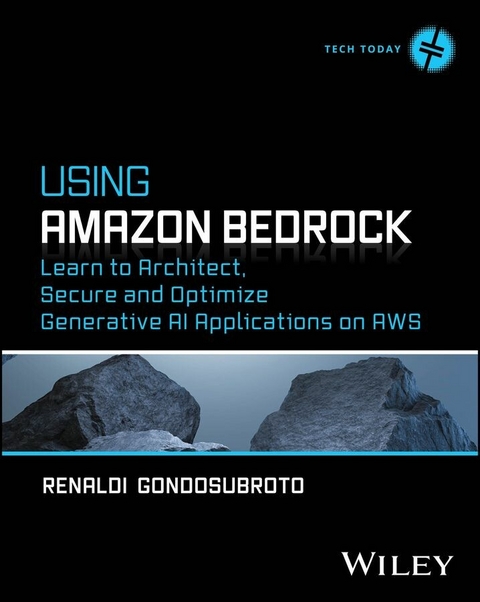
Using Amazon Bedrock (eBook)
732 Seiten
Wiley (Verlag)
978-1-394-38263-7 (ISBN)
A from-scratch roadmap to building generative AI solutions on AWS with Amazon Bedrock
In Using Amazon Bedrock: Learn to Architect, Secure and Optimize Generative AI Applications on AWS, accomplished Software Engineer, developer advocate, and AWS Community Builder, Renaldi Gondosubroto, delivers an in-depth walkthrough of Amazon Bedrock, the keystone generative AI service on the Amazon Web Services cloud. Gondosubroto offers a start-to-finish guide of the service and its capabilities, from prompt engineering with foundational models to building applications using the API, working with multimodal models, and fine-tuning.
This book provides hands-on instruction on Amazon Bedrock from an experienced developer and AI specialist. It's packed with real-world code samples, proven best practices, and techniques that result in reliable, secure, and cost-effective generative AI solutions. You'll also find:
- Demonstrations of robust governance guardrails and strategies for reducing development time
- Repeatable, industry-grade frameworks for continuously iterating and optimizing models in production
- Contemporary updates that incorporate the latest announcements made by Amazon at the re:Invent conference in December 2024 and beyond
Perfect for cloud architects, artificial intelligence engineers, and software engineers, Using Amazon Bedrock is an insightful, original, and practical roadmap to generative AI on AWS that explains the AI fundamentals you need to understand to get started in AWS generative AI development and the hands-on techniques you'll use every day to transform those concepts into efficient, working solutions.
RENALDI GONDOSUBROTO is an AWS Community Builder, an accomplished software engineer with over a decade of architecting solutions on AWS, and a developer advocate in the tech community. He currently holds all 14 AWS certifications. He has extensive experience developing AI solutions for small and large enterprises.
A from-scratch roadmap to building generative AI solutions on AWS with Amazon Bedrock In Using Amazon Bedrock: Learn to Architect, Secure and Optimize Generative AI Applications on AWS, accomplished Software Engineer, developer advocate, and AWS Community Builder, Renaldi Gondosubroto, delivers an in-depth walkthrough of Amazon Bedrock, the keystone generative AI service on the Amazon Web Services cloud. Gondosubroto offers a start-to-finish guide of the service and its capabilities, from prompt engineering with foundational models to building applications using the API, working with multimodal models, and fine-tuning. This book provides hands-on instruction on Amazon Bedrock from an experienced developer and AI specialist. It s packed with real-world code samples, proven best practices, and techniques that result in reliable, secure, and cost-effective generative AI solutions. You ll also find: Demonstrations of robust governance guardrails and strategies for reducing development time Repeatable, industry-grade frameworks for continuously iterating and optimizing models in production Contemporary updates that incorporate the latest announcements made by Amazon at the re:Invent conference in December 2024 and beyond Perfect for cloud architects, artificial intelligence engineers, and software engineers, Using Amazon Bedrock is an insightful, original, and practical roadmap to generative AI on AWS that explains the AI fundamentals you need to understand to get started in AWS generative AI development and the hands-on techniques you ll use every day to transform those concepts into efficient, working solutions.
CHAPTER 1
Introduction to Generative AI on AWS
In the past two years, generative AI has changed the way individuals and organizations have perceived and made use of AI. Generative AI refers to models that can create new content—such as text, images, or videos—based on training data. While technologies like Long Short-Term Memory (LSTM) networks, Generative Adversarial Networks (GANs), and variational autoencoders (VAEs) have long been part of this field, recent advancements have significantly accelerated its progress. Within the scope of this book, generative AI focuses on models available on Amazon Bedrock, including large language models (LLMs), multimodal language models (MLLMs), and diffusion models. Consider the swift acceleration of the AI landscape since the release of models like Claude (developed by Anthropic), enabling anyone to generate text for diverse use cases. Its capabilities have exceeded what most think AI can do—from generating new text, to answering users’ questions, to creating high-quality videos from a single line of text. Despite these breakthroughs, we have only a glimpse of its potential, as the field remains in the nascent stage of generative AI-driven innovation.
Generative AI's most significant impact is arguably its democratization, making it accessible to everyone. Previously, AI has always been seen as a technology that only those with the prerequisite knowledge could build solutions with and make use of. Advancements in generative AI have shifted this perspective, enabling widespread usage and development. Simple interfaces, like those offered by ChatGPT, Claude, and other generative AI platforms, allow anyone to explore AI applications for their needs, debunking the previous belief that a technical background is essential for working with AI.
The growth of generative AI has led to significant advancements, enabling organizations to increase productivity by leveraging generative AI capabilities provided by various firms. Startups and established enterprises are utilizing these tools to enhance their operations and innovate in their fields. Beyond just offering models, providers like Amazon offer additional value through privacy features, customization options, and seamless integration with the rest of the customers’ cloud ecosystem. Not only do they provide their models, but they also offer their platform—Amazon Bedrock—which allows users to access and use both their models and those from other providers through a unified application programming interface (API).
Amazon Bedrock is a fully managed service that provides easy access to a variety of high-performing foundational models—large-scale AI models pretrained on vast amounts of data that can be adapted for various tasks—from leading AI companies, including Amazon's own models, through a unified API. Bedrock simplifies the process of building and scaling generative AI applications by offering tools for customization, such as fine-tuning and retrieval-augmented generation (RAG) without the need of managing infrastructure. It enables customers who want to build their own tooling and also provides out-of-the-box options like Bedrock Agents. Additionally, features such as knowledge bases, guardrails, and workflow orchestration help users build robust applications. Users can experiment with different models and adjust them to their own specific needs with their own data, while deploying them into applications seamlessly.
Because training LLMs is too expensive for most organizations and requires leveraging the power of cloud computing, most organizations are consumers of existing models. A few may fine-tune or pretrain models, but rarely does an organization build models from scratch. Amazon Bedrock simplifies access to generative AI solutions, allowing you to focus on gaining the benefits without worrying about backend complexities or the overhead of maintaining them.
These advancements present an ideal opportunity to deepen your skills in generative AI technologies, specifically Amazon Bedrock. Industries ranging from sports and travel to life sciences are exploring the potential of generative AI to revolutionize their workflows and product offerings. Being well versed in generative AI will allow you to get ahead in the field, enabling you to be more marketable and employable in the industry, while being more confident in developing solutions—whether simple or complex—for different use cases.
This book will guide you through an even mix of conceptual knowledge and practical exercises that you will engage with, so that you can become familiar with different scenarios of its use cases and have some of your own thinking mixed into the practice to best learn from this book. Our goal is to get you familiarized with the introductory elements of generative AI in the context of Amazon Bedrock and have you put into practice your knowledge, encouraging you to apply it to your own use cases. By the end of the book, you will be able to confidently explain generative AI foundational concepts and be ready to start working with them to design your own applications powered by Amazon Bedrock.
In this chapter, we will cover the capabilities of Amazon Bedrock within the Amazon Web Services (AWS) ecosystem. We will also cover the current state of generative AI, along with the life cycle that can be expected of a generative AI solution. After that, we will walk through getting your local environment ready for developing generative AI solutions on AWS. By the end of the chapter, you will be ready to begin developing solutions on Amazon Bedrock, keeping in mind the different capabilities that you can leverage and build solutions with.
Generative AI has revolutionized AI's accessibility, allowing individuals and organizations to use its capabilities swiftly. Since OpenAI released GPT-3.5 and GPT-4, AI applications have advanced significantly, enabling users to generate text and other data formats effortlessly. With capabilities like instruction-following, reasoning ability combined with information retrieval, generative AI is now very powerful for real-world enterprise automation and productivity gains. Despite these innovations, we have only scratched the surface of generative AI's potential.
The Current Generative AI Landscape
The generative AI landscape is continuously changing, with AI providers rapidly innovating to provide the latest over their competitors, supplying the demand that more organizations are having for integrating AI technology into their environments. Learning about the current landscape and the basics of foundational models is crucial to understand Amazon Bedrock, as these models serve as the foundation of modern artificial intelligence (AI) and machine learning (ML) systems. These concepts build understanding on where Amazon Bedrock fits within the broader AI ecosystem, the relevant technological insights, and the innovation that it brings before we get into the in-depth, technical areas of our learning. We will discuss how the AI landscape looks in its evolution within the landscape today, starting with foundational models before discussing the challenges that are prevalent.
Introduction to Foundational Models
Foundational models (FMs) are large-scale neural networks that are trained on extensive datasets across diverse modalities, enabling them to be adapted to create or predict new data points, whether in text, images, or other formats. These models are a product of advancements in deep learning (DL), a subset of machine learning (ML), which itself is a branch of artificial intelligence (AI). The models have the unique ability to generate new content based on patterns learned from the data on which they were trained, which may range from text and images to music or code. The main advantage that they have over their other AI model counterparts is their flexibility, versatility, and adaptability, allowing for a wide array of applications across different use cases in diverse industries.
Large language models (LLMs) and multimodal large language models (MLLMs) are subsets of foundational models, which specialize in understanding and generating human language and other data modalities, respectively. LLMs are AI systems that can understand and generate human-like text, helping with tasks like answering questions, summarizing information, or even writing creative content. MLLMs take this a step further by working with both text and images, allowing them to describe pictures, generate captions, or create visuals based on written descriptions.
Examples of foundational models beyond LLMs include image generation models like Stable Diffusion. They exemplify the power of foundational models within the domain of text, showing how they can understand nuances of linguistic expression and comprehension, thus bridging the gap between the vast potential of generative AI and the specific prowess required for linguistic creativity and insight.
However, not all LLMs are foundational models; when an LLM is fine-tuned for a specific task, it becomes a specialized model beyond its foundational status. Although many foundational models are generative, some are not. For instance, CLIP (Contrastive Language-Image Pretraining) is widely recognized as a foundational model but does not have generative capabilities; instead, it excels at understanding and relating text to images.
When I first experimented with FMs, what surprised me was how they could learn quickly and easily be expanded from simple text completion and generation. This experience made me realize the sheer potential of these models to...
| Erscheint lt. Verlag | 21.10.2025 |
|---|---|
| Reihe/Serie | Tech Today |
| Sprache | englisch |
| Themenwelt | Mathematik / Informatik ► Informatik ► Theorie / Studium |
| Schlagworte | Ai on aws • amazon bedrock apps • amazon bedrock book • amazon bedrock development • amazon bedrock guide • amazon bedrock solutions • aws ai • Aws generative ai • bedrock api • bedrock development guide • generative AI • generative ai on aws |
| ISBN-10 | 1-394-38263-4 / 1394382634 |
| ISBN-13 | 978-1-394-38263-7 / 9781394382637 |
| Informationen gemäß Produktsicherheitsverordnung (GPSR) | |
| Haben Sie eine Frage zum Produkt? |
 EPUB (Adobe DRM)
Kopierschutz: Adobe-DRM
Adobe-DRM ist ein Kopierschutz, der das eBook vor Mißbrauch schützen soll. Dabei wird das eBook bereits beim Download auf Ihre persönliche Adobe-ID autorisiert. Lesen können Sie das eBook dann nur auf den Geräten, welche ebenfalls auf Ihre Adobe-ID registriert sind.
Details zum Adobe-DRM
Dateiformat: EPUB (Electronic Publication)
EPUB ist ein offener Standard für eBooks und eignet sich besonders zur Darstellung von Belletristik und Sachbüchern. Der Fließtext wird dynamisch an die Display- und Schriftgröße angepasst. Auch für mobile Lesegeräte ist EPUB daher gut geeignet.
Systemvoraussetzungen:
PC/Mac: Mit einem PC oder Mac können Sie dieses eBook lesen. Sie benötigen eine
eReader: Dieses eBook kann mit (fast) allen eBook-Readern gelesen werden. Mit dem amazon-Kindle ist es aber nicht kompatibel.
Smartphone/Tablet: Egal ob Apple oder Android, dieses eBook können Sie lesen. Sie benötigen eine
Geräteliste und zusätzliche Hinweise
Buying eBooks from abroad
For tax law reasons we can sell eBooks just within Germany and Switzerland. Regrettably we cannot fulfill eBook-orders from other countries.
aus dem Bereich