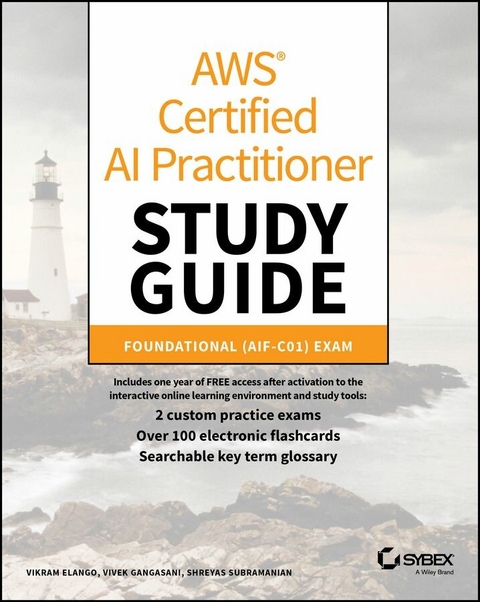
AWS Certified AI Practitioner Study Guide (eBook)
518 Seiten
Sybex (Verlag)
978-1-394-32820-8 (ISBN)
Quickly and intelligently prepare for the AIF-C01 exam and succeed in your first role as an AWS AI practitioner
In AWS Certified AI Practitioner Study Guide: Foundational (AIF-C01) Exam, a team of veteran AWS and AI specialists walks you through an efficient and effective path to success on the challenging AIF-C01 exam. You'll demonstrate your knowledge and effectiveness with artificial intelligence (AI) and machine learning (ML), generative AI technologies, and their associated AWS services and tools, independent of any specific job role or industry title.
You'll discover how to understand the appropriate uses of AI, ML, and generative AI technologies, when to use the various products and tools available, and how to ask relevant questions within your organization. The book covers the fundamentals of AI, ML, and generative AI, applications of foundation models, guidelines for responsible AI use, and security, compliance, and governance for AI solutions.
Inside the book:
- Complimentary access to the online Sybex learning environment, including practice tests and exams, chapter review questions, flashcards, and a searchable key term glossary
- Material to help you become familiar with Amazon Web Services tools, including EC2, S3, Lambda, and SageMaker
- Explanations of Amazon Web Services infrastructure, including discussions of AWS regions, availability zones, and edge locations
Perfect for anyone interested in building AI/ML solutions on Amazon Web Services, AWS Certified AI Practitioner Study Guide is a must-read resource for everyone planning to take the AIF-C01 exam, as well as those interested in working-or already working-in this dynamic and exciting field.
ABOUT THE AUTHORS
VIKRAM ELANGO is a Senior Generative AI Specialist Solutions Architect at AWS.
VIVEK GANGASANI is a Sr. Generative AI Specialist Architect and Tech Lead for Inference.
SHREYAS SUBRAMANIAN is a Principal Data Scientist at AWS, inventor with 20+ AI patents, and author of three AI books and 50+ technical publications.
Objective Map
The following table lists each domain and its weighting in the exam, along with the chapters in the book where that domain’s task statements and objectives are covered.
| Domain | Percentage of Exam | Chapter |
|---|
| Domain 1: Fundamentals of AI and ML | 20% | 1, 3, 4, 7, 8 |
| Task Statement 1.1: Explain basic AI concepts and terminologies | 6% | 1 |
| Define basic AI terms | 1 |
| Describe various types of inferencing | 1 |
| Describe the different types of data in AI models | 1 |
| Describe supervised learning, unsupervised learning, and reinforcement learning. | 1 |
| Task Statement 1.2: Identify practical use cases for AI. | 6% | 3, 4 |
| Recognize applications where AI/ML can provide value | 3 |
| Determine when AI/ML solutions are not appropriate | 3 |
| Select the appropriate ML techniques for specific use cases | 3 |
| Identify examples of real-world AI applications | 3 |
| Explain the capabilities of AWS managed AI/ML services | 4 |
| Task Statement 1.3: Describe the ML development lifecycle | 7% | 1, 7, 8 |
| Describe components of an ML pipeline | 8 |
| Understand sources of ML models | 1 |
| Describe methods to use a model in production | 8 |
| Identify relevant AWS services and features for each stage of an ML pipeline | 8 |
| Understand fundamental concepts of ML operations (MLOps | 8 |
| Understand model performance metrics | 7 |
| Domain 2: Fundamentals of Generative AI | 24% | 2, 3, 4, 5, 8 |
| Task Statement 2.1: Explain the basic concepts of generative AI. | 8% | 2, 8 |
| Understand foundational generative AI concepts | 2 |
| Identify potential use cases for generative AI models | 3 |
| Describe the foundation model lifecycle | 8 |
| Task Statement 2.2: Understand the capabilities and limitations of generative AI for solving business problems | 8% | 2, 5 |
| Describe the advantages of generative AI | 2 |
| Identify disadvantages of generative AI solutions | 2 |
| Understand various factors to select appropriate generative AI models | 5 |
| Determine business value and metrics for generative AI applications | 2 |
| Task Statement 2.3: Describe AWS infrastructure and technologies for building generative AI applications | 8% | 4 |
| Identify AWS services and features to develop generative AI applications | 4 |
| Describe the advantages of using AWS generative AI services to build applications | 4 |
| Understand the benefits of AWS infrastructure for generative AI applications | 4 |
| Understand cost trade-offs of AWS generative AI services | 4 |
| Domain 3: Applications of Foundation Models | 28% | 5, 6, 7 |
| Task Statement 3.1: Describe design considerations for applications that use foundation models. | 7% | 5, 6 |
| Identify selection criteria to choose pre-trained models | 5 |
| Understand the effect of inference parameters on model responses | 5 |
| Define Retrieval Augmented Generation (RAG) and describe its business applications | 6 |
| Identify AWS services that help store embeddings within vector databases | 6 |
| Explain the cost trade-offs of various approaches to foundation model customization | 6 |
| Understand the role of agents in multi-step tasks | 6 |
| Task Statement 3.2: Choose effective prompt engineering techniques | 7% | 5 |
| Describe the concepts and constructs of prompt engineering | 5 |
| Understand techniques for prompt engineering | 5 |
| Understand the benefits and best practices for prompt engineering | 5 |
| Define potential risks and limitations of prompt engineering | 5 |
| Task Statement 3.3: Describe the training and fine-tuning process for foundation models. | 7% | 7 |
| Describe the key elements of training a foundation model | 7 |
| Define methods for fine-tuning a foundation model | 7 |
| Describe how to prepare data to fine-tune a foundation model | 7 |
| Task Statement 3.4: Describe methods to evaluate foundation model performance | 7% | 7 |
| Understand approaches to evaluate foundation model performance | 7 |
| Identify relevant metrics to assess foundation model performance | 7 |
| Determine whether a foundation model effectively meets business objectives | 7 |
| Domain 4: Guidelines for Responsible AI | 14% | 9 |
| Task Statement 4.1: Explain the development of AI systems that are responsible | 7% | 9 |
| Identify features of responsible AI | 9 |
| Understand how to use tools to identify features of responsible AI | 9 |
| Understand responsible practices to select a model | 9 |
| Identify legal risks of working with generative AI | 9 |
| Identify characteristics of datasets | 9 |
| Understand effects of bias and variance | 9 |
| Describe tools to detect and monitor bias, trustworthiness, and truthfulness | 9 |
| Task Statement 4.2: Recognize the importance of transparent and explainable models | 7% | 9 |
| Understand the differences between models that are transparent and explainable and models that are not transparent and explainable | 9 |
| Understand the tools to identify transparent and explainable models | 9 |
| Identify trade-offs between model safety and transparency | 9 |
| Understand principles of human-centered design for explainable AI | 9 |
| Domain 5: Security, Compliance, and Governance for AI Solutions | 14% |
| Task Statement 5.1: Explain methods to secure AI systems. | 7% | 10 |
| Identify AWS services and features to secure AI systems | 10 |
| Understand the concept of source citation and documenting data origins | 10 |
| Describe best practices for secure data engineering | 10 |
| Understand security and privacy considerations for AI systems | 10 |
| Task Statement 5.2: Recognize governance and compliance regulations for AI systems | 7% | 10 |
| Identify regulatory compliance standards for AI systems | 10 |
| Identify AWS services and features to assist with governance and regulation... |
| Erscheint lt. Verlag | 21.10.2025 |
|---|---|
| Reihe/Serie | Sybex Study Guide |
| Sprache | englisch |
| Themenwelt | Mathematik / Informatik ► Informatik |
| Schlagworte | Aif-c01 • aif-c01 practice exam • aif-c01 practice tests • aws ai exam • aws ai test • aws certified ai practitioner exam answers • aws certified ai practitioner practice questions • certified ai practitioner exam • certified ai practitioner test |
| ISBN-10 | 1-394-32820-6 / 1394328206 |
| ISBN-13 | 978-1-394-32820-8 / 9781394328208 |
| Informationen gemäß Produktsicherheitsverordnung (GPSR) | |
| Haben Sie eine Frage zum Produkt? |
 EPUB (Adobe DRM)
Kopierschutz: Adobe-DRM
Adobe-DRM ist ein Kopierschutz, der das eBook vor Mißbrauch schützen soll. Dabei wird das eBook bereits beim Download auf Ihre persönliche Adobe-ID autorisiert. Lesen können Sie das eBook dann nur auf den Geräten, welche ebenfalls auf Ihre Adobe-ID registriert sind.
Details zum Adobe-DRM
Dateiformat: EPUB (Electronic Publication)
EPUB ist ein offener Standard für eBooks und eignet sich besonders zur Darstellung von Belletristik und Sachbüchern. Der Fließtext wird dynamisch an die Display- und Schriftgröße angepasst. Auch für mobile Lesegeräte ist EPUB daher gut geeignet.
Systemvoraussetzungen:
PC/Mac: Mit einem PC oder Mac können Sie dieses eBook lesen. Sie benötigen eine
eReader: Dieses eBook kann mit (fast) allen eBook-Readern gelesen werden. Mit dem amazon-Kindle ist es aber nicht kompatibel.
Smartphone/Tablet: Egal ob Apple oder Android, dieses eBook können Sie lesen. Sie benötigen eine
Geräteliste und zusätzliche Hinweise
Buying eBooks from abroad
For tax law reasons we can sell eBooks just within Germany and Switzerland. Regrettably we cannot fulfill eBook-orders from other countries.
aus dem Bereich