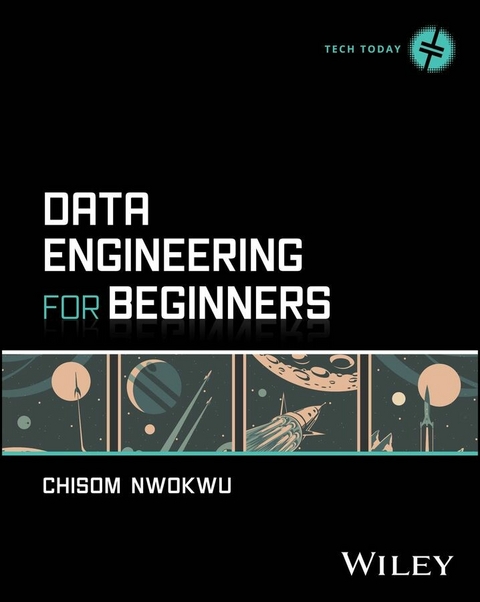
Data Engineering for Beginners (eBook)
565 Seiten
Wiley (Verlag)
978-1-394-32542-9 (ISBN)

A hands-on technical and industry roadmap for aspiring data engineers
In Data Engineering for Beginners, big data expert Chisom Nwokwu delivers a beginner-friendly handbook for everyone interested in the fundamentals of data engineering. Whether you're interested in starting a rewarding, new career as a data analyst, data engineer, or data scientist, or seeking to expand your skillset in an existing engineering role, Nwokwu offers the technical and industry knowledge you need to succeed.
The book explains:
- Database fundamentals, including relational and noSQL databases
- Data warehouses and data lakes
- Data pipelines, including info about batch and stream processing
- Data quality dimensions
- Data security principles, including data encryption
- Data governance principles and data framework
- Big data and distributed systems concepts
- Data engineering on the cloud
- Essential skills and tools for data engineering interviews and jobs
Data Engineering for Beginners offers an easy-to-read roadmap on a seemingly complicated and intimidating subject. It addresses the topics most likely to cause a beginning data engineer to stumble, clearly explaining key concepts in an accessible way. You'll also find:
- A comprehensive glossary of data engineering terms
- Common and practical career paths in the data engineering industry
- An introduction to key cloud technologies and services you may encounter early in your data engineering career
Perfect for practicing and aspiring data analysts, data scientists, and data engineers, Data Engineering for Beginners is an effective and reliable starting point for learning an in-demand skill. It's a powerful resource for everyone hoping to expand their data engineering Skillset and upskill in the big data era.
CHISOM NWOKWU, is a Big-Data Engineer, Multi-Published Author, and Creator specialising in the design and development of scalable data platforms for teams. She's an Azure Certified Data Engineer Associate who has worked with large international firms, including Microsoft and Bank of America.
Introduction
Data is more than just numbers and text; it’s the foundation of modern decision-making, innovation, and intelligent systems. Data is everywhere, from the personalized recommendations we see online while shopping to the analytics that drive billion-dollar businesses. But data alone isn’t enough. Behind the scenes are professionals who collect, clean, transform, and deliver data where it needs to go. These professionals are data engineers, and this book is your invitation to learn about data engineering.
The field of data engineering is growing at lightning speed, especially with the rise of artificial intelligence systems, which rely on quality data. Many people are eager to break into this field but find it difficult to navigate their learning journey. Others may already be working in tech- or data-adjacent roles but lack the foundational understanding of how modern data systems are designed, built, and maintained.
Data Engineering for Beginners is a comprehensive, beginner-friendly guide designed to help engineers, analysts, and industry professionals grasp the fundamentals of data engineering, learn necessary concepts with real-world scenarios, and ultimately launch a career with a well-defined roadmap.
This book is unique because it offers a clear and accessible introduction to complex and often intimidating concepts. Most resources on data engineering assume a certain level of prior knowledge or experience, making it difficult for true beginners to find a starting point.
I believe the strength of an engineer is understanding the rudiments of a topic, and that is what this book plans to achieve. It takes you on an intentional learning journey from understanding various data formats to designing databases, to learning how to secure data systems, to building architectures that scale.
With the rise of AI, data engineering has become even more popular. AI models also rely on vast amounts of high-quality data for training and operations, which would involve complex data processing and integration. Organizations are now keen on investing in data platforms and professionals who can manage those platforms, driving greater competition in the market.
What Does This Book Cover?
This book serves as a complete roadmap, starting from the basics and progressing to more advanced topics, providing a solid foundation for building your knowledge as you read.
Chapter 1: Understanding Data
This chapter explores the various forms of data: structured, semi-structured, and unstructured data, their advantages and their limitations. It also covers a brief history of data and the impact of data across several industries.
Chapter 2: Introduction to Data Engineering
This chapter introduces you to the world of data engineering, what it is, why it matters, and how it has evolved. You’ll learn about the role of a data engineer, the key stages of the data engineering life cycle, and how engineers navigate stakeholder needs to deliver real business value.
Chapter 3: Database Fundamentals
This chapter covers the essentials of databases, what they are, and how they store data. You’ll learn the difference between relational and NoSQL databases, and explore when to use each. We’ll also introduce the major types of NoSQL databases and their use cases and explain the ACID principles that ensure data integrity. This chapter gives you the tools to choose and work with the right database for your project needs.
Chapter 4: SQL Fundamentals
After discussing relational databases, we need to learn how to interact with them. This chapter is all about mastering SQL, starting with the basics, then build up to more powerful tools and advanced techniques like subqueries and window functions. You’ll also learn how to set up a SQL environment to practice writing and running your queries.
Chapter 5: Database Design
This chapter covers the principles of good schema design. We begin by exploring how to model data based on real-world requirements and best practices. You’ll learn how to understand and apply cardinality, design entity relationship diagrams (ERDs), and make smart decisions about normalization and denormalization to balance performance with data integrity.
Chapter 6: Data Warehouses, Data Lakes, and Data Lakehouses
This chapter introduces you to the world of data storage at scale, focusing on data warehouses, data lakes, and the hybrid data lakehouse architecture. You’ll learn how to design analytical models like star and snowflake schemas and explore data marts.
Chapter 7: Data Pipelines
In this chapter, you’ll learn the core methods of ingesting data, from traditional batch loads to real-time streaming. You will learn concepts like windowing for managing time in streaming, and architectural patterns like Lambda that combine batch and stream processing. This chapter also unpacks data orchestration, scheduling, and automation.
Chapter 8: Data Quality
This chapter focuses on data quality. You’ll learn about common causes of bad data and the real impact poor quality can have on business decisions and the key data quality dimensions.
Chapter 9: Data Security
In this chapter, you’ll learn core security principles and how to safeguard data both at rest and in transit. The chapter covers key concepts like authentication and authorization, as well as the basics of encryption and data masking to keep sensitive information safe.
Chapter 10: Data Governance
This chapter unpacks the essential concept of data governance through a simple, relatable analogy. You’ll learn about policies and processes that ensure data is managed responsibly and compliantly, along with common regulations.
Chapter 11: Big Data and Distributed Systems
This chapter introduces you to the exciting world of big data, starting with its fundamentals and the famous 5 V’s—volume, velocity, variety, veracity, and value—that define big data challenges. You’ll also explore popular big data frameworks like Apache Spark and Hadoop.
Chapter 12: Data Engineering on the Cloud
In this chapter, you’ll start by understanding what the cloud is and how it compares to traditional on-premises setups for data storage and processing. The chapter breaks down cloud service models: IaaS, PaaS, and SaaS. You’ll explore different storage types, object, block, and file storage, and learn how to leverage cloud compute services for data transformation.
Chapter 13: Building a Career in Data Engineering
This chapter gives you career tips. You’ll have a clear understanding of the various data engineering roles available and how to identify which fits your skills and interests best. You’ll learn strategies to ace interviews, including both technical challenges and behavioral questions.
Appendix: Sample Interview Questions
Get ready to test your knowledge! This appendix includes a curated set of common data engineering interview questions, complete with explanations. Topics span SQL, data modeling, pipeline design, and Apache Spark, giving you a well-rounded prep experience.
Data Engineering Glossary
To cap things off, you’ll explore a glossary of key terms, tools, and acronyms.
Who Should Read This Book?
In 2021, I started a new role as a software engineer, which required me to build and manage data platforms. Before this role, I had little or no background in data. For the first few months, I struggled to understand a lot of concepts. While I was successful in my deliverables, my foundation was faulty. Driven by curiosity, I started asking questions, engaging with industry experts, and deepening my expertise in the field. This journey sparked a passion in me that inspired the creation of this book, to share the knowledge I had acquired.
This book is for curious beginners, anyone starting their career or pivoting into data engineering. This book was written specifically for you; it’s a roadmap that gives you a solid starting point. It breaks down data engineering concepts with clear explanations and practical examples, giving you a strong foundation. I remember how intimidating it was when I first started, and I wanted to create something that feels like a friendly guide, not a textbook.
This book is also for software engineers, data analysts and scientists, and AI engineers in the room who keep hearing about data engineering at work but aren’t quite sure what it entails. Maybe you’re already writing SQL or deploying models but you don’t understand how the data gets cleaned, transformed, and served to you. This book shows you what’s happening behind the scenes, so you can speak the language, contribute more effectively to cross-functional teams, and create more impact in your role.
Then there are the career switchers, people who are trying to find their footing in tech. Data engineering is one of the most practical, foundational paths in the data world, and this book is your first step into the world of data, with no prior knowledge required.
Data Engineering for Beginners is both a learning tool and a reference that I hope you’ll come back to again and again. It contains real-world examples, interview tips, and scenarios that reflect...
| Erscheint lt. Verlag | 21.10.2025 |
|---|---|
| Reihe/Serie | Tech Today |
| Sprache | englisch |
| Themenwelt | Mathematik / Informatik ► Informatik |
| Schlagworte | big data careers • big data jobs • data engineering book • data engineering careers • Data engineering guide • data engineering handbook • data engineering jobs • data engineering skills • data engineering tutorial • entry-level data engineering jobs |
| ISBN-10 | 1-394-32542-8 / 1394325428 |
| ISBN-13 | 978-1-394-32542-9 / 9781394325429 |
| Informationen gemäß Produktsicherheitsverordnung (GPSR) | |
| Haben Sie eine Frage zum Produkt? |
 EPUB (Adobe DRM)
Kopierschutz: Adobe-DRM
Adobe-DRM ist ein Kopierschutz, der das eBook vor Mißbrauch schützen soll. Dabei wird das eBook bereits beim Download auf Ihre persönliche Adobe-ID autorisiert. Lesen können Sie das eBook dann nur auf den Geräten, welche ebenfalls auf Ihre Adobe-ID registriert sind.
Details zum Adobe-DRM
Dateiformat: EPUB (Electronic Publication)
EPUB ist ein offener Standard für eBooks und eignet sich besonders zur Darstellung von Belletristik und Sachbüchern. Der Fließtext wird dynamisch an die Display- und Schriftgröße angepasst. Auch für mobile Lesegeräte ist EPUB daher gut geeignet.
Systemvoraussetzungen:
PC/Mac: Mit einem PC oder Mac können Sie dieses eBook lesen. Sie benötigen eine
eReader: Dieses eBook kann mit (fast) allen eBook-Readern gelesen werden. Mit dem amazon-Kindle ist es aber nicht kompatibel.
Smartphone/Tablet: Egal ob Apple oder Android, dieses eBook können Sie lesen. Sie benötigen eine
Geräteliste und zusätzliche Hinweise
Buying eBooks from abroad
For tax law reasons we can sell eBooks just within Germany and Switzerland. Regrettably we cannot fulfill eBook-orders from other countries.
aus dem Bereich