Machine Learning For Dummies (eBook)
629 Seiten
For Dummies (Verlag)
978-1-394-37323-9 (ISBN)
The most human-friendly book on machine learning
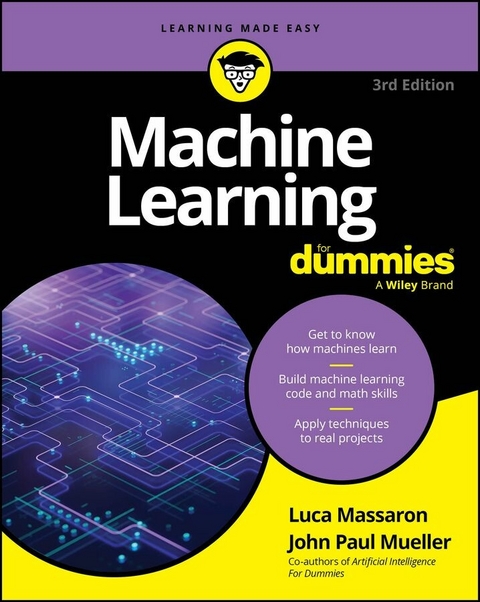
Somewhere buried in all the systems that drive artificial intelligence, you'll find machine learning-the process that allows technology to build knowledge based on data and patterns. Machine Learning For Dummies is an excellent starting point for anyone who wants deeper insight into how all this learning actually happens. This book offers an overview of machine learning and its most important practical applications. Then, you'll dive into the tools, code, and math that make machine learning go-and you'll even get step-by-step instructions for testing it out on your own. For an easy-to-follow introduction to building smart algorithms, this Dummies guide is your go-to.
- Piece together what machine learning is, what it can do, and what it can't do
- Learn the basics of machine learning code and how it integrates with large datasets
- Understand the mathematical principles that AI uses to make itself smarter
- Consider real-world applications of machine learning and write your own algorithms
With clear explanations and hands-on instruction, Machine Learning For Dummies is a great entry-level resource for developers looking to get started with AI and machine learning.
Luca Massaron is a data science, machine learning, and artificial intelligence expert. He's the author of Artificial Intelligence For Dummies, Deep Learning For Dummies, and Machine Learning For Dummies.
John Paul Mueller was a long-time tech author whose credits include previous editions of this book along with Artificial Intelligence For Dummies and Algorithms For Dummies.
Chapter 1
Getting the Real Story About AI
IN THIS CHAPTER
Getting beyond the hype of artificial intelligence (AI)
Distinguishing AI from machine learning
Understanding the science and engineering in machine learning
Delineating where engineering ends and art begins
Artificial intelligence (AI), the theory and development of computer systems capable of performing tasks that would otherwise require human intelligence, is a vast topic today, and it continues to grow larger all the time, thanks to the constant introduction of new technologies. Despite the complexity of these technologies, most people encounter AI through everyday applications, such as interacting with their digital assistants, receiving shopping recommendations, or creating text, images, and videos to post on social networks using generative AI tools. Talking to your smartphone is both fun and helpful for finding out things like the location of the best sushi restaurant in town or discovering how to get to the concert hall. As you interact with your smartphone, it learns more about the way you talk and makes fewer mistakes in understanding your requests. The capability of your smartphone to comprehend and interpret your unique way of speaking is an example of AI, and it is not the only application available. Part of the technology used to make everything happen is machine learning, which involves the use of various techniques to enable algorithms to make predictions based on historical data records.
You also likely encounter and make use of machine learning and AI all over the place today without really noticing. For example, when smart devices adapt to your preferences over time or when digital assistants improve their understanding of your commands, these are examples of machine learning in action. Likewise, recommender systems, such as those found on Amazon, help you decide what to buy based on criteria like previous purchases or products that complement your current choice. The use of both AI and machine learning is expected to keep increasing over time.
In this chapter, you are introduced to AI and machine learning and discover what it means from several perspectives, including how it affects you as a consumer and as a scientist or engineer. You also find that neither AI nor generative AI equals machine learning, even though the media often confuses all the terms. Machine learning is a crucial component of AI, focusing on predicting outcomes based on available information. Generative AI (genAI), which has recently gained importance in the news and our daily lives, is also part of the broader field of AI, but it serves purposes different from predictive machine learning because it aims to create new content, such as text, images, or videos, based on the instructions you provide.
Moving Beyond the Hype
As any technology becomes bigger, so does the hype, and AI certainly has a lot of hype surrounding it. For one thing, some people have chosen to engage in fear-mongering rather than science by equating AI with killer robots, such as those depicted in the film The Terminator. Actually, your first real experience with a robot is more likely to be in the form of a healthcare assistant or possibly as a coworker. The reality is that you interact with AI and machine learning in far more mundane ways than you might realize.
You may have also heard more about AI than machine learning. AI is currently receiving the lion’s share of attention, but in the form of genAI. As a discipline, AI includes both machine learning and genAI. This chapter helps you understand the relationship between machine learning and AI so that you can better understand how this book enables you to move into a technology that used to appear only within the confines of science fiction novels and films.
Machine learning and AI both have strong engineering components. That is, many aspects of these technologies, particularly the performance and behavior of systems and algorithms, can be measured and optimized through established practices and practical evaluation. In addition, both have strong scientific components, through which researchers test concepts and develop new approaches to simulating or approximating certain aspects of intelligence and decision-making. Finally, machine learning also has an artistic component where intuition, creativity, and experience can play a critical role. This is where a talented practitioner can excel, especially when the results from AI and machine learning may seem counterintuitive, and only the experience and creativity of a skilled practitioner can ensure that models or systems perform as expected.
Dreaming of Electric Sheep
Androids (a specialized kind of robot that looks and acts like a human, such as Data in Star Trek: The Next Generation) and some types of humanoid robots (a kind of robot that has human characteristics but is easily distinguished from a human, such as C-3PO in Star Wars) have become the poster children for AI. They present computers in a form that people can anthropomorphize (give human characteristics to, even though they aren’t human). In fact, it’s entirely possible that one day you won’t be able to distinguish between human and artificial life with ease. Science fiction authors, such as Philip K. Dick, have long predicted such an occurrence, and it seems all too possible today. In his novel “Do Androids Dream of Electric Sheep?” Dick discusses the whole concept of more real than real. The idea appears as part of the plot in the movie Blade Runner. However, some uses of robots today are just plain fun, as seen with robots serving at restaurants. The sections that follow help you understand how close technology currently gets to the ideals presented by science fiction authors and the movies.
For physical androids, the current state of the art is impressive but still not even close to humans. In text-based interactions, some advanced AI can hold remarkable human-like conversations, but don’t be fooled by their linguistic skills, as they lack genuine consciousness or understanding.
Understanding the history of AI and machine learning
There is a reason, other than anthropomorphism, that humans envision the ultimate AI as one that is embodied within some android. Ever since the ancient Greeks, humans have discussed the possibility of placing a mind inside a mechanical body. One such myth is that of a mechanical man called Talos. The fact that the ancient Greeks had complex mechanical devices, of which only one still exists (read about the Antikythera mechanism at www.ancient-wisdom.com/antikythera.htm), suggests that their dreams may have been inspired by more than just fantasy. Throughout the centuries, people have discussed mechanical persons capable of thought (such as Rabbi Judah Loew’s Golem).
AI is built on the hypothesis that mechanizing thought is possible. During the first millennium, Greek, Indian, and Chinese philosophers all explored formal reasoning and logic, which are the building blocks of the idea of mechanizing thought. As early as the 17th century, Gottfried Leibniz, Thomas Hobbes, and René Descartes discussed the potential for rationalizing all thought as simply mathematical symbols. Of course, the complexity of the problem eluded them. The point is that the vision for AI has been around for an incredibly long time, but the implementation of some working AI is relatively new.
The actual birth of AI as we know it today began with Alan Turing’s publication of “Computing Machinery and Intelligence” in 1950 (https://courses.cs.umbc.edu/471/papers/turing.pdf). In this paper, Turing explored the idea of how to determine whether machines can think. Of course, this paper led to the Imitation Game involving three players. Player A is a computer, and Player B is a human. Each must convince Player C (a human who can’t see either Player A or Player B) that they are human. If Player C can’t determine who is human and who isn’t in a consistent way, the computer wins.
A persistent issue with AI is excessive optimism. The problem that scientists are trying to solve with AI is incredibly complex. However, the early optimism of the 1950s and 1960s led scientists to believe that the world would produce intelligent machines in as little as 20 years. After all, machines were doing all sorts of amazing things, such as playing complex games. AI currently has its greatest success in areas such as logistics, data mining, advanced natural language processing (conversational AI), advanced computer vision, medical diagnosis, drug discovery, scientific research (for example, protein folding with models like AlphaFold: https://alphafold.com), software development, and materials science.
Exploring what machine learning can do for AI
Machine learning relies on algorithms to analyze datasets. Currently, machine learning can’t provide the sort of AI that the movies present. Even the best algorithms can’t think, feel, present any form of self-awareness, or exercise free will. Machine learning can identify complex patterns, make predictions, and, with generative models, create new data, performing all these tasks far faster than any human can and at a scale that exceeds human capabilities. As a result, machine learning can help humans work more efficiently. A true AI might eventually emerge when computers...
| Erscheint lt. Verlag | 20.10.2025 |
|---|---|
| Sprache | englisch |
| Themenwelt | Mathematik / Informatik ► Informatik |
| Schlagworte | ai books 2025 • ai data • artificial intelligence books • best artificial intelligence books • coding ai • coding machine learning • Deep learning • machine learning • machine learning algorithms • machine learning book • machine learning with pytorch • ml system design • PyTorch |
| ISBN-10 | 1-394-37323-6 / 1394373236 |
| ISBN-13 | 978-1-394-37323-9 / 9781394373239 |
| Informationen gemäß Produktsicherheitsverordnung (GPSR) | |
| Haben Sie eine Frage zum Produkt? |
 EPUB (Adobe DRM)
Kopierschutz: Adobe-DRM
Adobe-DRM ist ein Kopierschutz, der das eBook vor Mißbrauch schützen soll. Dabei wird das eBook bereits beim Download auf Ihre persönliche Adobe-ID autorisiert. Lesen können Sie das eBook dann nur auf den Geräten, welche ebenfalls auf Ihre Adobe-ID registriert sind.
Details zum Adobe-DRM
Dateiformat: EPUB (Electronic Publication)
EPUB ist ein offener Standard für eBooks und eignet sich besonders zur Darstellung von Belletristik und Sachbüchern. Der Fließtext wird dynamisch an die Display- und Schriftgröße angepasst. Auch für mobile Lesegeräte ist EPUB daher gut geeignet.
Systemvoraussetzungen:
PC/Mac: Mit einem PC oder Mac können Sie dieses eBook lesen. Sie benötigen eine
eReader: Dieses eBook kann mit (fast) allen eBook-Readern gelesen werden. Mit dem amazon-Kindle ist es aber nicht kompatibel.
Smartphone/Tablet: Egal ob Apple oder Android, dieses eBook können Sie lesen. Sie benötigen eine
Geräteliste und zusätzliche Hinweise
Buying eBooks from abroad
For tax law reasons we can sell eBooks just within Germany and Switzerland. Regrettably we cannot fulfill eBook-orders from other countries.
aus dem Bereich