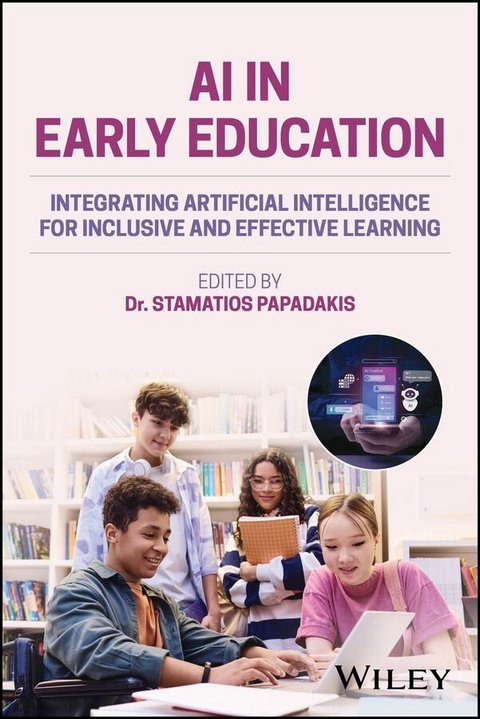
AI in Early Education (eBook)
640 Seiten
Wiley (Verlag)
978-1-394-35280-7 (ISBN)
An original and up-to-date examination of how to use AI to improve pre-school and early childhood education
In AI in Early Education: Integrating Artificial Intelligence for Inclusive and Effective Learning, examines how to use artificial intelligence technology to enhance teaching and learning with personalized learning pathways, inclusive instructional practices, and increased student engagement.
The book explores key themes, like AI literacy for young learners, ethical and pedagogical considerations, and the professional development that educators need to effectively integrate these tools into their classrooms.
You'll also find:
- Ways to use AI to support diverse learners, including those with special educational needs
- Hands-on strategies that offer educators clear, practical ways to bring AI tools into the classroom
- A careful emphasis on inclusion strategies, demonstrating how AI can help tailor learning experiences to meet the needs of all students
Perfect for educators, teacher trainers, researchers, regulators, and policymakers interested in how artificial intelligence might contribute to the improvement of early childhood and primary education, AI in Early Education is also a must-read for pre-service and in-service teachers and professionals involved in curriculum development and inclusive education.
Dr. Stamatios Papadakis is an Assistant Professor in Educational Technology at the Department of Preschool Education, University of Crete, Greece. His research focuses on the integration of digital technologies, computational thinking, and educational robotics in early childhood and primary education. He has authored and edited numerous books and articles on mobile learning, STEM education, and AI in education. He also serves as Editor and Editorial Board Member in several international journals and is actively involved in major European initiatives in digital education.
An original and up-to-date examination of how to use AI to improve pre-school and early childhood education In AI in Early Education: Integrating Artificial Intelligence for Inclusive and Effective Learning, examines how to use artificial intelligence technology to enhance teaching and learning with personalized learning pathways, inclusive instructional practices, and increased student engagement. The book explores key themes, like AI literacy for young learners, ethical and pedagogical considerations, and the professional development that educators need to effectively integrate these tools into their classrooms. You'll also find: Ways to use AI to support diverse learners, including those with special educational needs Hands-on strategies that offer educators clear, practical ways to bring AI tools into the classroom A careful emphasis on inclusion strategies, demonstrating how AI can help tailor learning experiences to meet the needs of all students Perfect for educators, teacher trainers, researchers, regulators, and policymakers interested in how artificial intelligence might contribute to the improvement of early childhood and primary education, AI in Early Education is also a must-read for pre-service and in-service teachers and professionals involved in curriculum development and inclusive education.
Chapter 1
Integrating Distributed Cognition and Culturally Responsive Pedagogy Frameworks for AI in Early Childhood Preservice Teacher Training: Toward a Culturally Responsive Educational AI (CREAI)
Rawad Chaker
Education, Cultures & Politics (ECP) Laboratory, Lyon 2 University, Lyon 69007, France
Corresponding author: rawad.chaker@univ-lyon2.fr
1.1 Early Childhood Educators and AI Literacy: What Framework?
The rapid development of artificial intelligence (AI) calls for early childhood educators to develop AI literacy, in order to integrate digital AI-powered tools effectively into their pedagogical practices, given the decisive role of early childhood education in determining students’ future schooling and educational trajectory (Sarama & Clements, 2009). Because AI is becoming an integral part of the knowledge economy (and more specifically, educational AI, e.g., Ng et al., 2023), it is essential to equip future teachers with the necessary skills to critically engage with these technologies and utilize them in meaningful ways (De la Hoz-Ruiz et al., 2025), in order for them to put this knowledge at work with young learners (Sperling et al., 2024) whatever their social and cultural backgrounds.
However, there is a lack of comprehensive frameworks in preservice teacher training that simultaneously address both cognitive and cultural challenges when integrating AI into education. Existing teacher education programs often focus on either technological proficiency or pedagogical adaptation, but fail to account for the cognitive risks associated with AI-supported learning. At the same time, they do not sufficiently equip future educators with strategies to cope with the cultural complexities of increasingly diverse classrooms, a growing reality in Western educational systems due to globalization and migration trends (Banks, 2015; Alim & Paris, 2017). To address the need to train preservice early childhood teachers on how to effectively integrate AI tools in their classrooms and real-life learning settings, we need to understand how cognition and culture shape the learning situation. To do this, we draw on two distinct, but related, cognitive and cultural frameworks, namely distributed cognition and culturally responsive teaching (CRT).
1.2 Distributed Cognition and Culturally Responsive Pedagogy: Toward an Integrative Framework for AI in Education?
Edwin Hutchins, a cognitive anthropologist, initially studied what he termed “naturally situated cognition” (1995, p. xii). Cognitive anthropology seeks to understand cognitive processes through the study of cultural dynamics. The distributed approach of cognition, advanced by Hutchins throughout his ethnographic research, was significantly marked by his 1995 publication, Cognition in the Wild, in which he argues that cognitive processes are observable and analyzable by an external observer because they are distributed across a cognitive system consisting of functional components, such as humans and artifacts, through the propagation of representational states of information. For the distributed cognition (DC) paradigm, the process of acquiring, processing, and utilizing information does not occur solely within the brain but is instead distributed across the individual’s entire body and environment, each part contributing to generating the individual’s thoughts, emotions, and behaviors. Consequently, cognition cannot be studied in isolation, but within the context of all interactions between the brain, body, and environment.
Our approach aims to move beyond the traditional cognitive science perspective, which focuses on the individual, by characterizing cognition as embodied and situated within its context (Barsalou, 2008), while accounting for its distributed dimension across various elements and the individual. In this chapter, we will try to understand how AI can be integrated within early childhood education, from the lens of distributed cognition, considering that AI tools such as generative AI are part of the functional cognitive system composed of the children, the teacher, the classroom, and the machine. We will see how, using the DC paradigm, AI can present as many advantages as risks in early childhood education.
To address some of those potential issues, we propose the culturally responsive pedagogical approach applied to the AI integration in preservice teacher training for early childhood. It takes into consideration cultural background, lived experiences, and socio-emotional realities of children (Gay, 2018). We show that joining both frameworks to approach teacher training could provide comprehensive and sustainable tools (Alim & Paris, 2017) that take into consideration both cognitive and cultural challenges met by teachers in their classrooms.
1.3 AI as an Extension of the Human Mind: Theoretical Perspectives from the DC Paradigm
The DC paradigm considers that a cognitive system consists of multiple cognitive subsystems nested within one another, and the boundary separating the internal environment (inside an individual’s brain) from the external environment is only a material distinction, not necessarily representing a different level of nesting (Hutchins, 1995). Thus, a cognitive system includes both internal and external information-processing activities: “communication inside the actors is seen as an internal process of the cognitive system,” and similarly, “computational media, such as figures and diagrams, are seen as internal representations within the system, and computations performed on them are additional internal processes of the system” (Hutchins, 1995, p. 128). In the latter case, this makes cognitive processes, understood as communicational processes, directly observable: the means of representation are tangible and visual (diagrams, maps, charts, etc.), enabling direct observation of cognitive processes within an informational system, “the cognitive activity being distributed across a social network” (Hutchins, 1995, p. 128).
But then, what about AI as an element of the learning environment? This extension of cognition from the brain into the environment arises from the interdependent fact that certain tasks are too complex to be fully entrusted to humans alone; parts of the involved processes are thus “offloaded” onto the sociotechnical environment (Hollan, Hutchins, & Kirsh, 2000; Chaker, 2024). The externalization of these tasks through tools is, in some cases, indispensable. Certain tasks become distributed, or in this context offloaded, into the environment, thereby relieving the individual from cognitive load. In doing so, tasks become both transformed and transformative: they no longer involve the same cognitive processes (Chaker, 2024). Part of the task can thus be coordinated with mechanical or digital tools (simplifying the primary task), or completely automated by a machine, which alters the nature of the task and consequently the work itself.
The Extended Mind perspective proposed by Clark and colleagues (Clark & Chalmers, 1998; Clark, 2008) posits that thought extends into the environment: in a sense, “a person enacts thinking” (Kirsh, 2019, p. 140). This helps explain why technical artifacts are not really “amplifiers” of cognitive abilities (in the sense that they would enable us to perform cognitive tasks otherwise impossible without these artifacts). Rather, we suggest that they serve as cognitive distributors of processes required to accomplish a task by modifying its exact nature.
Thus, a digital artifact, such as AI, does not directly amplify a subject’s cognitive abilities; rather, it transforms the cognitive task by representing it in a way that makes the solution to the problem apparent (Hollan, Hutchins, & Kirsh, 2000). Hence, because of their nature, using AI systems necessitates and develops certain skills that would not be developed using different tools.
1.4 Using the DC Paradigm to Inform About AI Critical Integration
1.4.1 Risks of Over-reliance on AI
Distributing cognition would thus lead to lighter cognitive processes (Zhang, 1997; Heintz, 2011) by shifting “the place where representations are produced and transformed from the mind to the environment” (Heintz, 2011, p. 287). However, this is not a mere “transfer” logic, where cognitive load is reduced simply because part of the task is offloaded onto the environment; rather, it results from a modification of the cognitive process itself. According to Hollan, Hutchins, and Kirsh (2000), the theory of DC identifies a set of fundamental principles:
- People establish and coordinate different types of structures in their environment.
- Effort is necessary to maintain this coordination.
- People offload cognitive effort onto the environment whenever possible.
- There is an enhancement of dynamic cognitive-load balancing within the social organization.
However, there are risks associated with increased AI engagement; individuals may become over‐reliant on AI, resulting in a reduced capacity for critical thinking, or a decline in memory retention (Bai, Liu, & Su, 2023). This over-reliance can lead to “metacognitive laziness” (Fan et al., 2024). This situation can potentially hinder children’s ability to self‐regulate and engage deeply in learning. Another research found that high confidence in generative AI is associated with less critical thinking and less cognitive effort dedicated to critical thinking (Lee et al., 2025).
Indeed,...
| Erscheint lt. Verlag | 20.10.2025 |
|---|---|
| Sprache | englisch |
| Themenwelt | Mathematik / Informatik ► Informatik ► Theorie / Studium |
| Schlagworte | AI education • ai preschool education • ai tools in education • Artificial Intelligence in Education • artificial intelligence tools in education • personalized early childhood education • Personalized Education • personalized preschool education |
| ISBN-10 | 1-394-35280-8 / 1394352808 |
| ISBN-13 | 978-1-394-35280-7 / 9781394352807 |
| Informationen gemäß Produktsicherheitsverordnung (GPSR) | |
| Haben Sie eine Frage zum Produkt? |
 EPUB (Adobe DRM)
Kopierschutz: Adobe-DRM
Adobe-DRM ist ein Kopierschutz, der das eBook vor Mißbrauch schützen soll. Dabei wird das eBook bereits beim Download auf Ihre persönliche Adobe-ID autorisiert. Lesen können Sie das eBook dann nur auf den Geräten, welche ebenfalls auf Ihre Adobe-ID registriert sind.
Details zum Adobe-DRM
Dateiformat: EPUB (Electronic Publication)
EPUB ist ein offener Standard für eBooks und eignet sich besonders zur Darstellung von Belletristik und Sachbüchern. Der Fließtext wird dynamisch an die Display- und Schriftgröße angepasst. Auch für mobile Lesegeräte ist EPUB daher gut geeignet.
Systemvoraussetzungen:
PC/Mac: Mit einem PC oder Mac können Sie dieses eBook lesen. Sie benötigen eine
eReader: Dieses eBook kann mit (fast) allen eBook-Readern gelesen werden. Mit dem amazon-Kindle ist es aber nicht kompatibel.
Smartphone/Tablet: Egal ob Apple oder Android, dieses eBook können Sie lesen. Sie benötigen eine
Geräteliste und zusätzliche Hinweise
Buying eBooks from abroad
For tax law reasons we can sell eBooks just within Germany and Switzerland. Regrettably we cannot fulfill eBook-orders from other countries.
aus dem Bereich