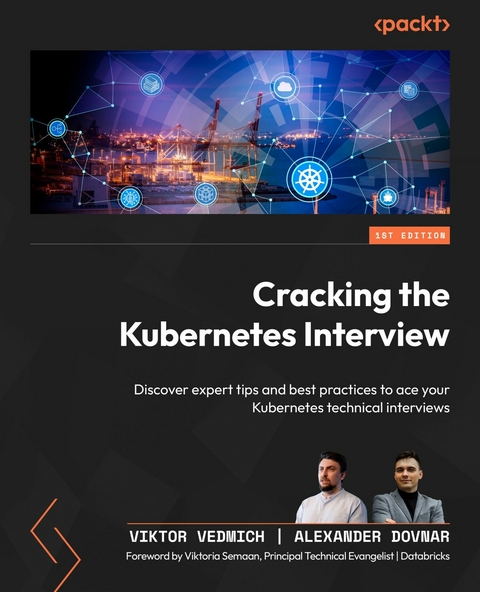
Cracking the Kubernetes Interview (eBook)
560 Seiten
Packt Publishing (Verlag)
978-1-80107-606-7 (ISBN)
Discover expert tips and best practices to ace your Kubernetes technical interviews
Advance your career and excel in modern IT with Kubernetes skills rooted in decades of real-world expertise to ensure your successKey FeaturesGet expert insights and detailed explanations of answers to essential Kubernetes interview questionsExplore strategies for navigating diverse Kubernetes interview scenariosTap into insider guidance from industry professionals with hands-on experiencePurchase of the print or Kindle book includes a free PDF eBookBook DescriptionIn the high-stakes world of cloud-native technologies, Kubernetes technical interviews are notoriously challenging, and theory-heavy resources leave candidates unprepared for real-world scenarios. This guide by Viktor Vedmich and Alexander Dovnar, two seasoned professionals with decades of combined experience in DevOps, AWS, and Kubernetes architecture, bridges that gap to help you unlock actionable strategies and insights to excel in even the toughest interviews. Beginning with core concepts such as Pods and Services, the book guides you through scaling, networking, GitOps, and deployment strategies. You ll explore advanced topics, including security, observability, monitoring, and troubleshooting, all framed in the context of real-world interviews. Each chapter includes practical scenarios and authentic questions that test both your understanding and problem-solving skills. Rather than relying on rote memorization, this guide helps you develop the depth and confidence expected of top-tier Kubernetes professionals. By the end of this hands-on journey, you'll be ready to take on roles from junior DevOps engineer to senior architect, equipped with the practical expertise needed to stand out in today s competitive hiring process.What you will learnPrepare effectively for scenario-based Kubernetes interview questions and challengesUnderstand Kubernetes components and their interactionsImprove your theoretical knowledge and collaboration skillsDiagnose and resolve Kubernetes issues efficientlyGain insights into common Kubernetes job roles and responsibilitiesApply best practices with real-world comparative examplesBuild confidence to succeed in Kubernetes interviews for various job levelsWho this book is forThis book is for software engineers, developers, DevOps professionals, SREs, and ML engineers aiming to level up their Kubernetes skills and secure roles involving designing, deploying, and managing applications in Kubernetes clusters. Whether you're new to Kubernetes or an experienced user, this book provides valuable insights and hands-on practice to excel in technical interviews and real-world applications. A basic understanding of Kubernetes, combined with a desire to enhance practical skills, will help you get the most out of this book. ]]>
Preface
Kubernetes is the backbone of modern cloud-native systems—but the engineers who stand out are the ones who can explain it under pressure and fix it when it breaks.
This book is built for exactly that. You’ll learn about the way Kubernetes is used in the real world, with production-style scenarios, more than 100 interview-ready questions with model answers, and dozens of clear diagrams that make tough topics click. We draw on years of hands-on work to show how Kubernetes behaves in production, how to troubleshoot it systematically, and how to talk through your approach with confidence.
Whether you’re new to Kubernetes or sharpening for a senior interview, you’ll get practical depth—and the language to communicate it.
This is what you’ll get in this book:
- 100+ practical, interview-style questions with model answers that you can rehearse
- Clear, plain-English explanations that go beyond surface definitions
- Dozens of visual diagrams that simplify networking, scaling, storage, and security
- Hands-on mini-labs and checklists to turn concepts into muscle memory
- Guidance that’s useful for developers, DevOps engineers, SREs, and ML engineers who run workloads on Kubernetes
By the end of this book, you will be able to do the following:
- Explain how Kubernetes works “from the inside out”
- Answer Kubernetes questions confidently in interviews and design reviews
- Troubleshoot, scale, and secure real clusters using modern best practices
- Operate with GitOps and automation to manage applications at scale
- Recognize and resolve common production pain points
- Communicate your decisions clearly to teammates and interviewers
Who this book is for
This book is for people who want to use Kubernetes with confidence—in real projects or technical interviews. It’s written for software developers running services on Kubernetes, DevOps and SRE practitioners operating clusters, and ML engineers deploying training/serving workloads.
To get the most out of this book, you should already know some basics—such as how Linux works, what containers are, and have a general understanding of networking and IT concepts.
Many people learning Kubernetes find it hard to move beyond the basics. They can follow tutorials, but still struggle when asked real-world questions or face problems in production. This book helps close that gap. It explains complex topics in a way that’s practical and easy to understand, so you can go from theory to hands-on confidence. It also helps you stay current with the fast-moving Kubernetes ecosystem and gives you the tools to succeed in both interviews and real DevOps work.
To effectively use this book, work through the diagrams first, then try the mini-labs. For each section, answer the included questions out loud using STAR (Situation–Task–Action–Result). Keep a short log of pitfalls you hit and how you fixed them; these become great interview stories. If you’re preparing for a panel, practice explaining trade-offs in plain English before you touch YAML.
What this book covers
Chapter 1, Understanding Kubernetes from Containers to Orchestration, introduces containers and shows why Kubernetes became the standard for running applications at scale.
Chapter 2, Kubernetes Key Components and Their Functions, covers the control plane (API server, scheduler, controller manager, and etcd) and how these parts work together.
Chapter 3, Exploring Kubernetes Basics, explains Pods, Namespaces, and workload primitives (Deployments, Jobs, CronJobs, DaemonSets, and static Pods), including labels/selectors and lifecycle.
Chapter 4, Principles of Scaling: Horizontal vs. Vertical, compares HPA and VPA, when to use each, and how to avoid common scaling pitfalls.
Chapter 5, Autoscaling in Action, goes deeper with Cluster Autoscaler and Karpenter for node-level scaling, with real guidance on cost and performance.
Chapter 6, Essentials of Kubernetes Networking, breaks down CNI, kube-proxy, DNS, and Pod/Service communication so you can reason about traffic paths.
Chapter 7, Kubernetes Network Architecture: Services and Ingresses, explores Service types, ingress controllers, and introduces the Gateway API. It also covers the basics of service mesh.
Chapter 8, Storage: Persistence and CSI Drivers, covers PVs, PVCs, StatefulSets, snapshots, and CSI drivers to design reliable stateful workloads.
Chapter 9, Security Best Practices in Kubernetes and RBAC, focuses on RBAC, secrets management, network policies, and building secure container images.
Chapter 10, Real-World Deployment Scenarios and Continuous Deployment, walks through rolling, blue/green, and canary strategies; it also introduces Helm and Kustomize for day-to-day delivery.
Chapter 11, Understanding GitOps: Principles and Practices, explains GitOps fundamentals with Argo CD and shows how to run pull-based, auditable deployments.
Chapter 12, Custom Resource Definitions and Operators , shows how to extend the Kubernetes API with custom resources, what operators are, and includes a small, hands-on operator example to demonstrate its functions.
Chapter 13, Ensuring High Availability and Reliability, teaches patterns for resilient clusters and applications: redundancy, failover, and reliability design.
Chapter 14, Monitoring Best Practices, covers metrics, logs, tracing, and alerting with tools such as Prometheus and Grafana.
Chapter 15, Backup, Maintenance, and Disaster Recovery in Kubernetes, builds backup strategies, plans safe maintenance, and designs recovery procedures for real failures.
Chapter 16, Real-world Troubleshooting Scenarios, works through production-style incidents in deployment, scaling, storage, and networking—with step-by-step diagnosis.
Chapter 17, Common Mistakes and How to Avoid Them, focuses on communication under pressure, structured problem-solving, and avoiding frequent Kubernetes pitfalls.
Chapter 18, Interview Stories from Authors, shares real interview stories, lessons learned, and practical preparation tips to sharpen your edge.
To get the most out of this book
You should have some basic Linux experience, understand concepts of containers, and be familiar with networking basics.
Be attentive and read the special “Interview tips” sections.
Download the example code files
The code bundle for the book is hosted on GitHub at https://github.com/PacktPublishing/Cracking-the-Kubernetes-Interview. We also have other code bundles from our rich catalog of books and videos available at https://github.com/PacktPublishing. Check them out!
Conventions used
There are a number of text conventions used throughout this book.
CodeInText: Indicates code words in text, database table names, folder names, filenames, file extensions, pathnames, dummy URLs, user input, and X/Twitter handles. For example: “The restartPolicy parameter is set to Never, so if the container exits, the Job will not restart it unless the Pod fails.”
A block of code is set as follows:
--- apiVersion: v1 kind: Service metadata: name: hello-sample-ext namespace: default spec: type: ExternalName externalName: google.com Any command-line input or output is written as follows:
Kubectl get pods Bold: Indicates a new term, an important word, or words that you see on the screen. For instance, words in menus or dialog boxes appear in the text like this. For example: “Automatic recovery process, often called a reconciliation loop, is a cornerstone of Kubernetes’ resilience.”
Warnings or important notes appear like this.
Tips and tricks appear like this.
Get in touch
Feedback from our readers is always welcome.
General feedback: If you have questions about any aspect of this book or have any general feedback, please email us at customercare@packt.com and mention the book’s title in the subject of your message.
Errata: Although we have taken every care to ensure the accuracy of our content, mistakes do happen. If you have found a mistake in this book, we would be grateful if you reported this to us. Please visit http://www.packt.com/submit-errata, click Submit Errata, and fill in the form.
Piracy: If you come across any illegal copies of our works in any form...
| Erscheint lt. Verlag | 30.10.2025 |
|---|---|
| Vorwort | Viktoria Semaan |
| Sprache | englisch |
| Themenwelt | Mathematik / Informatik ► Informatik ► Programmiersprachen / -werkzeuge |
| ISBN-10 | 1-80107-606-5 / 1801076065 |
| ISBN-13 | 978-1-80107-606-7 / 9781801076067 |
| Informationen gemäß Produktsicherheitsverordnung (GPSR) | |
| Haben Sie eine Frage zum Produkt? |
 EPUB (Ohne DRM)
Digital Rights Management: ohne DRM
Dieses eBook enthält kein DRM oder Kopierschutz. Eine Weitergabe an Dritte ist jedoch rechtlich nicht zulässig, weil Sie beim Kauf nur die Rechte an der persönlichen Nutzung erwerben.
Dateiformat: EPUB (Electronic Publication)
EPUB ist ein offener Standard für eBooks und eignet sich besonders zur Darstellung von Belletristik und Sachbüchern. Der Fließtext wird dynamisch an die Display- und Schriftgröße angepasst. Auch für mobile Lesegeräte ist EPUB daher gut geeignet.
Systemvoraussetzungen:
PC/Mac: Mit einem PC oder Mac können Sie dieses eBook lesen. Sie benötigen dafür die kostenlose Software Adobe Digital Editions.
eReader: Dieses eBook kann mit (fast) allen eBook-Readern gelesen werden. Mit dem amazon-Kindle ist es aber nicht kompatibel.
Smartphone/Tablet: Egal ob Apple oder Android, dieses eBook können Sie lesen. Sie benötigen dafür eine kostenlose App.
Geräteliste und zusätzliche Hinweise
Buying eBooks from abroad
For tax law reasons we can sell eBooks just within Germany and Switzerland. Regrettably we cannot fulfill eBook-orders from other countries.
aus dem Bereich