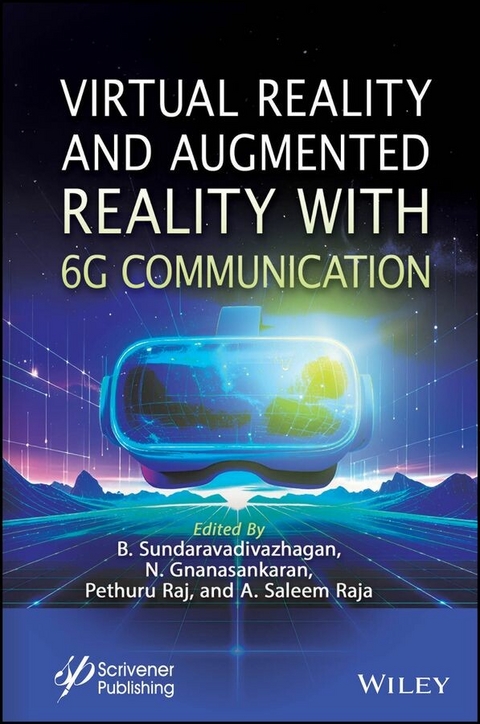
Virtual Reality and Augmented Reality with 6G Communication (eBook)
835 Seiten
Wiley-Scrivener (Verlag)
978-1-394-33606-7 (ISBN)
Stay ahead of the technological curve with this essential book, which provides a comprehensive guide to the transformative convergence of Virtual Reality (VR), Augmented Reality (AR), and 6G communication.
Virtual Reality and Augmented Reality with 6G Communication delves into the transformative landscape where cutting-edge technologies meet. This book explores the convergence of Virtual Reality (VR) and Augmented Reality (AR) with groundbreaking 6G technology, providing a comprehensive examination of use cases, applications, and the challenges associated with this synergy. As we stand on the precipice of a technological renaissance, this book serves as a comprehensive guide, navigating the uncharted territories where immersive experiences meet cutting-edge connectivity. This book comprehensively covers the basics of these innovative technologies by diving into the foundational realms of VR, AR, and 6G technology. Through in-depth explanations, this essential reference provides a profound understanding of the intricate mechanisms that power these transformative domains, setting the stage for the unparalleled convergence that awaits.
B. Sundaravadivazhagan, PhD is faculty in the Department of Information Technology at the University of Technology and Applied Science with more than 21 years of experience. He has published more than 25 technical articles in international journals and conferences. His research interests include the Internet of Things, artificial intelligence and machine learning, deep learning, cloud computing, and cyber security.
N. Gnanasankaran, PhD is assistant professor in the Department of Computer Science at Thiagarajar College with more than 15 years of research and teaching experience. He has published more than 35 research articles in international journals and conferences, four books, and 14 book chapters, and holds eight patents. His areas of research focus on software engineering, data science, machine learning, big data, and IoT.
Pethuru Raj, PhD is a chief architect in the Edge AI division of Reliance Jio Platforms Ltd. with more than 22 years of experience. He has more than 130 publications to his credit, including books, chapters, and articles published in international journals and conferences. His research interests include cyber-physical systems, cloud computing, and smart cities.
A. Saleem Raja, PhD is an associate professor in the Department of Information Technology at the Shinas University of Technology and Applied Sciences with more than 16 years of research experience. He has published more than 25 research papers in national and international journals, conferences, and book chapters. His research interests include cybersecurity, machine learning, deep learning, natural language processing, image processing, and the Internet of Things.
Stay ahead of the technological curve with this essential book, which provides a comprehensive guide to the transformative convergence of Virtual Reality (VR), Augmented Reality (AR), and 6G communication. Virtual Reality and Augmented Reality with 6G Communication delves into the transformative landscape where cutting-edge technologies meet. This book explores the convergence of Virtual Reality (VR) and Augmented Reality (AR) with groundbreaking 6G technology, providing a comprehensive examination of use cases, applications, and the challenges associated with this synergy. As we stand on the precipice of a technological renaissance, this book serves as a comprehensive guide, navigating the uncharted territories where immersive experiences meet cutting-edge connectivity. This book comprehensively covers the basics of these innovative technologies by diving into the foundational realms of VR, AR, and 6G technology. Through in-depth explanations, this essential reference provides a profound understanding of the intricate mechanisms that power these transformative domains, setting the stage for the unparalleled convergence that awaits.
1
Introduction to Virtual Reality and Augmented Reality
R. Niraimathi1, A. Manjula1, V. Chamundeeswari2* and S. Chitra Devi1
1ASP/EEE, Mohamed Sathak Engineering College, Kilakarai, India
2ASP/EEE, St. Joseph’s College of Engineering, Chennai, India
Abstract
Virtual reality (VR) and augmented reality (AR) are transformative technologies that significantly alter our interaction with digital information and the physical world. VR immerses users in entirely digital environments, creating a fully artificial experience, while AR overlays digital content onto the real world, enhancing our perception with virtual information and objects. This introduction provides a comprehensive overview of VR and AR, exploring their definitions, key features, and applications, and underscores their potential to revolutionize various industries and aspects of daily life.
Keywords: Virtual reality (VR), augmented reality (AR), immersive technologies, mixed reality (MR), artificial intelligence (AI), tactile internet, edge computing, digital transformation
1.1 Introduction
Virtual reality (VR) and augmented reality (AR) [1, 2] are rapidly evolving immersive technologies that bridge the gap between the digital and physical worlds [3, 4]. While VR creates entirely virtual spaces, AR augments the real-world environment with digital overlays, providing enhanced sensory experiences. These technologies are widely applied across industries, including gaming, healthcare, education, and manufacturing.
The future of VR and AR is closely linked to the advancement of communication technologies. With 5G already improving AR/VR applications, 6G networks [5–7] are expected to revolutionize the user experience, offering ultra-fast speeds, low latency, and seamless connectivity. This chapter explores the key characteristics of VR and AR, their applications, and the potential challenges and opportunities they offer in the 6G ecosystem.
1.2 Virtual Reality (VR)
Virtual reality is a computer-generated simulation that immerses users in a three-dimensional environment, allowing them to interact with it in a seemingly real or physical manner. This immersion is typically achieved through specialized headsets or devices that create a fully virtual experience [8, 9].
1.3 Augmented Reality (AR)
Augmented Reality involves superimposing digital information and images onto the real world through devices such as smartphones or smart glasses. AR [1] enhances the physical environment with additional layers of information, providing a contextually rich experience without replacing the real-world surroundings [10, 11].
1.4 Early Developments in Virtual Reality
- 1950s — The Sensorama:
- Created by Morton Heilig, the Sensorama was an arcadestyle machine that combined 3D film, audio, vibrations, and smells to create a multi-sensory experience.
- 1960s — The First VR Headset:
- Ivan Sutherland developed the “Sword of Damocles,” the first head-mounted display (HMD). It was a rudimentary device that displayed simple wireframe graphics and required a heavy computer to operate.
- 1970s — The Development of VR Simulations:
- Researchers began creating more complex simulations. Notably, NASA developed the Virtuality system for astronaut training, allowing immersive experiences in simulated environments.
- 1980s — The Term “Virtual Reality”:
- Jaron Lanier, founder of VPL Research, popularized the term “virtual reality.” VPL created early VR products, including gloves and goggles, enabling user interaction within virtual environments.
- 1990s — Commercialization Efforts:
- The 1990s saw attempts to bring VR to consumers, with products like the Virtuality arcade machines and the Sega VR headset, though they failed to gain widespread traction due to technical limitations.
1.5 Early Developments in Augmented Reality
- 1968 — The First AR System:
- Ivan Sutherland again played a pivotal role in the creation of the “Sword of Damocles” system, which, while primarily a VR device, also featured rudimentary AR capabilities by overlaying digital graphics onto a user’s view of the real world.
- 1990s — The Virtual Fixtures System:
- Louis Rosenberg developed the Virtual Fixtures system for the U.S. Air Force. This early AR system superimposed virtual information onto a physical environment, aiding in robotic control.
- 1999 — The Term “Augmented Reality”:
- The term “augmented reality” was coined by Tom Caudell, a researcher at Boeing, to describe a digital display system that helped assembly line workers visualize complex information.
- 2000s — Advancements in Mobile AR:
- The introduction of smartphones with cameras and GPS capabilities led to the development of mobile AR applications. Early examples included AR tools for navigation and location-based services.
- 2010s — AR Goes Mainstream:
- The release of apps like Pokémon GO in 2016 showcased the potential of AR, bringing it to a broad audience and demonstrating how digital elements could enhance realworld interactions.
1.6 Features of Virtual Reality (VR) and Augmented Reality (AR)
1.6.1 Virtual Reality (VR)
- Full Immersion: Creates entirely artificial environments, disconnecting users from the real world [12, 13].
- 3D Visualization: Users interact with 3D models and environments, enhancing realism.
- Multi-sensory Feedback: Incorporates sound, visuals, and haptic feedback for immersive experiences.
- Use of Wearable Devices: VR headsets and gloves are essential for full immersion.
- Interactive Simulations: Enables users to manipulate virtual elements in real time.
1.6.2 Augmented Reality (AR)
- Overlay of Digital Content: Integrates virtual objects with real-world environments.
- Real-Time Interaction: Users engage with both physical and digital elements simultaneously.
- Portability: Utilizes smartphones, AR glasses, and tablets for easy access.
- Context Awareness: Employs GPS, cameras, and sensors to adapt content to the user’s environment.
- Minimal Hardware Dependency: Requires less specialized equipment than VR, making it more accessible [14, 15].
Both technologies benefit significantly from high-speed networks like 6G, which enhance responsiveness, interactivity, and scalability.
1.7 Block Diagram of Virtual Reality Systems
Figure 1.1 depicts the virtual reality system that consists of capturing, pre-processing, encoding, transmission, and decoding blocks.
- Capturing: The VR video capturing process includes a multi-camera setup (e.g., Nokia’s VR camera OZO) in order to record the whole 360-degree scene in raw format [16, 17].
- Pre-processing: Captured video content is pre-processed in this step prior to encoding operation. The process includes filtering, color correction, stitching, and format conversion.
- Encoding: Compression operation on the pre-processed video is applied for efficient storing or streaming purposes. The state-of-the-art compression standards were used in this process, e.g., H.264/AVC and H.265/HEVC.
- Transmission: The compressed data is transmitted to the end user through the network to be consumed in the VR devices.
- Decoding: The end user receives the bitstream through the network on his/her device (e.g., mobile phone) and the transmitted video is decoded using the implemented decoder in the device.
- Rendering/Display: The decoded video content is rendered in this step and displayed in the head mounted displays (e.g., Samsung Gear VR [5]). The rendering and displaying process may include some post-processing operations prior to displaying, e.g., post-filtering, stitching, and re-sampling [18, 19].
Figure 1.1 Block diagram of a simple virtual reality system.
1.7.1 Components of Virtual Reality (VR)
Figure 1.2 portrays the components of virtual reality, which is explained below
- Head-Mounted Display (HMD)
- VR Headsets: Devices like the Oculus Rift, HTC Vive, or PlayStation VR provide immersive experiences by displaying stereoscopic 3D environments, blocking out the real world.
- Resolution and Field of View: High-resolution screens and wide fields of view enhance the immersion by providing a more realistic and encompassing experience.
- Motion Tracking Sensors
- Gyroscope and Accelerometer: Track the orientation and position of the user’s head, allowing them to look around the virtual environment.
- External Sensors: Some VR setups include external tracking systems, like the HTC Vive’s base stations, to track the position of the user in a room-scale environment [20, 21].
- Controllers
- Handheld Controllers: Devices like Oculus Touch or HTC Vive controllers allow users to interact...
| Erscheint lt. Verlag | 18.10.2025 |
|---|---|
| Sprache | englisch |
| Themenwelt | Mathematik / Informatik ► Informatik ► Theorie / Studium |
| Schlagworte | 3D Printin • 6G technology • AI Model Engineering • Artificial Intelligence • augmented reality • Blockchain technology • Deep learning • edge computing • Explainable Artificial Intelligence • Feature Methods • Healthcare • Information and Communication Technology • machine learning • Virtual Reality |
| ISBN-10 | 1-394-33606-3 / 1394336063 |
| ISBN-13 | 978-1-394-33606-7 / 9781394336067 |
| Informationen gemäß Produktsicherheitsverordnung (GPSR) | |
| Haben Sie eine Frage zum Produkt? |
 EPUB (Adobe DRM)
Kopierschutz: Adobe-DRM
Adobe-DRM ist ein Kopierschutz, der das eBook vor Mißbrauch schützen soll. Dabei wird das eBook bereits beim Download auf Ihre persönliche Adobe-ID autorisiert. Lesen können Sie das eBook dann nur auf den Geräten, welche ebenfalls auf Ihre Adobe-ID registriert sind.
Details zum Adobe-DRM
Dateiformat: EPUB (Electronic Publication)
EPUB ist ein offener Standard für eBooks und eignet sich besonders zur Darstellung von Belletristik und Sachbüchern. Der Fließtext wird dynamisch an die Display- und Schriftgröße angepasst. Auch für mobile Lesegeräte ist EPUB daher gut geeignet.
Systemvoraussetzungen:
PC/Mac: Mit einem PC oder Mac können Sie dieses eBook lesen. Sie benötigen eine
eReader: Dieses eBook kann mit (fast) allen eBook-Readern gelesen werden. Mit dem amazon-Kindle ist es aber nicht kompatibel.
Smartphone/Tablet: Egal ob Apple oder Android, dieses eBook können Sie lesen. Sie benötigen eine
Geräteliste und zusätzliche Hinweise
Buying eBooks from abroad
For tax law reasons we can sell eBooks just within Germany and Switzerland. Regrettably we cannot fulfill eBook-orders from other countries.
aus dem Bereich