


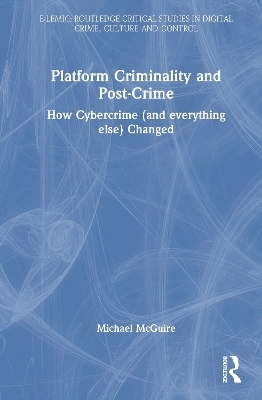
Platform Criminality and Post-Crime
How Cybercrime (and Everything Else) Changed
Seiten
2026
Routledge (Verlag)
978-0-367-47318-1 (ISBN)
Routledge (Verlag)
978-0-367-47318-1 (ISBN)
- Noch nicht erschienen (ca. April 2026)
- Versandkostenfrei
- Auch auf Rechnung
- Artikel merken
Online platforms now constitute so significant a mode of wealth production that many argue a new kind of economic order - ‘platform capitalism’ has emerged. This platform has also provided a new organisational dynamic for crime. This book explores how cybercrime has been decisively reshaped by the emergence of the digital platform.
This book explores how digital crime/cybercrime has been decisively reshaped by the emergence of the digital platform.
Online platforms now constitute so significant a mode of wealth production that many argue a new kind of economic order - ‘platform capitalism’ has emerged. But the platform vehicle has also provided a new organisational dynamic for criminal entrepreneurs, one that significantly adds to other advantages of digital technology exploited by earlier (cyber) criminals such as hyperconnection and capacity augmentation. The book traces the emergence of a shadow digital crime economy which both feeds off and contributes to the way digital societies now produce wealth and explores the role of the platform in underpinning this. It sets out three modalities of platform criminality; the emergence of criminal platforms; the targeting of commercial platforms and the misuse of platform by key institutional agents such as tech companies and the state. By exploring the reciprocal relations between legitimate and illegitimate platforms it suggests how platforms have not only changed the practice and organisation of cybercrime but have been instrumental in unravelling key elements of civil society, not least the legal consensus upon which democracy depends. It argues that ‘post-truth’ and the crisis of objectivity in which platforms are implicated lead directly into a ‘post-crime’ world, one where the boundaries between the legal and the criminal are becoming increasingly blurred.
This book will be of interest to students and scholars of criminology, cybersecurity, technology ethics, and digital economies. It will also appeal to professionals and policymakers engaged with these fields.
This book explores how digital crime/cybercrime has been decisively reshaped by the emergence of the digital platform.
Online platforms now constitute so significant a mode of wealth production that many argue a new kind of economic order - ‘platform capitalism’ has emerged. But the platform vehicle has also provided a new organisational dynamic for criminal entrepreneurs, one that significantly adds to other advantages of digital technology exploited by earlier (cyber) criminals such as hyperconnection and capacity augmentation. The book traces the emergence of a shadow digital crime economy which both feeds off and contributes to the way digital societies now produce wealth and explores the role of the platform in underpinning this. It sets out three modalities of platform criminality; the emergence of criminal platforms; the targeting of commercial platforms and the misuse of platform by key institutional agents such as tech companies and the state. By exploring the reciprocal relations between legitimate and illegitimate platforms it suggests how platforms have not only changed the practice and organisation of cybercrime but have been instrumental in unravelling key elements of civil society, not least the legal consensus upon which democracy depends. It argues that ‘post-truth’ and the crisis of objectivity in which platforms are implicated lead directly into a ‘post-crime’ world, one where the boundaries between the legal and the criminal are becoming increasingly blurred.
This book will be of interest to students and scholars of criminology, cybersecurity, technology ethics, and digital economies. It will also appeal to professionals and policymakers engaged with these fields.
M.R. McGuire has written extensively on issues around technology and technology crime. He has pioneered the development of critical approaches to cybercrime and is the author of Hypercrime: the New Geometry of Harm; Technology, Crime & Justice and is the editor of The Routledge Handbook of Technology, Crime & Justice. He is currently Senior Lecturer in Criminology at the University of Surrey.
1 How Cybercrime Changed: From Tools to Platforms 2 The Digital Crime Economy 3 Platform Criminality 4 First Order Platform Crime: Invisibility and Independence 5 Second Order Platform Crime: Cuckooing and Parasitism, Harvesting and Targeting 6 Platform Criminality and the Platform State: Digital Crime and a New World Order 7 Post-Crime
| Erscheint lt. Verlag | 17.4.2026 |
|---|---|
| Reihe/Serie | E-lemic: Routledge Critical Studies in Digital Crime, Culture and Control |
| Zusatzinfo | 16 Tables, black and white; 2 Line drawings, black and white; 25 Halftones, black and white; 27 Illustrations, black and white |
| Verlagsort | London |
| Sprache | englisch |
| Maße | 156 x 234 mm |
| Themenwelt | Informatik ► Netzwerke ► Sicherheit / Firewall |
| Mathematik / Informatik ► Informatik ► Theorie / Studium | |
| Recht / Steuern ► Strafrecht ► Kriminologie | |
| ISBN-10 | 0-367-47318-6 / 0367473186 |
| ISBN-13 | 978-0-367-47318-1 / 9780367473181 |
| Zustand | Neuware |
| Informationen gemäß Produktsicherheitsverordnung (GPSR) | |
| Haben Sie eine Frage zum Produkt? |
Mehr entdecken
aus dem Bereich


aus dem Bereich
Lehrbuch für Prüfung und Praxis
Buch | Softcover (2023)
Springer Fachmedien Wiesbaden GmbH (Verlag)
CHF 27,95
Management der Informationssicherheit und Vorbereitung auf die …
Buch (2024)
Carl Hanser (Verlag)
CHF 97,95
das große Buch zum Hacking mit Python : Schritt für Schritt …
Buch (2024)
Eulogia Verlag
CHF 27,95


