


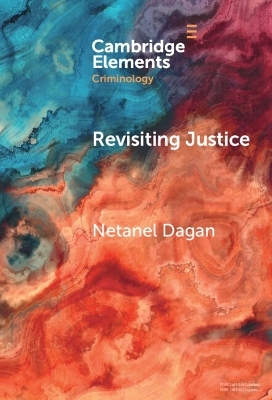
Revisiting Justice
The Moral Meaning of Parole
Seiten
2025
Cambridge University Press (Verlag)
978-1-009-58768-6 (ISBN)
Cambridge University Press (Verlag)
978-1-009-58768-6 (ISBN)
This Element argues that during parole hearings, parole actors conduct complex forms of moral labor. This moral labor goes beyond rehabilitation and risk assessment. Criminologists must engage with the moral meaning of punishment administration, and retributive theorists must aim to better understand the real experiences of punishment.
Expanding the boundaries of the 'moral turn' in criminology to the realm of punishment administration, this Element proposes reconceptualizing parole through a moral lens. Drawing from a mixed-method study of parole hearings for homicide cases in Israel, the author argues that during parole hearings, parole actors (Attorney General representatives, secondary victims, parole applicants, and parole board members) conduct complex forms of moral labor, specifically retributive-oriented. This moral labor goes beyond rehabilitation and risk assessment to 'do late justice.' In doing such moral labor, parole actors negotiate the moral meaning of crime, character, and deserved punishment with the passage of time. In conclusion, as demonstrated by the current study, Criminologists should engage to a greater extent with the moral meaning of punishment administration, and retributive theorists should aim to better understand the lived experiences of punishment.
Expanding the boundaries of the 'moral turn' in criminology to the realm of punishment administration, this Element proposes reconceptualizing parole through a moral lens. Drawing from a mixed-method study of parole hearings for homicide cases in Israel, the author argues that during parole hearings, parole actors (Attorney General representatives, secondary victims, parole applicants, and parole board members) conduct complex forms of moral labor, specifically retributive-oriented. This moral labor goes beyond rehabilitation and risk assessment to 'do late justice.' In doing such moral labor, parole actors negotiate the moral meaning of crime, character, and deserved punishment with the passage of time. In conclusion, as demonstrated by the current study, Criminologists should engage to a greater extent with the moral meaning of punishment administration, and retributive theorists should aim to better understand the lived experiences of punishment.
1. Introduction; 2. Re-theorizing parole; 3. Context, data, and analysis; 4. The moral landscape of parole: quantitative findings; 5. The moral theatre of parole: qualitative findings; 6. Revisiting justice: discussing the moral meaning of parole; 7. Conclusion; References.
| Erscheinungsdatum | 02.12.2025 |
|---|---|
| Reihe/Serie | Elements in Criminology |
| Zusatzinfo | Worked examples or Exercises |
| Verlagsort | Cambridge |
| Sprache | englisch |
| Gewicht | 290 g |
| Themenwelt | Informatik ► Datenbanken ► Data Warehouse / Data Mining |
| Recht / Steuern ► Strafrecht ► Kriminologie | |
| ISBN-10 | 1-009-58768-4 / 1009587684 |
| ISBN-13 | 978-1-009-58768-6 / 9781009587686 |
| Zustand | Neuware |
| Informationen gemäß Produktsicherheitsverordnung (GPSR) | |
| Haben Sie eine Frage zum Produkt? |
Mehr entdecken
aus dem Bereich


aus dem Bereich
Ein verständlicher Einstieg mit Python
Buch | Softcover (2024)
O'Reilly (Verlag)
CHF 41,85
eine Einführung mit Python, Scikit-Learn und TensorFlow
Buch | Softcover (2024)
O'Reilly (Verlag)
CHF 27,85


