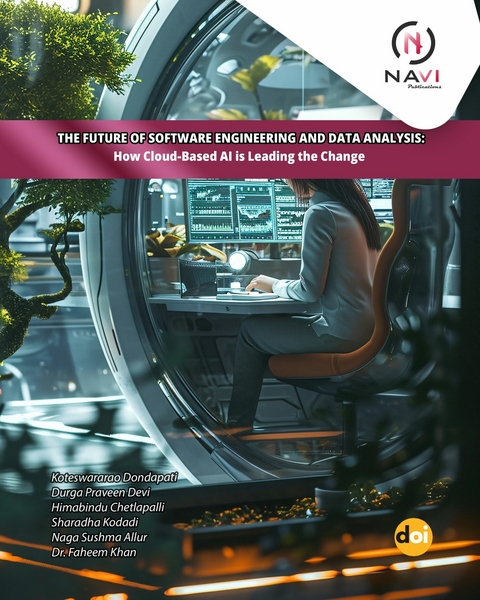
Future of Software Engineering and Data Analysis (eBook)
240 Seiten
Publishdrive (Verlag)
9789395745819 (ISBN)

Advances in cloud-based artificial intelligence (AI) are the main force behind the significant changes occurring in the fields of software engineering and data analysis. Traditional approaches are being redefined by this change, which also makes it possible for businesses to improve their operations by using complex algorithms and enormous processing resources. Software developers and data analysts can work together more successfully across borders because to cloud-based AI's scalability, flexibility, and accessibility. The capacity of cloud-based AI to handle and analyze massive information in real time, resulting in more informed decision-making, is one of its main advantages. Cloud-hosted machine learning models may continually learn from incoming data, increasing their prediction power and speeding up the time it takes to get insight. Teams may test out novel ideas without being constrained by on-premises technology because to this flexibility, which promotes an innovative culture. Additionally, cloud platforms provide a wide range of services and technologies that simplify the development lifecycle, such as integrated development environments (IDEs) and automated data processing pipelines. In addition to increasing efficiency, these resources democratize access to cutting-edge technology, allowing smaller businesses to compete with bigger ones. Workforce dynamics are also changing as a result of cloud-based AI's incorporation into data analysis and software engineering. Professionals may concentrate on higher-level strategic efforts, which foster creativity and problem-solving, while regular work becomes automated. But this change calls for a change in skill sets, highlighting the need of lifelong learning and adjustment to new tools and technology. In conclusion, cloud-based AI is driving a major shift in data analysis and software engineering that is marked by increased productivity, increased teamwork, and technological democratization. The future holds not just better performance but also a redesigned environment where creativity flourishes as long as organizations continue to accept these changes.
Advances in cloud-based artificial intelligence (AI) are the main force behind the significant changes occurring in the fields of software engineering and data analysis. Traditional approaches are being redefined by this change, which also makes it possible for businesses to improve their operations by using complex algorithms and enormous processing resources. Software developers and data analysts can work together more successfully across borders because to cloud-based AI's scalability, flexibility, and accessibility. The capacity of cloud-based AI to handle and analyze massive information in real time, resulting in more informed decision-making, is one of its main advantages. Cloud-hosted machine learning models may continually learn from incoming data, increasing their prediction power and speeding up the time it takes to get insight. Teams may test out novel ideas without being constrained by on-premises technology because to this flexibility, which promotes an innovative culture. Additionally, cloud platforms provide a wide range of services and technologies that simplify the development lifecycle, such as integrated development environments (IDEs) and automated data processing pipelines. In addition to increasing efficiency, these resources democratize access to cutting-edge technology, allowing smaller businesses to compete with bigger ones. Workforce dynamics are also changing as a result of cloud-based AI's incorporation into data analysis and software engineering. Professionals may concentrate on higher-level strategic efforts, which foster creativity and problem-solving, while regular work becomes automated. But this change calls for a change in skill sets, highlighting the need of lifelong learning and adjustment to new tools and technology. In conclusion, cloud-based AI is driving a major shift in data analysis and software engineering that is marked by increased productivity, increased teamwork, and technological democratization. The future holds not just better performance but also a redesigned environment where creativity flourishes as long as organizations continue to accept these changes.
CHAPTER 1
INTRODUCTION TO CLOUD-BASED AI
1.1 OVERVIEW OF CLOUD COMPUTING AND AI
Many different kinds of organizations are seeing their productivity improve as a result of the rapid breakthroughs that are being made in artificial intelligence (AI). The phrase "artificial intelligence" (AI) refers to the ability of machines to replicate human intellect in terms of understanding, learning, and decision-making based on facts. The introduction of cloud computing has made artificial intelligence available to businesses. An excellent parallel would be to rent processing power and data storage space from faraway servers that are located in the cloud system.
The utilization of cloud services provided by giants such as Amazon, Microsoft, or Google may be an alternative for businesses that would otherwise spend a lot on purchasing hardware and software components. The term "AI-as-a-Service" (AIAAS) refers to the products that are included in their category. These artificial intelligence technologies and capabilities are made accessible online for organizations to use in order to save both time and money. They are able to access these services with increased ease thanks to the cloud. In an effort to maintain their competitive edge, an increasing number of artificial intelligence (AI) companies are developing AI solutions that can function independently.
Additionally, many AI companies are combining AI with other techniques and technologies, such as big data analysis. The term "big data" refers to data collections that are so extensive that they exceed the capabilities of traditional data processing methods. With the use of artificial intelligence and big data analytics, businesses may be able to enhance their decision-making and the extraction of insights. Companies in the modern day are showing a great deal of interest in artificial intelligence (AI) that is supported by cloud computing services. It is both easy to use and inexpensive. They may simply pay for the artificial intelligence services that they use by subscribing to them in the cloud, rather than investing a lot on the infrastructure of AI technology.
Artificial intelligence is now available to businesses of all sizes, which democratizes its use. Using the cloud for computing to: Consider the following scenario: you are unable to complete a significant computational job, such as evaluating a mountain of data. On the other hand, your computer will not be able to handle managing all of this on its own. This demand is satisfied by cloud computing. Using cloud computing, users are able to access resources via a shared network of computers, sometimes known as the "cloud."
Fig. 1.1: Cloud Computing
Source: Data collection and processing thought artificial intelligence in cloud computing (2024)
This helps users to avoid being dependent on a single machine. Your assignment will be tackled by these computers working together to break it down into smaller tasks that each computer is capable of completing. Following that, they complete the compilation of all of the data and then provide it to you. In addition to having a big number of these devices, businesses that provide cloud computing also have a significant amount of storage space and internet connections that are ready for use. In order to maintain track of these assets and distribute them to their customers, they make use of sophisticated technology.
The most advantageous aspect is that you just have to pay for the resources that you make use of. Therefore, it is possible to acquire a significant amount of processing power in a short amount of time without having to make an expensive investment in hardware and software. The expanding capabilities of cloud computing are resulting in the discovery of a wide variety of novel applications. In the beginning, its major duty was to distribute work and collect outcomes, which is comparable to the way a grid organizes data information. Although it was sluggish in the past, it is now capable of handling vast amounts of data in a matter of seconds and is the driving force behind a wide variety of high-speed internet services today. Cloud computing, in a nutshell, is the same as having access to a group of powerful computers that can be called upon anytime you want their assistance.
1.1.1 AI in Cloud Computing
Combining AI with cloud computing enables powerful applications and services:
- Analytical Solutions: Artificial intelligence algorithms can sift through massive cloud-based databases in search of useful information. For instance, analytics driven by AI may help companies comprehend client habits, foretell future market tendencies, and enhance internal processes.
- AI algorithms can effectively process and mine massive volumes of data kept in the cloud to find trends, correlations, patterns, and other interesting things. Organizations may increase their efficiency and make choices based on data using this
- Automated Cloud Security: Artificial intelligence may improve cloud security by keeping a constant eye out for unusual or suspicious activity and reacting instantly to any dangers it finds. There will be less opportunity for cyber assaults because of this automation, which boosts general security.
- Saving Money: Artificial intelligence algorithms can optimize cloud resource utilization by altering computing resources dynamically according to demand. By doing so, businesses may save money by not wasting resources on unnecessary providing or underutilization.
- Better Decision-Making: Cloud-based AI systems can sift through massive databases and provide decision-makers with useful information.
- Future Impact: With the ever-increasing size of big data, the importance of organizations integrating AI and cloud computing will only increase. Big data management, user experiences, and security will all see major improvements thanks to AI. These innovations will boost market competitiveness and innovation for businesses of all sizes.
Because of the many benefits it offers, artificial intelligence (AI) in cloud computing is essential to the future success of companies. These benefits include improved decision-making, cost savings, increased security, and more advanced analytics.
Both downtime and ensuring that service is available continuously are important. Due to the efforts that have been made, users may have peace of mind knowing that their data and applications are secure and cona stanof tly accessible.
Fig. 1.2: AI in Cloud Computing
Source: Data collection and processing through artificial intelligence in cloud computing (2024)
1.1.2 Global Cloud Computing Market
The huge digital region that is known as the cloud computing sector is used by businesses all over the globe to host and manage their software and data. In addition to being customizable and economical, it can be used from any place as long as there is an internet connection. This is one of the factors that adds to its appeal. Several causes are driving the ever-expanding cloud computing business, including the following things:
- ne, more and more companies are embracing digital strategies; cloud computing facilitates the migration of company activities online.
- Telecommuting becomes the norm: By facilitating online meetings, collaboration, and safe file storage, cloud services let individuals operate remotely more easily throughout the epidemic.
- Thirdly, it may help you save money. Since you only pay for the resources, you use, using cloud services can be less expensive than purchasing and maintaining physical computer servers.
- It's adaptable: A company may easily increase its cloud computing or storage capacity if its demands change unexpectedly. They may also just reduce the amount if they find they don't require it.
- The cloud is essential for new technology: AI, smart gadgets, and big data analysis all rely on the cloud's abundant computational power and data storage.
- To acquire the greatest features and pricing for various aspects of their operations, some firms utilize more than one cloud provider. This allows them to employ multiple clouds for different requirements. More and more people are opting for this method, which is known as multi-cloud.
- Security is improving: To keep data safe from hackers and comply with stringent requirements, cloud companies are always enhancing their security procedures.
- The demand for speedier data processing is increasing as the number of internet-connected devices (such as smart thermostats or fitness trackers) continues to rise. This is made easier with the aid of edge computing, which is highly integrated with the cloud and processes data closer to its point of generation.
Fig. 1.3: Global cloud computing market
Source: Data collection and processing through artificial intelligence in cloud computing (2024)
1.1.3 Characteristic
1. On a Super Large Scale: Since cloud service providers are responsible for overseeing an enormous number of computers located in data centers all over the globe, the scale on which cloud computing functions is staggering. Similar to massive warehouses, these data centers hold countless servers, each with the capacity to store and analyze an enormous quantity of data. To back up their cloud services, major IT giants like IBM, Amazon, Microsoft, and Google have constructed massive infrastructures. Each of these systems relies on its cloud, which is made up of millions of servers. Hundreds or even thousands of servers may make up a private cloud, which even tiny organizations and...
| Erscheint lt. Verlag | 7.11.2023 |
|---|---|
| Sprache | englisch |
| Themenwelt | Mathematik / Informatik ► Informatik ► Software Entwicklung |
| ISBN-13 | 9789395745819 / 9789395745819 |
| Informationen gemäß Produktsicherheitsverordnung (GPSR) | |
| Haben Sie eine Frage zum Produkt? |
 EPUB (Ohne DRM)
Digital Rights Management: ohne DRM
Dieses eBook enthält kein DRM oder Kopierschutz. Eine Weitergabe an Dritte ist jedoch rechtlich nicht zulässig, weil Sie beim Kauf nur die Rechte an der persönlichen Nutzung erwerben.
Dateiformat: EPUB (Electronic Publication)
EPUB ist ein offener Standard für eBooks und eignet sich besonders zur Darstellung von Belletristik und Sachbüchern. Der Fließtext wird dynamisch an die Display- und Schriftgröße angepasst. Auch für mobile Lesegeräte ist EPUB daher gut geeignet.
Systemvoraussetzungen:
PC/Mac: Mit einem PC oder Mac können Sie dieses eBook lesen. Sie benötigen dafür die kostenlose Software Adobe Digital Editions.
eReader: Dieses eBook kann mit (fast) allen eBook-Readern gelesen werden. Mit dem amazon-Kindle ist es aber nicht kompatibel.
Smartphone/Tablet: Egal ob Apple oder Android, dieses eBook können Sie lesen. Sie benötigen dafür eine kostenlose App.
Geräteliste und zusätzliche Hinweise
Buying eBooks from abroad
For tax law reasons we can sell eBooks just within Germany and Switzerland. Regrettably we cannot fulfill eBook-orders from other countries.
aus dem Bereich