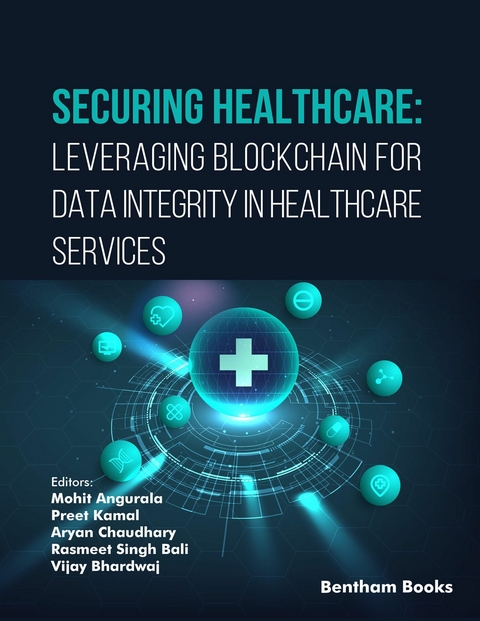
Securing Healthcare: Leveraging Blockchain for Data Integrity in Healthcare Services (eBook)
338 Seiten
Bentham Science Publishers (Verlag)
979-8-89881-063-4 (ISBN)
Securing Healthcare: Leveraging Blockchain for Data Integrity in Healthcare Services comprehensively examines how blockchain technology and smart contracts are reshaping data governance, privacy, and compliance across healthcare systems. Addressing rising concerns around data breaches, regulatory demands, and interoperability challenges, the book explores blockchain's potential to safeguard electronic health records, streamline billing processes, and enhance patient consent mechanisms. Chapters span topics such as medical credential verification, HIPAA compliance, insurance claims, pharmaceutical supply chains, and the role of startups in driving innovation. Emphasis is placed on the integration of smart contracts to automate regulatory compliance and reinforce data integrity within decentralized health ecosystems. Key features: Examines use cases in patient data sharing and consent management Explores smart contract integration for regulatory compliance Analyzes blockchain's role in healthcare billing and credentialing Highlights innovations transforming pharmaceutical transparency Discusses future trends and implementation challenges.
Introduction to Blockchain Technology in Healthcare
Mandeep Kaur Sandhu1, *, Mohit Angurala1
Abstract
Blockchain technology is rapidly gaining traction across various sectors, including healthcare, where it is revolutionizing how patient data is managed and shared among hospitals, diagnostic laboratories, pharmacies, and healthcare providers. By leveraging Blockchain networks, healthcare systems can ensure the secure and transparent exchange of medical data, enhancing performance and eliminating errors that could be potentially harmful. This technology empowers medical institutions by providing deeper insights and improving the analysis of medical records, thereby bolstering overall efficiency and security. In this chapter, we explore the transformative potential of Blockchain in healthcare, illustrating its key capabilities, facilitators, and the unified workflow processes it supports through diagrams. We highlight fourteen significant applications of Blockchain in healthcare, emphasizing its pivotal role in combatting fraud in clinical trials and enhancing data efficiency. The presented work ensures secure storage along with the seamless data verification of patients through distinct clinical stages, which further assures legitimacy and accessibility. It also empowers investigators to examine treatment outcomes in real time for large patient populations, thereby improving treatment precision and innovation in the medical field. We also discuss how Blockchain transparently secures and achieves sensitive genetic evidence, addressing issues of data ownership, privacy, and control. Blockchain ensures data integrity and security through its decentralized data storage model, offering versatility, interconnectivity, accountability, and robust authentication mechanisms for data access. This ensures that health records remain confidential and protected from specific threats, addressing concerns about data manipulation in healthcare settings effectively.
* Corresponding author Mandeep Kaur Sandhu: Department of Computer Science, Guru Nanak Dev University College, Pathankot, Punjab, India; E-mail: gimeti4@gmail.com
INTRODUCTION
Blockchain technology forms an immutable chain of records by recording transactions across numerous computers in a way that prevents retroactive manipulation without affecting the following blocks. Blockchain technology is a decentralized and public digital ledger. It is an anonymous and distributed electronic record. The integrity and credibility of the data obtained are maintained and ensured by this feature due to its guarantee of high levels of responsibility. To reduce the risk of exposing the patient to the wrong medications and fight against counterfeit products, Blockchain provides end-to-end tracking that will track the source of the fake products. This is very significant in the health sector and the manufacture of drugs [1]. This architecture amplifies security against cyber-attacks as compared to the traditional centralized databases in an attempt to safeguard patient records and retain their unalterable medical history in a secure domain. It can be noted that with the help of Blockchain, the problem of data handling and its protection is solved, at the same time making the data of all participants in the network to be open and available. Patient engagement is achieved in a separate process – patients learn who has access to their information and for what purpose and make choices concerning their records themselves [2]. Precision medicine applies Blockchain to analyze large-scale modality of anonymized data for enhancing healthcare services. By combining Blockchain IoT and wearable devices, healthcare practitioners are able to monitor real-time parameters such as glucose levels and blood pressure and consequently manage high-risk patients and provide early responses to emergencies [3].
It makes sense to use blockchain in the protection of personal information and to provide the capabilities of fast sharing and pooling of data in a single secure place because blockchain works on the basis of a P2P network of nodes that stores and exchanges information safely [4]. It enhances teamwork because patients’ information is stored in a central database, which will enable easy identification of practitioners for the study with specific characteristics. Blockchain is a distributed P2P system characterized by blocks, nodes, and miners that ensures the reliability of records of patients’ transactions in distributed systems. This design distributes data across several computers so as to be relatively more immune to manipulation and illegal access than the conventional centralized systems [5]. With the help of different models, such as public, private, hybrid, and consortium Blockchain networks, it enables customers/users to exchange value directly and with or without the help of an intermediary. These networks are made to be applied in specific industries such as logistics, medicine, and finance, where communication is strictly required to be First in, First out, open, and most importantly, secure.
A Blockchain maintains a distributed digital ledger via a chain of blocks. Each block contains:
- Data (the type depends on the blockchain's purpose).
- Hash (a unique digital fingerprint).
- Previous hash (linking the current block to the previous one).
This structure ensures data integrity, as tampering with one block would make all following blocks invalid (Fig. 1).
Fig. (1))The structure of the block.
BLOCKCHAIN VS. TRADITIONAL DATABASES
Blockchain and traditional databases provide different methods for managing data in healthcare systems [6]. Blockchain has decentralized control and uses encryption to protect data immutability and security. It offers great fault tolerance but has limited querying and familiarity. This new technology can integrate with Web 3.0 while improving the privacy and integrity of medical records. Traditional databases, on the other hand, provide well-known, dependable systems with broad SQL querying capabilities and a vast skill pool for management. However, they are centrally regulated and rely on optional encryption. Blockchain offers novel advantages for secure and immutable data management, possibly revolutionizing the handling and protection of healthcare information, while traditional databases benefit from their maturity and compatibility [7].
TYPES OF HEALTHCARE BLOCKCHAINS
In healthcare, blockchain can be implemented in both public and private settings. The choice depends on the specific use case and privacy requirements.
Public Blockchains
These are open, allowing anyone to participate in the network. However, they may not be suitable for storing private health information due to their transparency.
Private Blockchains
These are more appropriate for healthcare applications, as they offer controlled access and better privacy protection for sensitive medical data.
NEED OF BLOCKCHAIN IN HEALTHCARE
Blockchain technology in healthcare addresses several key challenges, including data transparency, traceability, immutability, audit, data provenance, flexible access, trust, privacy, and security, as shown in Fig. (2). By overcoming these obstacles, blockchain can transform healthcare data administration, establishing confidence in health data by enabling the tracking of changes from their source to their present form [8]. The application of blockchain in healthcare is still in its early stages. However, early solutions have shown the potential to reduce healthcare costs, streamline business processes, and improve access to information across disparate and diverse stakeholders working toward a common goal. As the technology matures, it promises to revolutionize how medical records are managed, enhance patient privacy, and streamline complex healthcare processes.
Fig. (2))Various challenges in healthcare addressed by blockchain technology.
REVOLUTIONIZING HEALTHCARE BY BLOCKCHAIN TECHNOLOGY
Blockchain technology has the potential to revolutionize patient-centric healthcare solutions by addressing long-standing challenges in data management, privacy, and patient empowerment. This section explores how blockchain is being applied to personal health records, consent management, and health data monetization. Fig. (3). shows the uses of Blockchain technology in...
| Erscheint lt. Verlag | 23.9.2025 |
|---|---|
| Sprache | englisch |
| Themenwelt | Mathematik / Informatik ► Informatik |
| ISBN-13 | 979-8-89881-063-4 / 9798898810634 |
| Informationen gemäß Produktsicherheitsverordnung (GPSR) | |
| Haben Sie eine Frage zum Produkt? |
 EPUB (Ohne DRM)
Digital Rights Management: ohne DRM
Dieses eBook enthält kein DRM oder Kopierschutz. Eine Weitergabe an Dritte ist jedoch rechtlich nicht zulässig, weil Sie beim Kauf nur die Rechte an der persönlichen Nutzung erwerben.
Dateiformat: EPUB (Electronic Publication)
EPUB ist ein offener Standard für eBooks und eignet sich besonders zur Darstellung von Belletristik und Sachbüchern. Der Fließtext wird dynamisch an die Display- und Schriftgröße angepasst. Auch für mobile Lesegeräte ist EPUB daher gut geeignet.
Systemvoraussetzungen:
PC/Mac: Mit einem PC oder Mac können Sie dieses eBook lesen. Sie benötigen dafür die kostenlose Software Adobe Digital Editions.
eReader: Dieses eBook kann mit (fast) allen eBook-Readern gelesen werden. Mit dem amazon-Kindle ist es aber nicht kompatibel.
Smartphone/Tablet: Egal ob Apple oder Android, dieses eBook können Sie lesen. Sie benötigen dafür eine kostenlose App.
Geräteliste und zusätzliche Hinweise
Buying eBooks from abroad
For tax law reasons we can sell eBooks just within Germany and Switzerland. Regrettably we cannot fulfill eBook-orders from other countries.
aus dem Bereich