


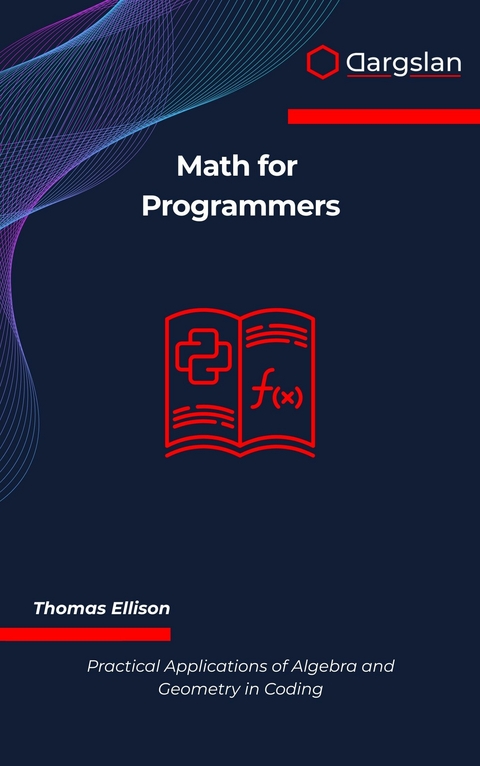
Math for Programmers (eBook)
546 Seiten
Dargslan s.r.o. (Verlag)
978-0-00-106759-2 (ISBN)
Transform Your Programming Skills with Mathematical Mastery - The Complete Guide to Algebra and Geometry for Developers
Are you ready to unlock the hidden power of mathematics in programming? 'Math for Programmers: Practical Applications of Algebra and Geometry in Coding' bridges the crucial gap between mathematical theory and real-world programming applications, empowering developers to write more efficient, innovative, and elegant code.
Why This Book Is Essential for Every Programmer
While many developers can write functional code, those who master the mathematical foundations behind their work gain unprecedented problem-solving capabilities. This comprehensive guide transforms complex mathematical concepts into immediately applicable programming solutions, whether you're building graphics engines, implementing machine learning algorithms, creating game physics, or developing cryptographic systems.
What You'll Master:
Algebraic Foundations: Numbers, variables, functions, and equation systems that form the backbone of algorithmic thinking
Vector and Matrix Operations: Essential skills for 3D graphics, data transformations, and spatial computing
Geometric Programming: Coordinate systems, shapes, polygons, and advanced transformations for visual applications
Trigonometry Applications: Animation, rotation, and spatial analysis techniques
Real-World Implementation: Hands-on projects in computer graphics, game development, and machine learning
Practical Applications Across Programming Domains:
This book goes beyond theory with practical examples, code snippets, and exercises in popular programming languages. You'll discover how mathematical thinking enhances specialized domains like cryptography, where algebraic concepts secure digital communications, and AI development, where linear algebra drives predictive models.
Progressive Learning Structure:
Starting with fundamental algebraic concepts, advancing through geometric principles, and culminating in advanced applications across various programming domains. Each chapter balances mathematical theory with programming practice, featuring examples using libraries like NumPy, Pygame, and Three.js.
Key Benefits for Your Programming Career:
✓ Enhanced problem-solving through structured mathematical approaches ✓ Optimized code through understanding algorithm mathematics ✓ Expanded career opportunities in graphics, gaming, data science, and AI ✓ Deeper comprehension of why programming techniques work
Perfect For:
Self-taught developers strengthening mathematical foundations
Experienced programmers expanding into math-intensive domains
Computer science students seeking practical applications
Game developers and graphics programmers
Data scientists and machine learning engineers
Comprehensive Resources Included:
Complete with mini-projects, capstone challenges, quick reference guides, and recommended tools. Whether you're implementing basic algorithms or building sophisticated 3D applications, this book serves as both learning resource and practical reference.
Transform your approach to programming through mathematical mastery. Discover how algebraic and geometric thinking can unlock new possibilities in your coding journey and elevate your development skills to the next level.
Start your mathematical programming transformation today!
Chapter 1: The Role of Math in Programming
Introduction: The Mathematical Foundation of Code
In the dimly lit server room of a major tech company, thousands of processors hum in perfect synchronization, executing billions of mathematical operations per second. Each line of code running on these machines represents a carefully crafted mathematical expression, transforming abstract numerical concepts into tangible digital experiences. This scene exemplifies a fundamental truth that many programmers overlook: mathematics is not merely a supporting tool in programming—it is the very language upon which all computational logic is built.
The relationship between mathematics and programming runs deeper than most developers realize. Every algorithm we write, every data structure we implement, and every optimization we perform is rooted in mathematical principles that have been refined over centuries. From the Boolean algebra that governs our conditional statements to the geometric transformations that power computer graphics, mathematical concepts form the invisible scaffolding that supports the entire digital world.
Consider the simple act of displaying text on your screen. Behind this seemingly straightforward operation lies a complex web of mathematical calculations: coordinate transformations to position each character, matrix operations to apply font rendering, color space conversions to ensure accurate display, and interpolation algorithms to smooth curves and edges. Each pixel that appears on your monitor is the result of numerous mathematical computations working in perfect harmony.
The mathematical nature of programming becomes even more apparent when we examine the fundamental operations that computers perform. At the most basic level, all computer operations can be reduced to mathematical functions operating on binary representations of data. Addition, subtraction, multiplication, and division form the arithmetic foundation, while logical operations like AND, OR, and NOT provide the Boolean framework for decision-making processes.
Historical Context: Mathematics as the Genesis of Computing
The historical development of computing provides compelling evidence for the inseparable relationship between mathematics and programming. The earliest computing machines were designed specifically to solve mathematical problems, and the programming languages we use today evolved directly from mathematical notation systems.
In the 1940s, Ada Lovelace wrote what is widely considered the first computer program—an algorithm for calculating Bernoulli numbers using Charles Babbage's Analytical Engine. Her work demonstrated that machines could be programmed to perform complex mathematical calculations, laying the groundwork for modern computational thinking. Lovelace's insights went beyond mere calculation; she envisioned machines capable of manipulating symbols and concepts, effectively describing what we now recognize as symbolic mathematics and computer algebra systems.
The development of programming languages further illustrates this mathematical heritage. FORTRAN (Formula Translation) was explicitly designed for scientific and mathematical computing, with syntax that closely mirrored mathematical expressions. ALGOL (Algorithmic Language) introduced structured programming concepts based on formal mathematical logic. Even modern languages like Python and JavaScript retain mathematical operators and functions as core language features, reflecting the enduring importance of mathematical computation in programming.
The emergence of computer science as an academic discipline was heavily influenced by mathematicians who recognized that computation could be studied as a branch of applied mathematics. Pioneers like Alan Turing, John von Neumann, and Donald Knuth approached programming problems through mathematical frameworks, establishing theoretical foundations that continue to guide software development today.
Mathematical Thinking in Problem Solving
Programming requires a specific type of analytical thinking that closely parallels mathematical reasoning. Both disciplines demand the ability to break complex problems into smaller, manageable components, identify patterns and relationships, and construct logical solutions based on established principles.
Mathematical thinking in programming manifests through several key cognitive processes. Abstraction allows programmers to focus on essential features while ignoring irrelevant details, much like how mathematicians work with abstract concepts like functions and sets. Pattern recognition enables developers to identify recurring structures and apply proven solutions, similar to how mathematicians recognize familiar problem types and apply appropriate theorems.
The process of logical deduction is central to both mathematics and programming. When debugging code, programmers trace through logical steps to identify inconsistencies, employing the same systematic reasoning used in mathematical proofs. Similarly, inductive reasoning helps programmers generalize from specific cases to create robust algorithms that handle broad categories of input.
Consider the problem of searching for an element in a sorted array. A mathematician might approach this by recognizing it as an optimization problem: finding the minimum number of comparisons needed to locate a target value. This mathematical perspective leads naturally to the binary search algorithm, which applies the mathematical principle of divide-and-conquer to achieve logarithmic time complexity.
The mathematical concept of proof by contradiction frequently appears in programming logic. When validating input data, programmers often assume invalid conditions and demonstrate why they cannot occur, effectively proving the validity of their assumptions. This approach mirrors mathematical proof techniques and provides a rigorous foundation for software reliability.
Core Mathematical Concepts in Programming
Algebra in Programming
Algebraic thinking permeates every aspect of programming, from variable manipulation to complex algorithm design. The fundamental concept of variables in programming directly corresponds to algebraic variables, representing unknown or changing values that can be manipulated according to defined rules.
Linear equations appear frequently in programming contexts. Consider a simple salary calculation program:
#!/bin/bash
# Linear equation example: total_pay = base_salary + (hours * hourly_rate)
base_salary=50000
hourly_rate=25
hours_worked=10
total_pay=$((base_salary + (hours_worked * hourly_rate)))
echo "Total pay: $total_pay"
This calculation represents a linear equation where the total pay is a linear function of hours worked. The mathematical relationship y = mx + b is clearly evident, with the hourly rate serving as the slope and the base salary as the y-intercept.
Polynomial expressions become crucial when dealing with algorithmic complexity analysis. The time complexity of nested loops often follows polynomial patterns:
#!/bin/bash
# Polynomial complexity example: O(n²) algorithm
n=100
operations=0
for ((i=1; i<=n; i++)); do
for ((j=1; j<=n; j++)); do
operations=$((operations + 1))
done
done
echo "Total operations: $operations"
echo "Expected (n²): $((n * n))"
This example demonstrates how nested iteration creates quadratic relationships between input size and computational work, directly corresponding to polynomial mathematics.
Systems of linear equations frequently arise in optimization problems and constraint satisfaction. Resource allocation algorithms, for instance, must solve systems of equations to determine optimal distributions:
#!/bin/bash
# System of equations example: resource allocation
# x + y = 100 (total resources)
# 2x + 3y = 250 (weighted constraint)
# Solving using substitution method
# x = 100 - y
# 2(100 - y) + 3y = 250
# 200 - 2y + 3y = 250
# y = 50, x = 50
total_resources=100
weighted_constraint=250
y=50
x=$((total_resources - y))
verification=$((2 * x + 3 * y))
echo "Solution: x=$x, y=$y"
echo "Verification: 2x + 3y = $verification (should equal $weighted_constraint)"
Geometry in Programming
Geometric concepts form the mathematical...
| Erscheint lt. Verlag | 30.9.2025 |
|---|---|
| Sprache | englisch |
| Themenwelt | Mathematik / Informatik ► Informatik ► Programmiersprachen / -werkzeuge |
| ISBN-10 | 0-00-106759-1 / 0001067591 |
| ISBN-13 | 978-0-00-106759-2 / 9780001067592 |
| Informationen gemäß Produktsicherheitsverordnung (GPSR) | |
| Haben Sie eine Frage zum Produkt? |
 EPUB (Adobe DRM)
Größe: 1,4 MB
Kopierschutz: Adobe-DRM
Adobe-DRM ist ein Kopierschutz, der das eBook vor Mißbrauch schützen soll. Dabei wird das eBook bereits beim Download auf Ihre persönliche Adobe-ID autorisiert. Lesen können Sie das eBook dann nur auf den Geräten, welche ebenfalls auf Ihre Adobe-ID registriert sind.
Details zum Adobe-DRM
Dateiformat: EPUB (Electronic Publication)
EPUB ist ein offener Standard für eBooks und eignet sich besonders zur Darstellung von Belletristik und Sachbüchern. Der Fließtext wird dynamisch an die Display- und Schriftgröße angepasst. Auch für mobile Lesegeräte ist EPUB daher gut geeignet.
Systemvoraussetzungen:
PC/Mac: Mit einem PC oder Mac können Sie dieses eBook lesen. Sie benötigen eine
eReader: Dieses eBook kann mit (fast) allen eBook-Readern gelesen werden. Mit dem amazon-Kindle ist es aber nicht kompatibel.
Smartphone/Tablet: Egal ob Apple oder Android, dieses eBook können Sie lesen. Sie benötigen eine
Geräteliste und zusätzliche Hinweise
Buying eBooks from abroad
For tax law reasons we can sell eBooks just within Germany and Switzerland. Regrettably we cannot fulfill eBook-orders from other countries.
aus dem Bereich


