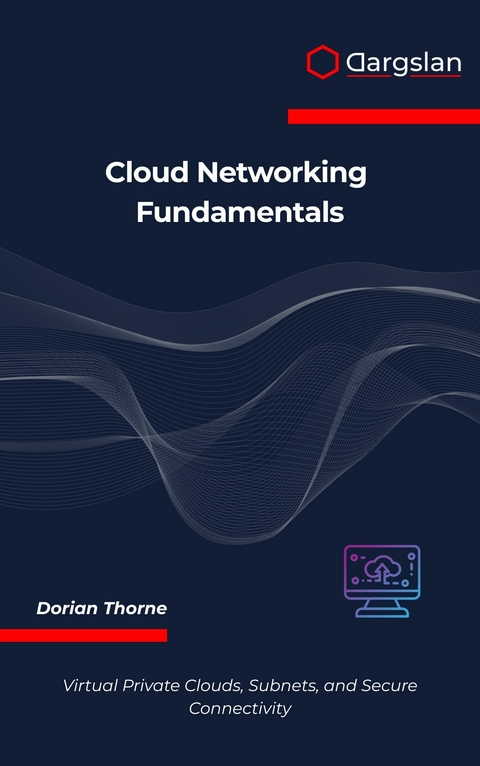
Cloud Networking Fundamentals (eBook)
318 Seiten
Dargslan s.r.o. (Verlag)
978-0-00-106728-8 (ISBN)
Master the Essential Foundation of Modern Cloud Infrastructure
Transform your cloud networking expertise with this comprehensive guide to Virtual Private Clouds, subnets, and secure connectivity across AWS, Azure, and Google Cloud Platform. Whether you're a network engineer transitioning to cloud environments or a cloud architect designing scalable infrastructure, this book provides the practical knowledge you need to build robust, secure cloud networks.
What You'll Learn:
VPC Architecture & Design - Master cloud-native network patterns and best practices across major cloud providers
Advanced Subnetting Strategies - Implement scalable subnet designs that support growth and security requirements
Hybrid Cloud Connectivity - Bridge on-premises networks with cloud environments using VPNs, private links, and peering
Cloud Security Networking - Deploy firewalls, NAT gateways, and private connectivity solutions effectively
Multi-Cloud Networking - Compare and implement VPC services across AWS, Azure, and Google Cloud
High Availability Patterns - Design resilient network architectures with disaster recovery capabilities
Monitoring & Troubleshooting - Diagnose and resolve cloud networking issues with proven methodologies
Practical, Implementation-Focused Content: This book goes beyond theory to provide hands-on guidance you can immediately apply. Each chapter includes real-world examples, architectural diagrams, and implementation strategies. Comprehensive appendices offer security checklists, CIDR notation guides, and step-by-step labs for creating your first VPC across multiple cloud platforms.
Perfect For:
Network engineers moving to cloud environments
Cloud architects designing scalable applications
DevOps professionals integrating networking with deployment pipelines
IT managers making strategic cloud networking decisions
Anyone preparing for cloud networking certifications
Key Features: ✓ Multi-cloud approach covering AWS, Azure, and GCP ✓ Hands-on labs with practical exercises ✓ Security-first networking implementations ✓ Troubleshooting guides and monitoring strategies ✓ Infrastructure-as-code networking examples ✓ Performance optimization techniques
The digital transformation demands cloud networking expertise. Traditional networking concepts evolve dramatically in cloud environments, requiring specialized knowledge of Virtual Private Clouds, cloud-native security models, and hybrid connectivity patterns. This book bridges the gap between traditional networking and cloud-native implementations.
From basic VPC creation to advanced multi-region architectures, you'll develop the skills to design, implement, and manage enterprise-grade cloud networks. Real-world case studies demonstrate how leading organizations architect their cloud networking for scalability, security, and performance.
Bonus Resources Include:
Cloud networking security checklist
CIDR notation cheat sheet
Public vs private IP implementation guide
Comprehensive glossary of cloud networking terms
Troubleshooting scenarios with solutions
Start building your cloud networking expertise today. Master the foundational technologies that power modern cloud infrastructure and position yourself at the forefront of the cloud revolution.
Chapter 2: Understanding Virtual Private Clouds (VPCs)
Introduction to Virtual Private Clouds
In the vast landscape of cloud computing, Virtual Private Clouds (VPCs) represent one of the most fundamental and critical components of modern cloud infrastructure. A Virtual Private Cloud is essentially a logically isolated section of a cloud provider's infrastructure where you can launch cloud resources in a virtual network that you define. This virtual network closely resembles a traditional network that you would operate in your own data center, but with the added benefits of scalability, flexibility, and the robust infrastructure provided by cloud platforms.
The concept of VPCs emerged from the need to provide enterprises and organizations with a secure, isolated environment within the shared cloud infrastructure. Before VPCs, cloud resources were typically deployed in a shared network environment, which raised concerns about security, compliance, and network isolation. VPCs addressed these concerns by creating a virtualized network layer that provides complete control over the networking environment, including selection of IP address ranges, creation of subnets, and configuration of route tables and network gateways.
When working with VPCs in cloud environments, administrators gain unprecedented control over their network topology. This control extends to defining IP address ranges using Classless Inter-Domain Routing (CIDR) blocks, creating multiple subnets for different tiers of applications, configuring security groups and network access control lists (NACLs), and establishing connectivity between the VPC and external networks through various gateway options.
Core Components of VPCs
CIDR Blocks and IP Address Management
The foundation of any VPC begins with the definition of its IP address space through CIDR (Classless Inter-Domain Routing) blocks. When creating a VPC, you must specify a CIDR block that defines the range of IP addresses available for use within that VPC. This CIDR block serves as the primary address space from which all subnets within the VPC will derive their IP ranges.
A typical VPC CIDR block might look like 10.0.0.0/16, which provides 65,536 IP addresses (from 10.0.0.0 to 10.0.255.255). The choice of CIDR block is crucial as it determines the total number of IP addresses available and affects future scalability and connectivity options. Cloud providers typically support CIDR blocks ranging from /16 (65,536 addresses) to /28 (16 addresses), though the exact range may vary depending on the specific cloud platform.
# Example of checking available CIDR blocks in a cloud environment
# This command would list all VPCs and their associated CIDR blocks
aws ec2 describe-vpcs --query 'Vpcs[*].[VpcId,CidrBlock,State]' --output table
# Creating a new VPC with a specific CIDR block
aws ec2 create-vpc --cidr-block 10.0.0.0/16 --tag-specifications 'ResourceType=vpc,Tags=[{Key=Name,Value=MyVPC}]'
Note: When selecting CIDR blocks for your VPC, consider future expansion needs and avoid overlapping with existing networks that you might need to connect to via VPN or direct connect services.
Subnets and Availability Zones
Within a VPC, subnets serve as the building blocks for organizing and segmenting your network infrastructure. Each subnet is associated with a specific Availability Zone (AZ) and must be assigned a CIDR block that is a subset of the VPC's CIDR block. Subnets can be classified as either public or private, depending on their routing configuration and internet accessibility.
Public subnets are configured with route tables that direct traffic to an Internet Gateway, allowing resources within these subnets to communicate directly with the internet. These subnets are typically used for web servers, load balancers, and other internet-facing resources that need direct internet connectivity.
Private subnets, on the other hand, do not have direct routes to the internet through an Internet Gateway. Resources in private subnets can access the internet through Network Address Translation (NAT) gateways or NAT instances, but they cannot receive inbound connections directly from the internet. This configuration is ideal for database servers, application servers, and other backend resources that should not be directly accessible from the internet.
# Creating a public subnet in an existing VPC
aws ec2 create-subnet --vpc-id vpc-12345678 --cidr-block 10.0.1.0/24 --availability-zone us-west-2a
# Creating a private subnet in the same VPC
aws ec2 create-subnet --vpc-id vpc-12345678 --cidr-block 10.0.2.0/24 --availability-zone us-west-2b
# Listing all subnets in a VPC
aws ec2 describe-subnets --filters "Name=vpc-id,Values=vpc-12345678" --query 'Subnets[*].[SubnetId,CidrBlock,AvailabilityZone,State]' --output table
The distribution of subnets across multiple Availability Zones is a critical architectural decision that directly impacts the high availability and fault tolerance of your cloud infrastructure. By deploying resources across multiple AZs, you ensure that your applications can continue operating even if one AZ experiences issues.
VPC Architecture Patterns
Multi-Tier Architecture
One of the most common VPC architecture patterns is the multi-tier design, which separates different layers of an application into distinct subnets with appropriate security controls. This pattern typically includes a web tier (public subnets), application tier (private subnets), and database tier (private subnets with additional restrictions).
In a multi-tier architecture, the web tier hosts load balancers and web servers that need internet access to serve user requests. The application tier contains the business logic servers that process requests from the web tier and communicate with the database tier. The database tier houses the data storage systems and is typically the most restricted, allowing connections only from the application tier.
# Example of setting up a multi-tier VPC architecture
# Step 1: Create the VPC
aws ec2 create-vpc --cidr-block 10.0.0.0/16 --tag-specifications 'ResourceType=vpc,Tags=[{Key=Name,Value=MultiTierVPC}]'
# Step 2: Create subnets for each tier
# Web tier (public subnet)
aws ec2 create-subnet --vpc-id vpc-12345678 --cidr-block 10.0.1.0/24 --availability-zone us-west-2a --tag-specifications 'ResourceType=subnet,Tags=[{Key=Name,Value=WebTier-AZ1}]'
# Application tier (private subnet)
aws ec2 create-subnet --vpc-id vpc-12345678 --cidr-block 10.0.2.0/24 --availability-zone us-west-2a --tag-specifications 'ResourceType=subnet,Tags=[{Key=Name,Value=AppTier-AZ1}]'
# Database tier (private subnet)
aws ec2 create-subnet --vpc-id vpc-12345678 --cidr-block 10.0.3.0/24 --availability-zone us-west-2a --tag-specifications 'ResourceType=subnet,Tags=[{Key=Name,Value=DBTier-AZ1}]'
Note: The multi-tier architecture pattern provides clear separation of concerns, improved security through network segmentation, and better scalability by allowing each tier to scale independently.
Hub and Spoke Architecture
The hub and spoke architecture pattern is particularly useful for organizations with multiple VPCs or hybrid cloud deployments. In this pattern, a central "hub" VPC serves as the connection point for multiple "spoke" VPCs, providing centralized services such as shared internet connectivity, monitoring, and security services.
This architecture pattern offers several advantages, including simplified network management, centralized security controls, reduced complexity in inter-VPC communication, and cost optimization through shared resources. The hub VPC typically contains shared services such as NAT gateways, VPN connections, and security appliances, while spoke VPCs contain application-specific resources.
Routing and Connectivity
Route Tables and Traffic Flow
Route tables are fundamental components that control the flow of network traffic within and outside of your VPC. Each subnet must be associated with a route table, which contains a set of rules (routes) that determine where network traffic is directed. Understanding route tables is crucial for implementing proper network segmentation and ensuring secure communication between different parts of your infrastructure.
Every VPC comes with a default route table that initially contains only a local route, allowing communication between all subnets within the VPC. Additional custom route tables can be created to implement more granular routing policies and security controls.
# Creating a custom route table
aws ec2 create-route-table --vpc-id vpc-12345678 --tag-specifications 'ResourceType=route-table,Tags=[{Key=Name,Value=PublicRouteTable}]'
# Adding a route to the internet gateway
aws ec2 create-route --route-table-id rtb-12345678 --destination-cidr-block 0.0.0.0/0 --gateway-id igw-12345678
# Associating a subnet with the route table
aws ec2 associate-route-table --subnet-id subnet-12345678 --route-table-id rtb-12345678
# Viewing route table details
aws ec2 describe-route-tables --route-table-ids rtb-12345678 --output table
The priority of routes in a route table follows the longest prefix match rule, where more specific routes...
| Erscheint lt. Verlag | 29.9.2025 |
|---|---|
| Sprache | englisch |
| Themenwelt | Mathematik / Informatik ► Informatik ► Netzwerke |
| ISBN-10 | 0-00-106728-1 / 0001067281 |
| ISBN-13 | 978-0-00-106728-8 / 9780001067288 |
| Informationen gemäß Produktsicherheitsverordnung (GPSR) | |
| Haben Sie eine Frage zum Produkt? |
 EPUB (Adobe DRM)
Größe: 1,3 MB
Kopierschutz: Adobe-DRM
Adobe-DRM ist ein Kopierschutz, der das eBook vor Mißbrauch schützen soll. Dabei wird das eBook bereits beim Download auf Ihre persönliche Adobe-ID autorisiert. Lesen können Sie das eBook dann nur auf den Geräten, welche ebenfalls auf Ihre Adobe-ID registriert sind.
Details zum Adobe-DRM
Dateiformat: EPUB (Electronic Publication)
EPUB ist ein offener Standard für eBooks und eignet sich besonders zur Darstellung von Belletristik und Sachbüchern. Der Fließtext wird dynamisch an die Display- und Schriftgröße angepasst. Auch für mobile Lesegeräte ist EPUB daher gut geeignet.
Systemvoraussetzungen:
PC/Mac: Mit einem PC oder Mac können Sie dieses eBook lesen. Sie benötigen eine
eReader: Dieses eBook kann mit (fast) allen eBook-Readern gelesen werden. Mit dem amazon-Kindle ist es aber nicht kompatibel.
Smartphone/Tablet: Egal ob Apple oder Android, dieses eBook können Sie lesen. Sie benötigen eine
Geräteliste und zusätzliche Hinweise
Buying eBooks from abroad
For tax law reasons we can sell eBooks just within Germany and Switzerland. Regrettably we cannot fulfill eBook-orders from other countries.
aus dem Bereich