


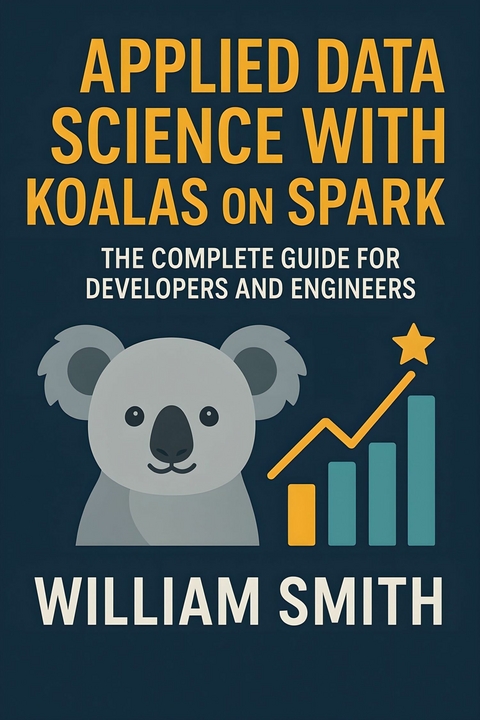
Applied Data Science with Koalas on Spark (eBook)
250 Seiten
HiTeX Press (Verlag)
978-0-00-106642-7 (ISBN)
'Applied Data Science with Koalas on Spark'
Unlock the full potential of distributed data science with 'Applied Data Science with Koalas on Spark,' a comprehensive guide designed for practitioners eager to bridge the world of Python's familiar pandas API and the scalable, efficient power of Apache Spark. This meticulously structured book walks readers through the architectural foundations of Koalas, offering deep insights into its API design, seamless integration pathways with PySpark and pandas, and the translation of Pythonic workflows to a distributed compute environment. With a strong emphasis on environment management, interoperability, and DevOps best practices, it serves as a practical roadmap for anyone looking to effortlessly scale their data workflows.
Moving beyond the basics, the book covers the entire data science lifecycle, from robust data ingestion, schema management, and large-scale data cleansing to sophisticated feature engineering, exploratory data analysis, and visualization in distributed environments. Detailed chapters offer advanced techniques for scalable data wrangling, auditable pipeline construction, efficient aggregations, and cutting-edge feature engineering-including support for NLP, geospatial, and temporal data. Machine learning practitioners will find actionable strategies for integrating Koalas with Spark MLlib, orchestrating distributed model training, and deploying explainable, production-grade analytics at scale, complemented by recommendations for model lifecycle management in both batch and streaming contexts.
Recognizing the challenges of building resilient, secure, and future-ready data platforms, the book addresses performance optimization, resource management, production integration, and the latest advancements in Spark-including adaptive query execution and the evolution from Koalas to Pandas API on Spark. Security, compliance, and data governance considerations are explored in depth, ensuring data scientists and engineers are equipped to meet modern regulatory and enterprise standards. The text concludes with guidance on transitioning to new paradigms like lakehouse architectures and real-time analytics, making it an indispensable resource for future-proofing large-scale data science systems.
Chapter 2
Scalable Data Ingestion and Cleaning with Koalas
Data scientists know that the journey from raw source to refined insight hinges on robust ingestion and cleaning. In this chapter, uncover not just the ’how’, but the ’why’ behind scalable data acquisition and quality engineering. We build methodologies for relentless data volume and complexity-turning tangled, inconsistent, or even corrupted inputs into reliable, analytics-ready assets with the full leverage of Koalas and Spark under the hood.
2.1 Distributed Loading Patterns for Large Datasets
Efficient ingestion of large-scale, heterogeneous datasets into Koalas DataFrames necessitates architectural patterns that exploit distributed computing and parallel I/O capabilities inherent in modern data processing frameworks. Given the varied formats such as CSV, Parquet, and JSON, alongside cloud-native storage solutions, it is imperative to adopt loading strategies that optimize resource utilization, minimize latency, and maintain schema consistency.
A fundamental principle is leveraging parallel reads by partitioning data across compute nodes. For formats like Parquet, which natively support columnar storage and metadata indexing, partitioning aligns naturally with file splits or directory structures following a specific key hierarchy. This physical partitioning enables Koalas to parallelize read operations over multiple files or file chunks, feeding distinct partitions into workers concurrently. Conversely, CSV and JSON formats, traditionally row-oriented and less structured, require explicit data partitioning before ingestion. Employing techniques such as file chunking, where large files are evenly divided into byte-range splits, allows distributed systems to read simultaneously by locating row boundaries accurately. However, this approach necessitates careful handling to avoid splitting records improperly; hence, leveraging libraries that support delimiter-aware chunking is recommended.
Cloud-native object stores such as Amazon S3, Azure Blob Storage, or Google Cloud Storage are commonly used as reservoirs for large datasets, but their eventual consistency models and latency characteristics introduce loading challenges. To counteract this, a best practice involves using manifest files or partitioned folder structures to index data explicitly, enabling Koalas to enumerate files deterministically and parallelize the loading without unnecessary retries or metadata requests. Additionally, leveraging built-in connectors with optimized APIs (like Hadoop’s FileSystem API adapted for cloud storage) can reduce overhead by minimizing round-trip calls and employing bulk metadata retrieval.
Schema inference versus explicitly defining schemas is a decision impacting both load performance and correctness. Schema inference is convenient for datasets with evolving or unknown structures, as it analyzes sample data to build a schema dynamically. However, for large datasets, this process can be a performance bottleneck due to multiple passes over the data or expensive metadata reads. Moreover, inference introduces risks of schema drift or inconsistent typing when formats like JSON vary across records. Therefore, for production-grade pipelines, specifying the schema upfront is advisable. Explicit schemas eliminate ambiguity, enhance load speed by avoiding inference overhead, and facilitate validation steps prior to ingestion. Koalas supports schema definitions using Spark’s StructType and StructField constructs, allowing detailed control over data types and nullability constraints.
Mitigating bottlenecks in distributed data loading also involves balancing the granularity of partitions. Too coarse partitions limit parallelism, underutilizing cluster resources, while excessively fine partitions incur overhead from task scheduling and small file read penalties. An effective strategy is to align partition sizes with an optimal range (commonly 128 MB to 1 GB per partition), tuned according to cluster capacity and workload characteristics. For cloud storage, this often translates to organizing files in directories partitioned by time slices, geographic region, or other high-cardinality keys, which also serve as pruning filters during queries.
Network I/O and shuffle operations commonly emerge as constraints during loading. Minimizing unnecessary data movement by pushing predicate filters down to the storage layer, filtering at load time when supported (e.g., Parquet predicate pushdown), reduces data transferred across the network. When reading from CSV or JSON, selective column reading and early projection reduce memory and CPU demands on workers. Additionally, distributed caching mechanisms can alleviate repeated reads from slow storage or hotspots.
An illustrative example for parallel loading from Parquet files stored on S3 with an explicit schema in Koalas is as follows:
from pyspark.sql.types import StructType, StructField, StringType, IntegerType
schema = StructType([
StructField("user_id", StringType(), True),
StructField("event_type", StringType(), True),
StructField("timestamp", IntegerType(), True)
])
# Read partitioned Parquet dataset from S3 with explicit schema
df = ks.read_parquet(
"s3a://example-bucket/events/",
schema=schema,
...
| Erscheint lt. Verlag | 20.8.2025 |
|---|---|
| Sprache | englisch |
| Themenwelt | Mathematik / Informatik ► Informatik ► Programmiersprachen / -werkzeuge |
| ISBN-10 | 0-00-106642-0 / 0001066420 |
| ISBN-13 | 978-0-00-106642-7 / 9780001066427 |
| Informationen gemäß Produktsicherheitsverordnung (GPSR) | |
| Haben Sie eine Frage zum Produkt? |
 EPUB (Adobe DRM)
Größe: 725 KB
Kopierschutz: Adobe-DRM
Adobe-DRM ist ein Kopierschutz, der das eBook vor Mißbrauch schützen soll. Dabei wird das eBook bereits beim Download auf Ihre persönliche Adobe-ID autorisiert. Lesen können Sie das eBook dann nur auf den Geräten, welche ebenfalls auf Ihre Adobe-ID registriert sind.
Details zum Adobe-DRM
Dateiformat: EPUB (Electronic Publication)
EPUB ist ein offener Standard für eBooks und eignet sich besonders zur Darstellung von Belletristik und Sachbüchern. Der Fließtext wird dynamisch an die Display- und Schriftgröße angepasst. Auch für mobile Lesegeräte ist EPUB daher gut geeignet.
Systemvoraussetzungen:
PC/Mac: Mit einem PC oder Mac können Sie dieses eBook lesen. Sie benötigen eine
eReader: Dieses eBook kann mit (fast) allen eBook-Readern gelesen werden. Mit dem amazon-Kindle ist es aber nicht kompatibel.
Smartphone/Tablet: Egal ob Apple oder Android, dieses eBook können Sie lesen. Sie benötigen eine
Geräteliste und zusätzliche Hinweise
Buying eBooks from abroad
For tax law reasons we can sell eBooks just within Germany and Switzerland. Regrettably we cannot fulfill eBook-orders from other countries.
aus dem Bereich


