


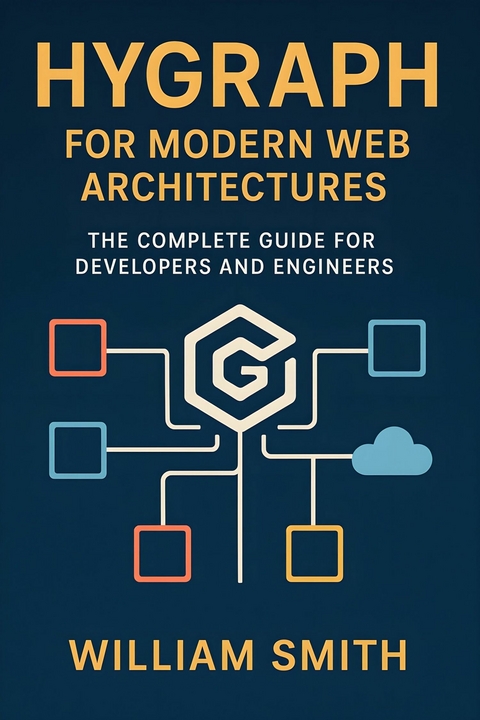
Hygraph for Modern Web Architectures (eBook)
250 Seiten
HiTeX Press (Verlag)
978-0-00-106639-7 (ISBN)
'Hygraph for Modern Web Architectures'
'Hygraph for Modern Web Architectures' is an authoritative guide for architects, developers, and digital leaders seeking to harness the full potential of headless content management in today's fast-evolving digital landscape. This comprehensive book offers an in-depth exploration of Hygraph's robust, API-first platform and demonstrates how GraphQL at its core enables advanced querying, seamless integration, and elegant delivery of content across web, mobile, IoT, and beyond. Readers are guided through foundational concepts, practical strategies for multi-channel architectures, and effective approaches to content federation, positioning Hygraph as an essential pillar in scalable and future-ready web solutions.
Spanning composable content modeling, advanced API integrations, and frontend delivery patterns, the book dissects technical patterns and best practices for architecting dynamic, component-driven experiences. Experts and practitioners will find deep dives into schema flexibility, localization, versioning, and governance-empowering teams to orchestrate scalable multilingual and omnichannel strategies. The coverage extends to automation through webhooks and cloud-native integrations, asset pipelines, editorial workflows, and the seamless blending of Hygraph into modern SaaS and e-commerce ecosystems, all while maintaining rigorous standards for security, compliance, and content validation.
Rounding out its scope, the book addresses critical considerations for performance, scalability, DevOps automation, observability, and business intelligence. With chapters devoted to proactive monitoring, disaster recovery, and leveraging machine learning for personalization, it firmly situates Hygraph amid the latest trends in headless and API-first architectures. Whether you are building from scratch or modernizing complex digital platforms, 'Hygraph for Modern Web Architectures' serves as your comprehensive blueprint for mastering the next generation of content-driven applications.
Chapter 2
Composable Content Modeling at Scale
In this chapter, discover the advanced techniques and design strategies that transform content modeling from a simple schema exercise into a strategic architecture for global digital enterprises. Unravel how scalability, adaptability, and reusability define the new frontier of content management, where every block and relation is engineered for change-and where Hygraph enables composable systems to thrive under complex, real-world demands.
2.1 Schema Design Patterns
The architecture of data schemas fundamentally influences the agility, performance, and maintainability of any content management system, with Hygraph presenting unique opportunities and challenges due to its headless and graph-based nature. Foundational schema design begins with the Entity-Relationship (ER) model, which introduces entities as abstractions of real-world objects and relationships as associations between them. In Hygraph, entities translate to content models, and the application of ER principles ensures clarity in data representation and semantic integrity.
At the basic level, a schema often employs discrete, flat entities interconnected through relations or references. This approach maximizes modularity and is conducive to clear access controls, as each content type is independently managed. However, such decomposition can hinder performance when frequent joins or multiple API calls are required for composite views. To balance this, one may design denormalized schemas that embed related data as nested fields or JSON structures, reducing query complexity at the expense of potential data duplication and update anomalies.
More advanced schema patterns involve composite and nested structures. Composite patterns leverage Hygraph’s modular content fields, enabling one content model to encapsulate reusable nested objects. For instance, a Product content model might embed a Specification composite, containing key-value attributes, facilitating schema reuse across various product lines. This approach enhances extensibility by isolating recurring data constructs and supports cleaner, semantic queries. Nonetheless, excessive nesting can complicate validation rules and impede schema evolution, requiring careful schema governance and versioning policies.
Nested structures, particularly recursive references and self-relations, address hierarchical data needs such as category trees or organizational charts. Employing a parent-child reference pattern, Hygraph schemas can represent arbitrarily deep hierarchies. While powerful, deep nesting can exponentially increase query complexity and rendering latency. Techniques such as connection depth limits, pagination of nested results, and caching strategies must be incorporated to maintain optimal performance.
Maintainability hinges on a schema’s logical organization and adherence to consistent naming conventions, field constraints, and documentation. Hygraph schemas benefit substantially from templated fields and shared content blocks that prevent redundant schema definitions and promote consistency. Furthermore, leveraging interfaces and unions in GraphQL schemas modeled from Hygraph promotes polymorphism, enabling flexible yet type-safe queries over heterogeneous entities.
Extensibility is tightly coupled with the schema’s composability. A modular schema facilitates incremental adaptation to evolving business requirements. For instance, introducing a new content type that inherits common fields from a base type minimizes redundancy and reduces integration risk. Additionally, aggressive use of metadata fields and localization support prepares the system for multilingual and multi-tenant scalability, which are frequent real-world demands.
Performance trade-offs manifest when deciding between normalization versus denormalization, nesting versus flat referencing, and static type definitions versus dynamic field configurations. Normalized schemas, while elegant, cause costly joins and potentially increased response times on complex queries. Conversely, denormalized schemas can speed retrieval but introduce complexity in data synchronization workflows. Hygraph’s GraphQL API can mitigate some query burdens by selecting precise fields, but overall design must anticipate workload patterns and query-frequency hotspots.
Several anti-patterns impede effective Hygraph schema design:
- Overloading single content models with heterogeneous data.
- Excessive use of optional fields that reduce schema predictability.
- Neglect of clear delineation between content and configuration data.
Such patterns increase cognitive load and complicate client-side logic. Another frequent pitfall is heavy reliance on cascading references without considering query depth limits, leading to performance bottlenecks.
Emerging best practices advocate constructing schemas as modular, flexible building blocks using a layered approach. Base content models define essential shared properties; composite components encapsulate reusable constructs; extension layers introduce business-specific attributes. This strategy aligns with Domain-Driven Design (DDD) principles, ensuring schemas evolve coherently alongside domain complexity. Versioning schemas via branching or environment separation allows staged rollout and rollback of changes, vital for continuous integration pipelines.
Reusability is further enhanced by establishing a well-curated library of content modules and composites, combined with automated validation and schema linting tools to enforce quality standards. Combining Hygraph’s native localization and scheduling capabilities with extension fields anticipates globalized content workflows and temporal content variations without proliferating new schema types.
Effective schema design in Hygraph marries foundational ER principles with advanced composite and nested structures, tempered through a rigorous evaluation of maintainability, extensibility, and performance considerations. Practical templates and avoidance of anti-patterns foster robust, agile schemas capable of adapting to rapid business evolution while underpinning performant, scalable content delivery architectures.
2.2 Polymorphism and Content Relationships
Polymorphism in data modeling enables the representation of entities that can take multiple forms while sharing a common interface or structural characteristics. This capability is fundamental when designing flexible and extensible systems, especially those requiring heterogeneous collections or complex content assemblies. Two predominant techniques to model polymorphic data structures are the use of union types and interface types, each catering to specific design demands. In conjunction, these techniques facilitate the construction of deep relational fields, effectively managing interconnected content with complex parent-child hierarchies and multi-type aggregations.
Union Types for Flexible Data Representation
Union types allow a single data field to hold values from a fixed set of distinct types, essentially representing a tagged alternative among them. This is particularly useful when a field or property may semantically correspond to one of several disjoint schemas. Consider an entity ContentItem that may represent either an Article, Video, or Image. A union type encapsulating these variants ensures type safety while preserving runtime flexibility.
Formally, a union type
expresses that a variable of type U adheres to exactly one of the constituent types. Accessors and processors typically employ pattern matching or type guards to discriminate the runtime variant. Union types provide precision, constraining polymorphic fields to known alternatives, which benefits validation, serialization, and querying processes.
interface Article {
type: ’article’;
title: string;
...
| Erscheint lt. Verlag | 26.9.2025 |
|---|---|
| Sprache | englisch |
| Themenwelt | Mathematik / Informatik ► Informatik ► Programmiersprachen / -werkzeuge |
| ISBN-10 | 0-00-106639-0 / 0001066390 |
| ISBN-13 | 978-0-00-106639-7 / 9780001066397 |
| Informationen gemäß Produktsicherheitsverordnung (GPSR) | |
| Haben Sie eine Frage zum Produkt? |
 EPUB (Adobe DRM)
Größe: 770 KB
Kopierschutz: Adobe-DRM
Adobe-DRM ist ein Kopierschutz, der das eBook vor Mißbrauch schützen soll. Dabei wird das eBook bereits beim Download auf Ihre persönliche Adobe-ID autorisiert. Lesen können Sie das eBook dann nur auf den Geräten, welche ebenfalls auf Ihre Adobe-ID registriert sind.
Details zum Adobe-DRM
Dateiformat: EPUB (Electronic Publication)
EPUB ist ein offener Standard für eBooks und eignet sich besonders zur Darstellung von Belletristik und Sachbüchern. Der Fließtext wird dynamisch an die Display- und Schriftgröße angepasst. Auch für mobile Lesegeräte ist EPUB daher gut geeignet.
Systemvoraussetzungen:
PC/Mac: Mit einem PC oder Mac können Sie dieses eBook lesen. Sie benötigen eine
eReader: Dieses eBook kann mit (fast) allen eBook-Readern gelesen werden. Mit dem amazon-Kindle ist es aber nicht kompatibel.
Smartphone/Tablet: Egal ob Apple oder Android, dieses eBook können Sie lesen. Sie benötigen eine
Geräteliste und zusätzliche Hinweise
Buying eBooks from abroad
For tax law reasons we can sell eBooks just within Germany and Switzerland. Regrettably we cannot fulfill eBook-orders from other countries.
aus dem Bereich


