


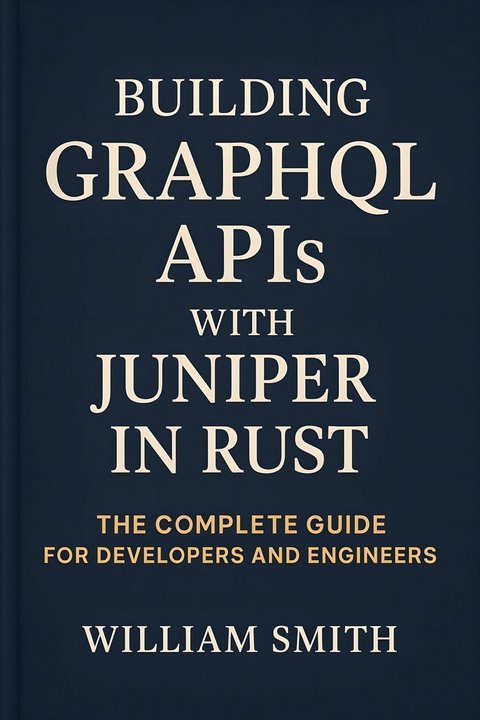
Building GraphQL APIs with Juniper in Rust (eBook)
250 Seiten
HiTeX Press (Verlag)
978-0-00-106622-9 (ISBN)
'Building GraphQL APIs with Juniper in Rust'
In 'Building GraphQL APIs with Juniper in Rust,' readers are expertly guided through the intersection of two acclaimed technologies: the Rust programming language and GraphQL API design. The book opens with a comprehensive exploration of both platforms, outlining GraphQL's architectural strengths and contrasting it against traditional REST and RPC paradigms. It then delves into Rust's compelling advantages for web backends, including its safety guarantees and cutting-edge concurrency model, before introducing the Juniper framework as a robust choice for scalable API delivery.
The heart of the book meticulously details every stage of building, refining, and securing a GraphQL API in Rust. Readers will discover practical strategies for schema design, resolver implementation, and seamless connection to diverse data sources-ranging from SQL and NoSQL databases to microservices and external APIs. Advanced topics such as schema evolution, batching, caching, fine-grained access control, and performance optimization are demystified through Rust-centric examples and patterns. Throughout, special attention is given to critical concerns like input validation, authentication, real-time data, and high-availability architectures, ensuring both developer productivity and production-grade stability.
To round out its comprehensive coverage, the book navigates quality assurance, testing methodologies, operational best practices, and the latest advancements in GraphQL. Readers are equipped with guidance on containerization, continuous delivery, observability, and strategies for incident recovery. The final chapters distill industry best practices and common anti-patterns, explore the trajectory of GraphQL's future, and foster participation in the active Rust and Juniper open-source communities. Whether building new APIs or modernizing legacy systems, this book is an indispensable resource for engineers seeking robust, high-performance, and maintainable GraphQL services in Rust.
Chapter 2
Schema Design and Management
At the heart of any robust GraphQL service lies its schema-the contract that steers data access, evolution, and expressiveness. This chapter uncovers the art and science of crafting, modularizing, and evolving GraphQL schemas in Rust using Juniper. Through advanced techniques and practical strategies, you’ll learn to wield the full power of static typing, custom logic, and schema modularity, ensuring every API maintains both flexibility and integrity as business logic evolves.
2.1 Defining GraphQL Schemas in Juniper
Juniper, a Rust-based GraphQL server library, leverages Rust’s strong typing system and trait-based abstractions to encode schema definitions that reflect intricate domain logic with high fidelity. Central to Juniper’s design philosophy is the seamless integration of Rust’s type safety and expressive macro system, which collectively empower developers to compose modular, reliable GraphQL schemas.
GraphQL schemas in Juniper are primarily expressed through Rust structs and enums that represent GraphQL objects, scalars, enums, interfaces, and unions. These types are annotated and augmented using procedural macros, which auto-generate the verbose boilerplate required to construct the GraphQL type system and field resolvers. The core benefit of this approach is direct and idiomatic Rust code articulation of domain models, enabling straightforward composition and reuse.
To define an object type in Juniper, the developer typically applies the #[derive(GraphQLObject)] macro or #[juniper::object] attribute macros on Rust structs or impl blocks. The former approach is more declarative and suited for data containers, while the latter provides the flexibility to implement dynamic resolution logic through method calls.
Consider an example defining a user object with basic fields and nested relationships:
#[graphql(description = "A user in the system")]
struct User {
id: i32,
name: String,
email: String,
}
struct QueryRoot;
#[juniper::object]
impl QueryRoot {
fn user(&self, id: i32) -> Option<User> {
// Domain-specific logic to fetch a user by id
fetch_user_by_id(id)
}
fn all_users(&self) -> Vec<User> {
fetch_all_users()
}
}
Here, the #[derive(GraphQLObject)] macro generates resolvers for each struct field by simply returning the corresponding Rust fields, capitalizing on Rust’s native field access. The #[juniper::object] macro on QueryRoot provides an idiomatic method to define queryable fields backed by arbitrary business logic expressed in Rust.
The power of Juniper schema composition becomes apparent when modeling more complex domain logic that involves interfaces and unions. Juniper requires explicit Rust trait implementations to represent GraphQL interfaces, effectively allowing polymorphic query responses typically essential in realistic API designs.
For instance, defining a GraphQL interface requires implementing the GraphQLInterface trait for the Rust type:
trait Character {
fn id(&self) -> i32;
...
| Erscheint lt. Verlag | 26.9.2025 |
|---|---|
| Sprache | englisch |
| Themenwelt | Mathematik / Informatik ► Informatik ► Programmiersprachen / -werkzeuge |
| ISBN-10 | 0-00-106622-6 / 0001066226 |
| ISBN-13 | 978-0-00-106622-9 / 9780001066229 |
| Informationen gemäß Produktsicherheitsverordnung (GPSR) | |
| Haben Sie eine Frage zum Produkt? |
 EPUB (Adobe DRM)
Größe: 904 KB
Kopierschutz: Adobe-DRM
Adobe-DRM ist ein Kopierschutz, der das eBook vor Mißbrauch schützen soll. Dabei wird das eBook bereits beim Download auf Ihre persönliche Adobe-ID autorisiert. Lesen können Sie das eBook dann nur auf den Geräten, welche ebenfalls auf Ihre Adobe-ID registriert sind.
Details zum Adobe-DRM
Dateiformat: EPUB (Electronic Publication)
EPUB ist ein offener Standard für eBooks und eignet sich besonders zur Darstellung von Belletristik und Sachbüchern. Der Fließtext wird dynamisch an die Display- und Schriftgröße angepasst. Auch für mobile Lesegeräte ist EPUB daher gut geeignet.
Systemvoraussetzungen:
PC/Mac: Mit einem PC oder Mac können Sie dieses eBook lesen. Sie benötigen eine
eReader: Dieses eBook kann mit (fast) allen eBook-Readern gelesen werden. Mit dem amazon-Kindle ist es aber nicht kompatibel.
Smartphone/Tablet: Egal ob Apple oder Android, dieses eBook können Sie lesen. Sie benötigen eine
Geräteliste und zusätzliche Hinweise
Buying eBooks from abroad
For tax law reasons we can sell eBooks just within Germany and Switzerland. Regrettably we cannot fulfill eBook-orders from other countries.
aus dem Bereich


