


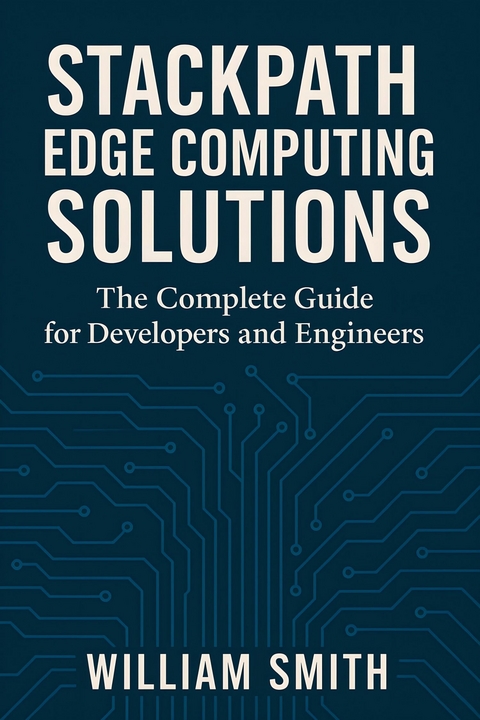
StackPath Edge Computing Solutions (eBook)
250 Seiten
HiTeX Press (Verlag)
978-0-00-106614-4 (ISBN)
'StackPath Edge Computing Solutions'
'StackPath Edge Computing Solutions' offers a comprehensive and authoritative exploration of the rapidly evolving landscape of edge computing, positioning StackPath's robust platform at the heart of next-generation digital transformation. Starting with foundational concepts, industry drivers, and the nuanced spectrum between cloud and edge, this book provides invaluable insights into the motivations, architectures, and market forces shaping the edge computing ecosystem. Readers gain a nuanced understanding not only of the technical imperatives-such as latency, bandwidth, data localization, and regulatory impacts-but also StackPath's pivotal role and strategic partnerships in the global edge market.
Delving deeply into StackPath's core platform, the book uncovers the intricacies of physical and virtual edge infrastructure, global connectivity, distributed services, and developer enablement. It presents practical guidance on deploying and managing diverse edge workloads, from containerized applications to serverless functions, all underpinned by robust resource isolation, lifecycle management, and advanced API-driven automation. The text further addresses the unique challenges and best practices in securing edge environments, ensuring compliance, and protecting sensitive data through cutting-edge techniques such as zero trust architecture, DDoS mitigation, and incident response.
Beyond fundamental architecture and operations, the book explores advanced topics essential for organizations adopting a leading-edge strategy. These include media acceleration, real-time content delivery, edge networking, and DevOps automation tailored for distributed systems. Readers will also discover future-focused innovations, such as AI/ML deployment at the edge, federated and privacy-preserving computation, multi-cloud architectures, and the impact of 5G and blockchain. With a strong emphasis on intelligent observability, governance, and community-driven standards, 'StackPath Edge Computing Solutions' is an essential guide for technical leaders, architects, and developers seeking to harness the full potential of edge computing for resilient, high-performance applications.
Chapter 2
StackPath Platform: Architecture and Core Components
Beneath the surface of seamless edge delivery lies a complex latticework of infrastructure, orchestration, and software innovation. This chapter dissects the StackPath platform from the ground up, unveiling how hardware, virtualization, global networking, and developer tools converge to power next-generation edge computing. Get ready to decode the building blocks-and strategic design principles-that transform vision into a resilient, programmable edge fabric.
2.1 Physical and Virtual Edge Infrastructure
StackPath’s edge computing architecture is fundamentally anchored on the strategic deployment of physical Points of Presence (POPs) dispersed globally to maximize throughput, minimize latency, and enhance resilience. Each physical POP represents a critical node in the network, hosting bare metal infrastructure that serves as the foundational layer for subsequent virtualization and container orchestration. These POPs are not uniform boxes but are characterized by intentional hardware heterogeneity designed to optimize workload-specific performance within the constraints of regional demand and environmental factors.
The physical layer primarily employs high-density rack-mounted servers equipped with multi-core CPUs, expanded DDR4/DDR5 memory modules, and fast NVMe storage arrays. Hardware selection is governed by the dual imperatives of workload diversity and operational reliability. For instance, compute-intensive tasks benefit from CPU architectures supporting advanced vector extensions and extensive cache hierarchies, while storage-heavy applications leverage persistent memory and SSD tiers optimized for low-latency I/O. The edge sites themselves differ in scale based on anticipated traffic volumes; metropolitan POPs often deploy larger server farms to accommodate enterprise and high-concurrency consumer applications, whereas rural or less densely trafficked locations maintain minimalistic configurations that prioritize energy efficiency.
StackPath employs a bare metal deployment strategy as the backbone of its physical infrastructure to reduce virtualization overhead and deliver near-native performance, critical for latency-sensitive applications such as real-time video processing and financial transaction acceleration. Bare metal deployments eliminate intermediary hypervisor layers, allowing direct utilization of hardware features such as SR-IOV for high-throughput networking and kernel bypass techniques (e.g., DPDK) for packet processing acceleration. These capabilities are indispensable in competitive edge computing scenarios where every microsecond of performance gain translates into substantial user experience improvements.
Resilience at the physical edge is achieved through geographic diversity, hardware redundancy, and autonomous failover protocols. Each POP incorporates multiple power feeds, redundant network paths, and server clusters capable of redistributing workloads in the event of hardware failure. Environmental controls, such as localized cooling and surge protection suited to regional conditions, are calibrated to ensure uptime levels exceeding 99.999%. Firmware-level monitoring coupled with predictive analytics mitigates potential disruptions by enabling proactive hardware replacement or load migration.
Overlaying this physical substrate is a sophisticated virtualization framework that integrates virtual machines (VMs) and container technologies, allowing dynamic resource allocation and workload isolation at varying levels of granularity. VMs offer robust security boundaries essential for multi-tenant environments, permitting operators to provision dedicated resources with strict access controls and customizable hypervisor policies. Conversely, containers enable rapid deployment and scalability for microservice architectures by encapsulating applications with their dependencies while sharing the underlying OS kernel. StackPath’s edge orchestration platform efficiently manages this hybrid virtualization landscape, dynamically scheduling containers or VMs based on workload profiles and resource availability to optimize performance and cost.
The choice between physical and virtualized resources at edge sites necessitates balancing performance, flexibility, and operational complexity. In high-demand POPs, physical servers running bare metal workloads coexist with virtualized instances to maximize hardware utilization without compromising service-level objectives. For latency-critical applications, bare metal often prevails, while broader application ecosystems with fluctuating demand patterns capitalize on the elasticity and quick provisioning offered by containers. Edge nodes with limited hardware resources lean more heavily on lightweight virtual environments to maintain multi-tenancy without excessive overhead.
Hardware diversity extends into the virtualized domain through heterogeneity in underlying hypervisors and container runtimes. StackPath supports mainstream hypervisors such as KVM and VMware ESXi, ensuring compatibility with a wide range of guest OSes and security profiles. On the container side, orchestration technologies like Kubernetes and Mesos are leveraged to deliver automated scaling, service discovery, and lifecycle management. This layered virtualization architecture promotes a decoupled model where physical upgrades or hardware swapping at POPs can occur seamlessly with minimal disruption to tenant workloads.
An illustrative trade-off arises in edge site design when considering resource placement between centralized data centers and distributed POPs. While central facilities can aggregate extensive hardware resources, their relative distance increases network latency. Deploying edge infrastructure physically closer to end users mitigates this but introduces constraints on hardware footprint and power. Virtualization mitigates physical limitations by multiplexing smaller resource pools while maintaining operational flexibility.
Ultimately, StackPath’s integration of physical and virtual edge infrastructure embodies a hybrid principle: leveraging bare metal efficiency and hardware specialization alongside the agility and isolation of virtualization and containerization. This synergy enables a scalable, resilient edge computing fabric that dynamically adjusts to heterogeneous application demands and evolving traffic patterns while maintaining stringent performance and security postures.
kind: Deployment
metadata:
name: edge-video-processor
spec:
replicas: 3
selector:
matchLabels:
app: video-processor
template:
metadata:
labels:
app: video-processor
...
| Erscheint lt. Verlag | 26.9.2025 |
|---|---|
| Sprache | englisch |
| Themenwelt | Mathematik / Informatik ► Informatik ► Programmiersprachen / -werkzeuge |
| ISBN-10 | 0-00-106614-5 / 0001066145 |
| ISBN-13 | 978-0-00-106614-4 / 9780001066144 |
| Informationen gemäß Produktsicherheitsverordnung (GPSR) | |
| Haben Sie eine Frage zum Produkt? |
 EPUB (Adobe DRM)
Größe: 784 KB
Kopierschutz: Adobe-DRM
Adobe-DRM ist ein Kopierschutz, der das eBook vor Mißbrauch schützen soll. Dabei wird das eBook bereits beim Download auf Ihre persönliche Adobe-ID autorisiert. Lesen können Sie das eBook dann nur auf den Geräten, welche ebenfalls auf Ihre Adobe-ID registriert sind.
Details zum Adobe-DRM
Dateiformat: EPUB (Electronic Publication)
EPUB ist ein offener Standard für eBooks und eignet sich besonders zur Darstellung von Belletristik und Sachbüchern. Der Fließtext wird dynamisch an die Display- und Schriftgröße angepasst. Auch für mobile Lesegeräte ist EPUB daher gut geeignet.
Systemvoraussetzungen:
PC/Mac: Mit einem PC oder Mac können Sie dieses eBook lesen. Sie benötigen eine
eReader: Dieses eBook kann mit (fast) allen eBook-Readern gelesen werden. Mit dem amazon-Kindle ist es aber nicht kompatibel.
Smartphone/Tablet: Egal ob Apple oder Android, dieses eBook können Sie lesen. Sie benötigen eine
Geräteliste und zusätzliche Hinweise
Buying eBooks from abroad
For tax law reasons we can sell eBooks just within Germany and Switzerland. Regrettably we cannot fulfill eBook-orders from other countries.
aus dem Bereich


