


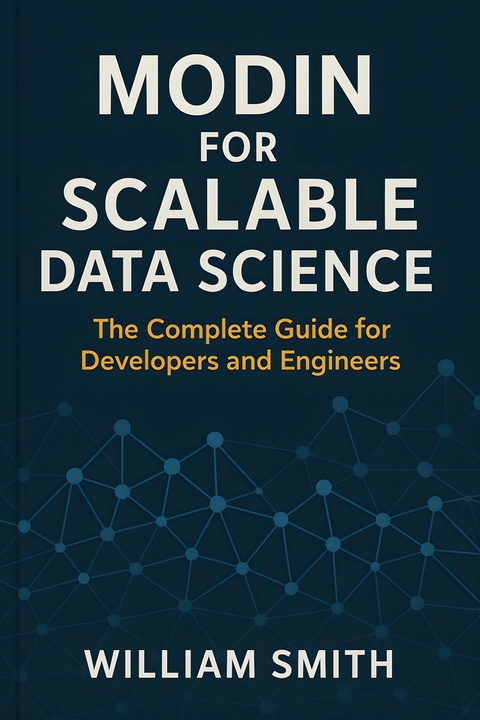
Modin for Scalable Data Science (eBook)
250 Seiten
HiTeX Press (Verlag)
978-0-00-106546-8 (ISBN)
'Modin for Scalable Data Science'
In the era of massive datasets and ever-expanding analytics pipelines, 'Modin for Scalable Data Science' is a comprehensive guide for data engineers and scientists determined to break through the limits of single-node data workflows. The book opens by analyzing the bottlenecks inherent in contemporary data science, from memory and CPU constraints in pandas to the challenges of distributed data movement. It offers a thorough survey of modern distributed frameworks such as Spark and Dask, before introducing Modin-a breakthrough library that bridges the ease of pandas with the power of distributed computing. Real-world use cases, including large-scale ETL, feature engineering, and interactive analytics, highlight the practical motivations behind adopting scalable data science solutions.
Diving deep into Modin's architecture, the book explores its pluggable execution backends, innovative task graph design, and robust integration with crucial data science and machine learning ecosystems like NumPy, scikit-learn, and RAPIDS. Readers learn best practices for deploying and tuning Modin in diverse environments: from laptops to cloud clusters, containerized solutions via Kubernetes, and advanced resource management in production-grade settings. Thorough attention is paid to security, data locality, and the nuances of environment-specific configuration, ensuring readers gain both strategic understanding and actionable know-how for leveraging Modin at scale.
As a hands-on reference, the book meticulously details Modin's compatibility with pandas, approaches to debugging distributed DataFrames, and advanced profiling and optimization techniques. It empowers practitioners to automate machine learning pipelines, handle real-time inference, and scale MLOps with tools such as Ray Tune and Kubeflow. For those looking to extend or contribute to Modin, the closing chapters provide blueprints for plugin development, internal API mastery, and effective engagement with the open source community. This guide is essential for anyone seeking to harness the full potential of distributed data science without sacrificing the simplicity of familiar Python workflows.
Chapter 2
Modin: Core Architecture and Ecosystem Integration
At the heart of Modin’s promise is a reimagined data processing engine that combines pandas usability with distributed power. This chapter peels back the layers of Modin’s architecture, revealing the innovations that enable seamless scaling, performance, and extensibility. Readers will trace how Modin orchestrates computations, interfaces with diverse backends, and integrates with the broader Python data science ecosystem—demystifying the mechanics that empower effortless scaling across clusters.
2.1 Overview of Modin’s System Architecture
Modin’s architecture embodies a thoughtfully engineered multilayered design that systematically separates concerns to simultaneously achieve high performance, broad compatibility, and extensibility within distributed data processing environments. This architecture is principally composed of four integral layers: the API Layer, the Query Compiler, the DataFrame abstraction, and the Execution Backends. Each layer encapsulates distinct responsibilities and collectively orchestrates the optimized execution of data manipulation tasks with minimal user intervention.
At the top, the API Layer directly exposes the Pandas-compatible interface that is fundamental to Modin’s mission of transparent acceleration for existing Python codebases. By faithfully replicating the Pandas API, Modin reduces friction for end users seeking scalable data analysis without needing to modify legacy code. The API Layer effectively acts as a facade, intercepting method calls such as read_csv, groupby, or apply, and translating these into Modin-specific internal representations. This layer is carefully implemented to ensure that the behavioral semantics, error messages, and edge case handling are consistent with Pandas, guaranteeing functional parity. Furthermore, lightweight modifications or extensions at this level allow Modin to incorporate additional optimizations specific to distributed execution without imposing changes upon the user-facing syntax.
Beneath the API Layer resides the Query Compiler, a pivotal abstraction in Modin’s design that bridges the high-level API semantics with execution decisions on distributed backends. The Query Compiler undertakes the role of parsing the sequence of API invocations and compiling them into an internal logical plan. This internal representation encodes the computational graph of DataFrame transformations and actions, organizing operations into a form amenable to systemic optimization and dependency tracking. By decoupling the logical specification of computations from their physical execution, the Query Compiler enables Modin to apply query-level optimizations analogous to those in relational database systems, such as operation fusion, predicate pushdown, and lazy evaluation. This architectural choice significantly enhances performance by minimizing unnecessary data movement and redundant operations prior to dispatching computation for execution.
Integral to the system is the DataFrame Abstraction, which functions as the core data structure representation within Modin’s runtime environment. Unlike the monolithic in-memory Python DataFrame of Pandas, Modin’s DataFrame is distributed and logically partitioned to exploit parallelism. This abstraction encapsulates references to internal partitions, metadata such as data types and index schemas, and maintains consistency guarantees under distributed updates. Crucially, this layer shields the user from the intricacies of underlying distributed state management and partition orchestration, while providing a familiar interface for DataFrame manipulations. The design ensures that every DataFrame operation translates to operations on partitions or transformations of metadata, thus efficiently distributing workload and reducing coordination overhead across a cluster. This abstraction supports both row- and column-oriented partitioning schemes, facilitating interoperability with various execution backends.
At the foundation lie the Execution Backends, which represent the layer responsible for physically executing the compiled logical plans on concrete distributed computation engines. Modin’s modular backend architecture supports integration with multiple distributed frameworks, such as Ray and Dask, each bringing distinct scheduling, data locality, and fault tolerance mechanisms. This backend agnosticism is key to Modin’s extensibility and adaptability in diverse infrastructure environments, enabling users to leverage the best available compute framework for their workload and cluster configuration. Within this design, execution backends handle core tasks including task scheduling, memory management, inter-worker communication, and load balancing. Modin translates the optimized logical plans into backend-specific task graphs, which are then submitted for parallel execution. The backends also provide instrumentation for monitoring and adaptive optimization, feeding runtime metrics back to higher layers for potential plan revision or dynamic resource allocation.
The delineation between these layers enforces separation of concerns, allowing Modin to maintain compatibility with the Pandas API while executing transparently on distributed systems. This layered structure facilitates independent development and optimization of components; for example, the Query Compiler can be enhanced with novel query optimizations without altering API compatibility, while new execution backends can be incorporated to exploit emerging distributed platforms without impacting the logical query semantics.
From the standpoint of distributed systems best practices, Modin’s architecture exhibits several hallmarks. The use of a logical query compilation layer mirrors paradigms established in scalable query engines, promoting high-level optimization and deferred execution that reduce system load and maximize throughput. The encapsulation of distributed state and partitioning within the DataFrame abstraction embodies the principle of data locality and encapsulation critical to avoiding bottlenecks in distributed memory access. Meanwhile, the backend modularity respects the design tenet of abstraction and pluggability, supporting adaptability and resilience as cluster computing landscapes evolve. Together, these design choices position Modin not merely as a convenience layer but as a robust, scalable foundation for large-scale data analytic workflows rooted in familiar Python idioms.
Modin’s multi-layered architecture articulates a clear division of responsibilities that align with performance, compatibility, and extensibility goals. The API Layer prioritizes user experience and functional consistency; the Query Compiler introduces system-level optimizations; the DataFrame abstraction manages distributed data and execution semantics; and the Execution Backends provide a flexible compute substrate. This stratified approach seamlessly binds user-level interface expectations with the complexities of distributed execution, embodying contemporary principles of scalable system design.
2.2 Task Graphs and Data Partitioning
Modin’s core mechanism for accelerating large-scale DataFrame computations is its decomposition of operations into a directed acyclic graph (DAG) of tasks coupled with a strategic partitioning of data. This architecture facilitates parallel execution while optimizing resource use and data locality. The representation of computations as a DAG enables Modin to express dependencies between subtasks explicitly, thus guiding both scheduling and partition management.
When a user submits a DataFrame operation, Modin first translates this high-level command into a set of elemental tasks representing minimal units of work on data partitions. Each node in the DAG corresponds to an atomic task, such as applying a function to a partition or performing a shuffle operation between partitions. Edges in the DAG encode data dependencies, ensuring tasks execute in a serial or parallel order consistent with correctness.
For example, a group-by aggregation operation requires grouping data across partitions, which entails tasks that rearrange data followed by aggregation subtasks on each resulting partition. Thus, Modin constructs a DAG combining stages: mapping partitions, shuffling, and reducing. This abstraction enables systematic analysis of the data flow and efficient orchestration of execution.
Modin partitions DataFrames into smaller, manageable shards, balancing the trade-offs among task granularity, data locality, and parallel speedup. Partitioning strategies depend on the operation’s nature and underlying execution engine capabilities.
The most common strategy is row-wise partitioning, where a DataFrame is split into contiguous row blocks. This approach leverages natural data locality, as many operations such as filtering, selection, and map transformations operate independently on rows. With even partition sizes, workload distribution across nodes or workers is balanced,...
| Erscheint lt. Verlag | 24.7.2025 |
|---|---|
| Sprache | englisch |
| Themenwelt | Mathematik / Informatik ► Informatik ► Programmiersprachen / -werkzeuge |
| ISBN-10 | 0-00-106546-7 / 0001065467 |
| ISBN-13 | 978-0-00-106546-8 / 9780001065468 |
| Informationen gemäß Produktsicherheitsverordnung (GPSR) | |
| Haben Sie eine Frage zum Produkt? |
 EPUB (Adobe DRM)
Größe: 832 KB
Kopierschutz: Adobe-DRM
Adobe-DRM ist ein Kopierschutz, der das eBook vor Mißbrauch schützen soll. Dabei wird das eBook bereits beim Download auf Ihre persönliche Adobe-ID autorisiert. Lesen können Sie das eBook dann nur auf den Geräten, welche ebenfalls auf Ihre Adobe-ID registriert sind.
Details zum Adobe-DRM
Dateiformat: EPUB (Electronic Publication)
EPUB ist ein offener Standard für eBooks und eignet sich besonders zur Darstellung von Belletristik und Sachbüchern. Der Fließtext wird dynamisch an die Display- und Schriftgröße angepasst. Auch für mobile Lesegeräte ist EPUB daher gut geeignet.
Systemvoraussetzungen:
PC/Mac: Mit einem PC oder Mac können Sie dieses eBook lesen. Sie benötigen eine
eReader: Dieses eBook kann mit (fast) allen eBook-Readern gelesen werden. Mit dem amazon-Kindle ist es aber nicht kompatibel.
Smartphone/Tablet: Egal ob Apple oder Android, dieses eBook können Sie lesen. Sie benötigen eine
Geräteliste und zusätzliche Hinweise
Buying eBooks from abroad
For tax law reasons we can sell eBooks just within Germany and Switzerland. Regrettably we cannot fulfill eBook-orders from other countries.
aus dem Bereich


