


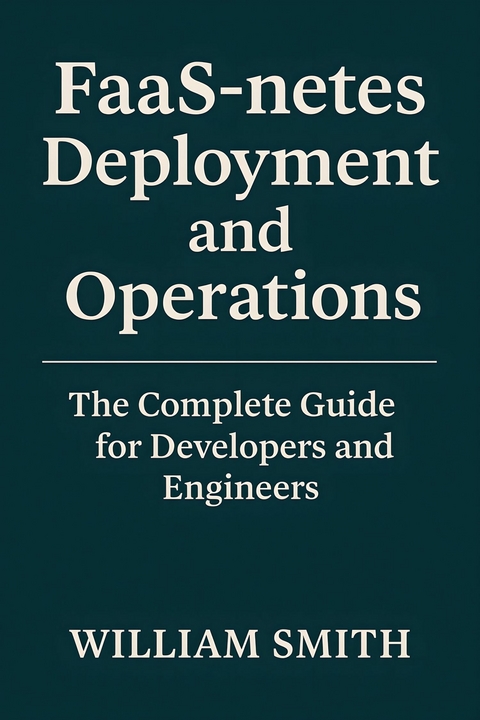
FaaS-netes Deployment and Operations (eBook)
250 Seiten
HiTeX Press (Verlag)
978-0-00-106538-3 (ISBN)
'FaaS-netes Deployment and Operations'
'FaaS-netes Deployment and Operations' is the definitive guide to deploying, managing, and optimizing serverless workloads on Kubernetes. Designed for cloud engineers, architects, and DevOps professionals, this comprehensive resource demystifies the fundamentals of Function-as-a-Service (FaaS) in the Kubernetes landscape, bridging the gap between commercial FaaS offerings and open-source, cloud-native implementations like Knative, OpenFaaS, Kubeless, and Fission. Through expert explanations, the book systematically covers architectural components, event-driven programming models, and real-world workload patterns, equipping readers with a deep understanding of how serverless paradigms are evolving within enterprise and multi-cloud environments.
The book delves into the practicalities of execution environments, autoscaling, function lifecycle management, and multi-tenancy-all essential for building robust, secure, and resilient serverless platforms. Readers learn to architect efficient deployment pipelines using tools like Helm, Kustomize, Terraform, and Crossplane; they explore advanced networking, ingress management, and observability enabled by contemporary service mesh, monitoring, and tracing solutions. Emphasis is placed on security and policy enforcement-covering runtime secrets, RBAC, artifact integrity, compliance, and tenant isolation-to ensure that serverless workloads remain trusted, compliant, and auditable at scale.
Beyond operational best practices, 'FaaS-netes Deployment and Operations' confronts the frontiers of performance optimization, cost management, and hybrid cloud integration in FaaS-netes, addressing challenges such as cold starts, multi-cluster deployments, edge FaaS, and emerging trends like WebAssembly. The book culminates with in-depth case studies and forward-looking perspectives, offering invaluable lessons from real-world implementations, integration of AI/ML in serverless workflows, and future projections for the Kubernetes-powered serverless ecosystem. This authoritative reference is essential for anyone interested in driving innovation with serverless technologies across dynamic, cloud-native infrastructures.
Chapter 2
Architectural Deep Dive: Execution, Scaling, and Lifecycle
Go beneath the surface of FaaS-netes to uncover the advanced machinery powering function execution on Kubernetes. This chapter immerses you in the architectural intricacies of scaling, isolation, and state management that govern high-performing serverless systems. By unraveling these layers, you’ll discover how state-of-the-art platforms orchestrate secure, efficient, and scalable execution—all while confronting the notorious cold start, parallelism, and multi-tenancy challenges inherent to cloud-native serverless.
2.1 FaaS Execution Environments on Kubernetes
Function-as-a-Service (FaaS) platforms on Kubernetes leverage the inherent container orchestration capabilities to execute ephemeral functions through containerized runtimes, sandboxing techniques, and process-level isolation mechanisms. The design and implementation of these execution environments profoundly influence system efficiency, security posture, resource utilization, and cross-language support, thereby shaping the operational characteristics and developer experience of serverless solutions within Kubernetes ecosystems.
At the core of FaaS execution lies the containerized runtime, which encapsulates function code, its dependencies, and supporting runtime libraries into a lightweight container image. Kubernetes orchestrates these containers by employing native abstractions such as Pods, which provide isolated network and process contexts. Each function invocation is typically implemented as a short-lived container instantiation, facilitating rapid scale-out and concurrency control. This model exploits Kubernetes’ scheduler and scaling APIs, enabling seamless integration of serverless workloads with the cluster’s resource management and policy frameworks.
Runtime abstraction strategies diversify the execution environment by decoupling function logic from underlying container technologies. This is achieved through intermediate layers such as Function Runtimes or Runtime Shim components that interface with Kubernetes Custom Resource Definitions (CRDs) or specific serverless frameworks like Knative or OpenFaaS. These abstractions enable heterogeneous support for multiple programming languages and frameworks by embedding language-specific interpreters or virtual machines within containers or by invoking external execution sandboxes.
Sandboxing is a pivotal mechanism for enhancing security and resource isolation in FaaS environments. At the container level, sandboxing enforces namespace separation, control groups (cgroups), and seccomp profiles to restrict resource access and system call capabilities. More advanced sandboxes incorporate microVMs—lightweight virtual machines such as Firecracker or Kata Containers—providing additional hardware-assisted isolation boundaries. These microVMs reduce attack surfaces and mitigate risks posed by multi-tenant execution, albeit at the cost of increased resource overhead and startup latency compared to traditional containers.
Process-level isolation forms the foundation upon which sandboxing and containerization build. By segregating function invocations into isolated processes within containers, Kubernetes ensures that failures or crashes in one function do not propagate to others. Process isolation also facilitates fine-grained monitoring, logging, and tracing of individual function executions, contributing to improved observability and debugging capabilities in distributed serverless applications.
Balancing support for multiple languages and frameworks within a single FaaS environment requires modular and extensible runtime architectures. For instance, runtime frameworks can provide language-neutral invocation mechanisms such as HTTP or gRPC endpoints, while embedding or dynamically loading language-specific handlers. This design supports polyglot applications and enables rapid introduction of new language runtimes without altering the core orchestration logic. Moreover, language-specific container base images with optimized dependencies contribute to minimizing container image sizes and improving cold-start performance.
The resource footprint of FaaS execution environments is a critical concern, especially in large-scale Kubernetes deployments. Containerized runtimes abstract underlying resources but also impose overhead due to duplicated library dependencies, runtime daemons, and container runtime interfaces. Consequently, lighter-weight runtime images and efficient container layering strategies are employed to reduce image size and startup time. Function bundling or shared base images enable container reuse, lowering resource consumption and improving cache hit rates in container registries.
Security implications are multifaceted, arising from the automated, multi-tenant, and ephemeral nature of FaaS workloads. Container runtime security best practices such as minimal privilege, immutable infrastructure, and runtime security policies are integral to safeguarding function executions. Kubernetes enhances this through Role-Based Access Control (RBAC), Network Policies, and Pod Security Policies. Additionally, sandboxing approaches incorporating microVMs or unikernels enhance kernel and hardware-level isolation, minimizing the risk of code injection, privilege escalation, or lateral movement within the cluster.
Compatibility across diverse execution backends remains an ongoing challenge due to variability in container runtimes, networking models, and cluster configurations. Standardized interfaces and Open Container Initiative (OCI) compliance ensure portability of container images and runtimes across Kubernetes distributions. Serverless frameworks often abstract backend specifics by providing unified function deployment APIs, event sources integration, and autoscaling capabilities, mitigating discrepancies between environments. Interoperability between containerized runtimes and alternative sandboxes demands adherence to common invocation standards and well-defined lifecycle management protocols.
In sum, FaaS execution environments on Kubernetes harness container orchestration to provide scalable, isolated, and multi-language capable runtimes for serverless functions. Runtime abstractions facilitate extensibility and language diversity, while sandboxing and process-level isolation underpin security and fault containment. Resource footprint considerations drive optimization of container images and sharing strategies. Security is reinforced through layered defenses spanning container runtime to kernel isolation. Compatibility across backends is achieved via conformance to standards and serverless framework abstractions, enabling Kubernetes to serve as a versatile substrate for modern FaaS deployments.
2.2 Scaling Models: Horizontal, Vertical, and Event-Driven
Autoscaling architectures form the backbone of adaptive cloud-native systems, ensuring application performance and resource efficiency under dynamic workload conditions. The principal approaches-Horizontal Pod Autoscaling (HPA), Vertical Pod Autoscaling (VPA), and event-driven custom controllers-address scaling at different granularity and responsiveness levels. Each model introduces unique mechanisms for concurrency management, resource monitoring, and trigger definition that collectively enable Function-as-a-Service (FaaS) platforms to handle fluctuating demand while minimizing costs.
Horizontal Pod Autoscaling extends the system’s capacity by adjusting the number of pod replicas based on observed metrics such as CPU utilization, memory consumption, or custom application-level indicators. This paradigm leverages container orchestration platforms’ native capabilities to replicate stateless workloads, thereby increasing throughput and parallel processing capacity. HPA typically employs a control loop that periodically queries specified metrics and compares current load to target thresholds before incrementally scaling the pod count. A critical component of HPA is the concurrency model of the application; functions must be designed to be horizontally scalable without introducing stateful dependencies or contention points that could degrade performance. For example, a stateless HTTP handler can effortlessly benefit from additional pod replicas, whereas stateful workloads require sophisticated synchronization mechanisms or external state stores to maintain consistency.
Vertical Pod Autoscaling approaches scaling from the perspective of adjusting resource allocations (CPU, memory) within individual pods rather than altering their count. VPA monitors pod resource usage over time and dynamically updates resource requests and limits to better fit the workload demands, reducing resource wastage and avoiding throttling. Unlike HPA, which relies on replication to augment capacity, VPA fine-tunes pod performance by provisioning adequate resources for each instance. However, vertical scaling entails pod restarts or recreations since container resource limits are immutable at runtime-necessitating strategies to minimize disruption, such as draining traffic before eviction or scheduling updates during low-demand windows. Vertical scaling is particularly advantageous for workloads with unpredictable...
| Erscheint lt. Verlag | 24.7.2025 |
|---|---|
| Sprache | englisch |
| Themenwelt | Mathematik / Informatik ► Informatik ► Programmiersprachen / -werkzeuge |
| ISBN-10 | 0-00-106538-6 / 0001065386 |
| ISBN-13 | 978-0-00-106538-3 / 9780001065383 |
| Informationen gemäß Produktsicherheitsverordnung (GPSR) | |
| Haben Sie eine Frage zum Produkt? |
 EPUB (Adobe DRM)
Größe: 595 KB
Kopierschutz: Adobe-DRM
Adobe-DRM ist ein Kopierschutz, der das eBook vor Mißbrauch schützen soll. Dabei wird das eBook bereits beim Download auf Ihre persönliche Adobe-ID autorisiert. Lesen können Sie das eBook dann nur auf den Geräten, welche ebenfalls auf Ihre Adobe-ID registriert sind.
Details zum Adobe-DRM
Dateiformat: EPUB (Electronic Publication)
EPUB ist ein offener Standard für eBooks und eignet sich besonders zur Darstellung von Belletristik und Sachbüchern. Der Fließtext wird dynamisch an die Display- und Schriftgröße angepasst. Auch für mobile Lesegeräte ist EPUB daher gut geeignet.
Systemvoraussetzungen:
PC/Mac: Mit einem PC oder Mac können Sie dieses eBook lesen. Sie benötigen eine
eReader: Dieses eBook kann mit (fast) allen eBook-Readern gelesen werden. Mit dem amazon-Kindle ist es aber nicht kompatibel.
Smartphone/Tablet: Egal ob Apple oder Android, dieses eBook können Sie lesen. Sie benötigen eine
Geräteliste und zusätzliche Hinweise
Buying eBooks from abroad
For tax law reasons we can sell eBooks just within Germany and Switzerland. Regrettably we cannot fulfill eBook-orders from other countries.
aus dem Bereich


