


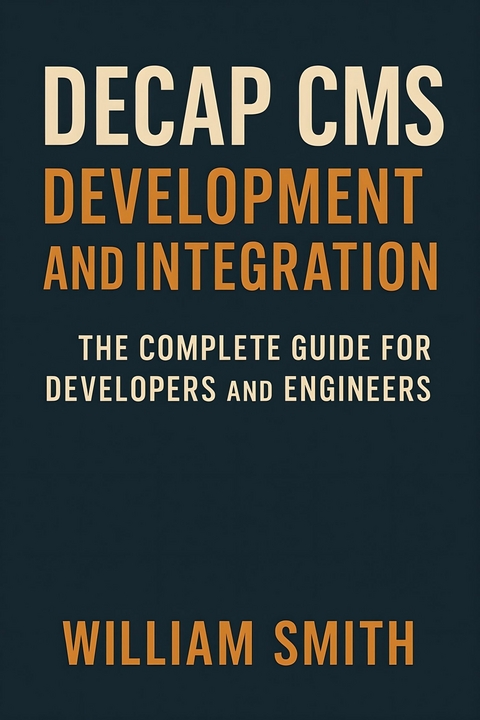
Decap CMS Development and Integration (eBook)
250 Seiten
HiTeX Press (Verlag)
978-0-00-106531-4 (ISBN)
'Decap CMS Development and Integration'
Unlock the full potential of modern content management workflows with 'Decap CMS Development and Integration,' a comprehensive technical guide for developers, architects, and digital teams seeking mastery over Decap (formerly Netlify) CMS. This book provides a meticulous exploration of Decap CMS architecture, diving into its foundational Git-centric philosophy, decoupled design, and stateless core, while guiding readers through essential configuration, authentication strategies, access control, and deep JAMstack integration. From robust content modeling using collections and custom widgets to handling editorial complexities like localization, asset management, and data migrations, each chapter is crafted to ensure maintainable, future-proof content systems.
Moving beyond foundational topics, the book delivers extensive insights into advanced user interface customization, tailored editorial workflows, and real-world operational requirements. Readers learn to implement personalized UI theming, configure complex review and publishing pipelines, enable real-time collaboration for distributed teams, and maintain strict usability and accessibility standards. It also covers programmatic extensibility-illustrating how to develop custom widgets, plugins, backend adapters, and integrate with external data sources, webhooks, and diverse APIs-making it an invaluable resource for teams looking to push the boundaries of content automation and bespoke digital experiences.
To address the modern demands of scalability, security, and governance, 'Decap CMS Development and Integration' dedicates entire sections to CI/CD pipeline integrations, infrastructure-as-code automation, and best practices for monitoring, backup, compliance, and operational policies. Further, it explores cutting-edge use cases, including multi-tenant SaaS scenarios, headless commerce, omnichannel content distribution, and AI-driven editorial innovation. Whether you're embedding Decap CMS into Next.js, Gatsby, Hugo, or experimenting with emerging frameworks and microfrontend architectures, this book is your essential companion for building secure, efficient, and forward-thinking CMS-driven platforms.
Chapter 2
Advanced Content Modeling and Field Extensions
Modern content requirements rarely fit into predefined molds—this chapter ventures deep into the power and subtlety of Decap CMS’s content modeling engine. Discover how to architect sophisticated, maintainable data structures that reflect the true complexity of today’s multi-relational, media-rich, and internationalized content domains. Explore custom extensibility patterns that let you break traditional boundaries, making Decap CMS a foundation for even the most ambitious digital experiences.
2.1 Complex Field Types and Nested Structures
Decap CMS’s schema architecture extends beyond primitive fields by allowing the construction of complex field types, enabling the representation of intricate data relationships within content models. This section rigorously examines the design and implementation of nested objects, lists, maps, and polymorphic fields. It further elucidates strategies for their optimal use, including conditional logic application, rigorous validation mechanisms, and schema optimization aimed at balancing technical extensibility with editorial usability.
Nested objects encapsulate groups of related fields within a parent field, effectively creating hierarchical data structures. They are fundamental to representing structured data such as addresses, multimedia metadata, or user profiles within a single content entry.
A nested object is defined by embedding a fields array inside a parent object field:
{
label: ’Author’,
name: ’author’,
widget: ’object’,
fields: [
{ label: ’Name’, name: ’name’, widget: ’string’ },
{ label: ’Email’, name: ’email’, widget: ’string’ },
{ label: ’Bio’, name: ’bio’, widget: ’text’ }
]
}
This encapsulation aids in logical grouping, reducing schema complexity and improving editorial experience by presenting coherent input segments. Nested objects should be used when related fields share a conceptual boundary and are queried or mutated as a single unit.
Lists provide an efficient way to represent ordered collections. They are specified using the list widget and accept either primitive or object-typed elements.
For homogeneous lists where entries share the same field structure, using a list of objects defines a repeatable sub-entity:
{
label: ’Gallery Images’,
name: ’gallery_images’,
widget: ’list’,
fields: [
{ label: ’Image URL’, name: ’url’, widget: ’image’ },
{ label: ’Caption’, name: ’caption’, widget: ’string’ }
]
}
Heterogeneous lists, containing different field types for each element, require polymorphic or discriminated union implementations (discussed later). Lists also support minimum and maximum length constraints, as well as limiting media selection where appropriate.
While JSON objects naturally represent maps, explicit support for key-value pairs within Decap CMS schemas is limited. However, developers can simulate map structures using lists of objects with designated key and value fields. This enables associating arbitrary keys with corresponding values and preserving natural object semantics:
{
label: ’Metadata’,
name: ’metadata’,
widget: ’list’,
fields: [
{ label: ’Key’, name: ’key’, widget: ’string’ },
{ label: ’Value’, name: ’value’, widget: ’string’ }
]
}
When performance-critical, maps can alternatively be flattened or pre-processed during build time to native object representations in front-end frameworks.
Polymorphic fields enhance schema flexibility by allowing fields to assume multiple structural forms, distinguished by discriminator keys. Such fields enable editors to select among alternate content models within a single entry point, pivotal for components like rich media blocks or content embeds.
In Decap CMS, polymorphism can be implemented using the types keyword in lists or objects, providing a finite set of schemas selectable on a per-item basis:
{
label: ’Content Blocks’,
name: ’content_blocks’,
widget: ’list’,
types: [
{
label: ’Text Block’,
name: ’text_block’,
widget: ’object’,
fields: [
{ label: ’Text’, name: ’text’, widget: ’text’ }
]
},
{
label: ’Image Block’,
name: ’image_block’,
widget: ’object’,
fields: [
{ label: ’Image’, name: ’image’, widget: ’image’ },
{ label: ’Caption’, name: ’caption’, widget: ’string’ }
]
}
]
}
Each block type acts as a discriminated union member, offering a distinct structure while maintaining a cohesive list interface.
Applying conditional logic within nested and polymorphic structures allows schemas to dynamically adapt to editorial context or external inputs, enhancing usability and reducing error propensity. Decap CMS supports conditionals via the pattern and required properties, supplemented by UI-level constraints defined through conditional callbacks or external plugin integration.
For instance, a nested field may reveal additional keys based on parent field values:
{
label: ’Video Metadata’,
name: ’video_metadata’,
widget: ’object’,
fields: [
{ label: ’Has Subtitles’, name: ’has_subtitles’, widget: ’boolean’ },
{
label: ’Subtitle Language’,
name: ’subtitle_language’,
widget: ’string’,
required: false,
pattern: {
name: ’conditional-presence’,
value: ’^.+$’,
message: ’Subtitle Language is required if Has Subtitles is true.’
},
condition: (fields) => fields.has_subtitles === true
}
]
}
Such conditional rules enforce editorial workflows and reduce invalid content submissions through context-sensitive requirements.
Complex nested schemas necessitate validation mechanisms that traverse deeply to enforce consistency and data integrity. Native validation provided by Decap CMS includes type checking, pattern matching, and required status, applying recursively through nested structures.
For more advanced cases, custom validation functions can implement cross-field constraints or contextual logic. These validations are defined as callback functions receiving the entire data node, enabling comparative checks across sibling and parent fields, such as ensuring chronological order or mutually...
| Erscheint lt. Verlag | 24.7.2025 |
|---|---|
| Sprache | englisch |
| Themenwelt | Mathematik / Informatik ► Informatik ► Programmiersprachen / -werkzeuge |
| ISBN-10 | 0-00-106531-9 / 0001065319 |
| ISBN-13 | 978-0-00-106531-4 / 9780001065314 |
| Informationen gemäß Produktsicherheitsverordnung (GPSR) | |
| Haben Sie eine Frage zum Produkt? |
 EPUB (Adobe DRM)
Größe: 676 KB
Kopierschutz: Adobe-DRM
Adobe-DRM ist ein Kopierschutz, der das eBook vor Mißbrauch schützen soll. Dabei wird das eBook bereits beim Download auf Ihre persönliche Adobe-ID autorisiert. Lesen können Sie das eBook dann nur auf den Geräten, welche ebenfalls auf Ihre Adobe-ID registriert sind.
Details zum Adobe-DRM
Dateiformat: EPUB (Electronic Publication)
EPUB ist ein offener Standard für eBooks und eignet sich besonders zur Darstellung von Belletristik und Sachbüchern. Der Fließtext wird dynamisch an die Display- und Schriftgröße angepasst. Auch für mobile Lesegeräte ist EPUB daher gut geeignet.
Systemvoraussetzungen:
PC/Mac: Mit einem PC oder Mac können Sie dieses eBook lesen. Sie benötigen eine
eReader: Dieses eBook kann mit (fast) allen eBook-Readern gelesen werden. Mit dem amazon-Kindle ist es aber nicht kompatibel.
Smartphone/Tablet: Egal ob Apple oder Android, dieses eBook können Sie lesen. Sie benötigen eine
Geräteliste und zusätzliche Hinweise
Buying eBooks from abroad
For tax law reasons we can sell eBooks just within Germany and Switzerland. Regrettably we cannot fulfill eBook-orders from other countries.
aus dem Bereich


