


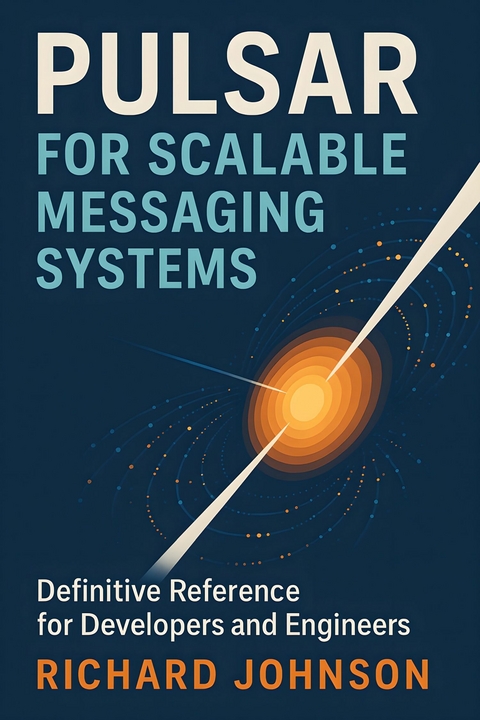
Pulsar for Scalable Messaging Systems (eBook)
250 Seiten
HiTeX Press (Verlag)
978-0-00-106504-8 (ISBN)
'Pulsar for Scalable Messaging Systems'
'Pulsar for Scalable Messaging Systems' is a definitive guide to Apache Pulsar, meticulously crafted for engineers, architects, and technical leaders seeking to build and operate robust distributed messaging infrastructures. The book begins with a comprehensive exploration of Pulsar's architectural fundamentals, including its stateless brokers, storage-compute separation, and unique integration with Apache BookKeeper and ZooKeeper. By contrasting Pulsar with other leading messaging systems such as Kafka and RabbitMQ, readers are equipped to evaluate design trade-offs and make informed technology decisions for their own ecosystems. This foundational perspective sets the stage for deeper technical dives throughout the text.
Advancing beyond theory, the book delivers actionable insights and best practices for deploying, scaling, and managing Pulsar in a variety of real-world scenarios. Detailed chapters address multi-region and hybrid cluster topologies, infrastructure automation with tools like Terraform and Kubernetes, capacity planning, and operational lifecycle management. Readers will discover robust strategies for disaster recovery, message durability, rolling upgrades, and backup, ensuring resilience in even the most demanding environments. Furthermore, in-depth guidance on monitoring, observability, security, and compliance empowers organizations to maintain high-performance, secure, and compliant operations at scale.
Within its rich and practical framework, the book also opens new horizons in stream processing, multi-tenancy, transactional messaging, and complex integration patterns with data lakes, warehouses, and leading stream processing frameworks. Step-by-step examples detail schema management, deployment of Pulsar Functions, IO connector integrations, and advanced routing mechanisms. With real-world case studies and advanced topics such as geo-replication, federated clusters, and global scalability, 'Pulsar for Scalable Messaging Systems' is an indispensable resource for building next-generation, mission-critical messaging platforms.
Chapter 1
Introduction and Architectural Fundamentals
Apache Pulsar represents a paradigm shift in the landscape of distributed messaging systems, blending innovative architecture with remarkable flexibility and scalability. This chapter serves as both an invitation and a roadmap, unveiling the core motivations behind Pulsar’s inception and the critical architectural elements that distinguish it from established messaging platforms. Through detailed exploration and insightful comparisons, you’ll gain a foundation for leveraging Pulsar as the backbone of modern event-driven systems.
1.1 Motivation for Scalable Messaging
The landscape of distributed applications has undergone a rapid transformation, marked by unprecedented scale and complexity that have fundamentally altered messaging system requirements. Early messaging architectures, designed primarily for enterprise integration and modest throughput, now face challenges imposed by large-scale data-intensive environments such as streaming analytics, event-driven microservices, and real-time collaborative platforms. This transition demands messaging infrastructures capable of addressing stringent performance and reliability constraints while accommodating the evolving operational paradigms of modern cloud-native environments.
One of the principal drivers behind the evolution of messaging systems is the explosive growth in data volumes and message throughput. Applications spanning IoT networks, financial services, and social media generate immense streams of events characterized by unpredictability and burstiness. Legacy messaging middleware, often reliant on tightly coupled broker models or limited horizontal scalability, becomes a bottleneck under such intensive workloads. Modern systems require architectures that can scale out elastically, maintaining high throughput without degradation in performance, even as the number of producers and consumers grows by orders of magnitude.
Durability forms a critical axis in these considerations. The integrity of messages-ensuring no data loss despite failures or network partitions-is paramount for applications with strict consistency and reliability mandates. Traditional queuing systems often trade durability for latency or throughput, relying on in-memory buffering or ephemeral storage that can be compromised under fault conditions. Consequently, next-generation messaging systems integrate persistent, replicated storage mechanisms that guarantee message retention over arbitrary time spans, enabling system recovery and replay without losing critical event data. This functionality is essential for auditability, fault tolerance, and reconciling state in distributed systems.
Latency requirements have simultaneously tightened, driven by real-time use cases where millisecond-level responsiveness directly impacts user experience and operational effectiveness. Messaging frameworks must minimize end-to-end delay, from message publication through delivery and acknowledgment. Achieving low latency at scale is technically challenging; it demands efficient network utilization, optimized I/O paths, and sophisticated flow control mechanisms that prevent congestion without sacrificing throughput. Furthermore, the messaging architecture must support configurable delivery guarantees, such as at-least-once or exactly-once semantics, enabling fine-tuned trade-offs between latency and reliability depending on application demands.
Vendor neutrality and interoperability have emerged as critical factors in technology selection for messaging solutions. Enterprises increasingly favor open standards and APIs that facilitate portability and integration across heterogeneous environments. Proprietary messaging protocols pose risks, including vendor lock-in and restricted ecosystem compatibility. Consequently, popular messaging platforms adopt multi-protocol support and provide standardized client interfaces, enabling seamless interaction with diverse languages, frameworks, and infrastructure components. This ubiquity simplifies developer adoption and sustains long-term system extensibility.
Elasticity is another cornerstone requirement engendered by the dynamic nature of cloud deployments and fluctuating workloads. Static capacity provisioning leads to resource inefficiency and jeopardizes system reliability during traffic spikes. Messaging systems must intrinsically support seamless horizontal scaling, automatically reallocating partitions, redistributing load, and scaling storage as demand fluctuates. This elasticity must operate transparently, without interrupting message flow or compromising delivery semantics. Such capabilities are vital for cost-effective operation and continuous availability in environments characterized by highly variable workloads.
These multifaceted demands expose the limitations of conventional messaging paradigms and spark the innovation of new architectures tailored to contemporary challenges. Apache Pulsar exemplifies this new generation through its separation of compute and storage layers, a distributed log-based design, and a robust tiered storage mechanism. Pulsar’s architecture enables robust durability by persisting messages to distributed, replicated storage independent of brokers, while brokers handle transient message routing and client interaction. This decoupling facilitates seamless horizontal scaling, fault isolation, and elasticity without sacrificing performance.
Moreover, Pulsar’s design incorporates multi-tenant and geo-replication capabilities, further addressing the globalized deployment models prevalent in modern infrastructures. Its native support for multiple subscription modes (exclusive, shared, failover) accommodates diverse consumption patterns and delivery guarantees, empowering developers with precise control over messaging behavior. By embracing an open architecture and supporting protocols such as Kafka and AMQP via proxy layers and connectors, Pulsar enhances vendor neutrality and ecosystem integration.
The evolution of messaging systems is a direct response to the increasing scale, reliability requirements, latency constraints, and operational flexibility demanded by modern distributed applications. The combination of throughput, durability, latency, vendor neutrality, and elasticity fundamentally redefines the messaging landscape. Pulsar’s innovative architecture and feature set embody a transformative solution crafted to address these converging pressures, positioning it as a pivotal technology in the scalable messaging domain.
1.2 Core Pulsar Architecture
Apache Pulsar’s architecture is engineered for distributed messaging that demands high throughput, low latency, and strong durability. The design encapsulates three fundamental components: brokers, bookies (storage nodes powered by Apache BookKeeper), and ZooKeeper (for system coordination). Together, they deliver a scalable, elastic, and resilient messaging platform optimized for cloud-native environments and large-scale deployments.
At the forefront are the brokers, which serve as the primary interaction point for producers and consumers. Brokers are stateless components, responsible for protocol handling, message routing, and topic ownership management. Their statelessness enables dynamic scaling-new broker instances can be added or removed without impacting ongoing message processing or requiring complex state synchronization. Brokers dynamically assign topic ownership among themselves, leveraging ZooKeeper for metadata coordination. This dynamic topic distribution allows Pulsar to balance load efficiently, handle failures gracefully, and support multi-tenant isolation transparently.
Behind the brokers lie the bookies, the foundational storage layer implemented via Apache BookKeeper. Bookies are distributed, replicated log storage nodes responsible for durable message persistence. Each message published to a topic is durably stored in ledger segments managed by bookies. Pulsar applies write-ahead logging by appending messages into ledgers that are striped across multiple bookies. This ensures fault tolerance; when one bookie becomes unavailable, the system continues without data loss thanks to replication. The separation of storage from brokers decouples compute from persistence, allowing independent scaling. For instance, storage capacity can scale by adding bookies without the necessity to increase the number of brokers. This storage-compute separation is a critical pillar in Pulsar’s architecture, facilitating elasticity and minimizing resource overprovisioning.
Coordination and metadata management are centralized within Apache ZooKeeper. ZooKeeper holds essential cluster metadata, such as topic ownership, configuration settings, and broker liveliness. Brokers and bookies coordinate with ZooKeeper to perform leader election, detect failures, and update routing tables. Despite the reliance on ZooKeeper’s consistency guarantees for metadata, Pulsar minimizes ZooKeeper interactions at runtime, thereby enhancing system responsiveness and scalability. ZooKeeper acts as a...
| Erscheint lt. Verlag | 25.6.2025 |
|---|---|
| Sprache | englisch |
| Themenwelt | Mathematik / Informatik ► Informatik ► Programmiersprachen / -werkzeuge |
| ISBN-10 | 0-00-106504-1 / 0001065041 |
| ISBN-13 | 978-0-00-106504-8 / 9780001065048 |
| Informationen gemäß Produktsicherheitsverordnung (GPSR) | |
| Haben Sie eine Frage zum Produkt? |
 EPUB (Adobe DRM)
Größe: 690 KB
Kopierschutz: Adobe-DRM
Adobe-DRM ist ein Kopierschutz, der das eBook vor Mißbrauch schützen soll. Dabei wird das eBook bereits beim Download auf Ihre persönliche Adobe-ID autorisiert. Lesen können Sie das eBook dann nur auf den Geräten, welche ebenfalls auf Ihre Adobe-ID registriert sind.
Details zum Adobe-DRM
Dateiformat: EPUB (Electronic Publication)
EPUB ist ein offener Standard für eBooks und eignet sich besonders zur Darstellung von Belletristik und Sachbüchern. Der Fließtext wird dynamisch an die Display- und Schriftgröße angepasst. Auch für mobile Lesegeräte ist EPUB daher gut geeignet.
Systemvoraussetzungen:
PC/Mac: Mit einem PC oder Mac können Sie dieses eBook lesen. Sie benötigen eine
eReader: Dieses eBook kann mit (fast) allen eBook-Readern gelesen werden. Mit dem amazon-Kindle ist es aber nicht kompatibel.
Smartphone/Tablet: Egal ob Apple oder Android, dieses eBook können Sie lesen. Sie benötigen eine
Geräteliste und zusätzliche Hinweise
Buying eBooks from abroad
For tax law reasons we can sell eBooks just within Germany and Switzerland. Regrettably we cannot fulfill eBook-orders from other countries.
aus dem Bereich


