


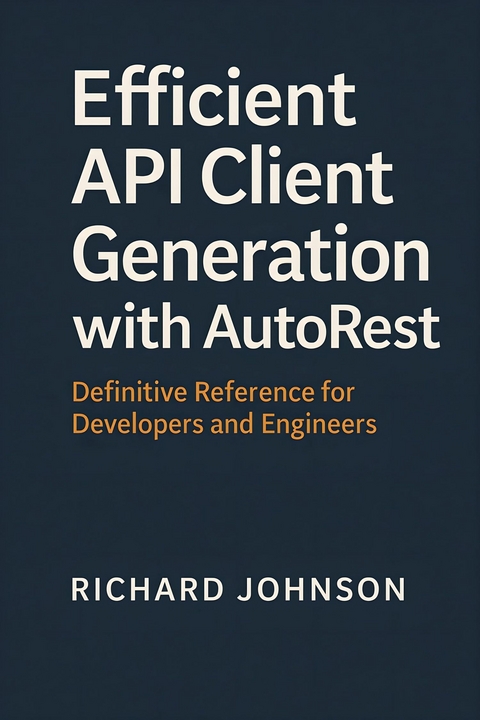
Efficient API Client Generation with AutoRest (eBook)
250 Seiten
HiTeX Press (Verlag)
978-0-00-106503-1 (ISBN)
'Efficient API Client Generation with AutoRest'
'Efficient API Client Generation with AutoRest' is a comprehensive guide that navigates the modern landscape of API client automation, focusing on leveraging AutoRest for scalable, consistent, and enterprise-ready SDK generation. Beginning with foundational concepts in RESTful architecture, OpenAPI specification, and the pitfalls of manual client maintenance, the book methodically demonstrates why automated client code generation is vital for organizations with complex and evolving API surfaces. Readers are introduced to the comparative strengths of AutoRest and alternative generators, setting the stage for informed technology adoption.
Through detailed exploration, the book unveils AutoRest's architectural internals, including its sophisticated pipeline, plugin ecosystem, template engine, and multi-language output support for platforms like C#, Java, TypeScript, Python, and Go. Practical chapters cover real-world configuration strategies, workflow integration in CI/CD environments, robust customization using vendor extensions and bespoke templates, and advanced modeling techniques such as polymorphism, versioning, and multi-API generation. The content is enriched with pragmatic guidance on security, contract testing, quality assurance, and compliance, ensuring generated clients are not only functional but production-grade.
The concluding sections shift focus to operational excellence at scale, addressing large-team collaboration, automated regeneration, versioned distribution, and long-term maintenance strategies for legacy APIs. Readers will learn to extend AutoRest for custom needs, build in-house plugins, and contribute to the broader community. Throughout, best practices, reusable patterns, and field-tested troubleshooting approaches are woven in-culminating in reference architectures for greenfield and brownfield adoption. For architects, developers, and DevOps practitioners alike, this book is an essential resource for mastering modern API client generation and lifecycle management.
Chapter 2
In-Depth: AutoRest Architecture and Ecosystem
AutoRest stands apart thanks to its modular architecture, designed for extensibility, flexibility, and robust multi-language output. In this chapter, you’ll peel back the layers of AutoRest’s internal machinery—seeing not only how your OpenAPI definitions are transformed into real client code, but also how you can influence, debug, and extend every stage of this journey. Whether you’re aiming to tune AutoRest for your unique scenarios or decode its inner workings, this exploration will unlock new potential and mastery.
2.1 Modular Pipeline: Architecture and Extensibility Points
AutoRest’s transformation pipeline embodies a modular and extensible architecture designed to convert OpenAPI specifications into idiomatic client libraries across multiple programming languages. It decomposes the complex code generation process into a sequence of discrete, well-defined stages. Each stage carries out a dedicated task, progressively refining and translating the input schema until final code artifacts emerge. This design ensures clarity, ease of maintenance, and extensive flexibility, allowing users and contributors to intervene or customize behavior at various touchpoints.
The pipeline begins with the Input Parsing stage, where raw OpenAPI documents-typically JSON or YAML-are ingested and parsed into a uniform Abstract Syntax Tree (AST). The parser rigorously validates schema syntax and structure, converting diverse vendor extensions and OpenAPI versions into a normalized internal representation. This normalization is crucial to decouple subsequent transformations from dialect-specific idiosyncrasies, delivering a canonical model of API surface, contracts, and metadata.
Following parsing, the pipeline advances to Model Transformation. Here, the normalized AST is subjected to a series of refinement passes. These passes perform tasks such as eliminating duplicates, resolving references ($ref), inferring missing schema details, and simplifying polymorphic constructs like oneOf or anyOf. Additionally, semantic enhancements occur in this stage; for example, parameter locations and serialization styles are harmonized, and logical operations like flattening deeply nested models are applied to aid downstream code generation. This stage is implemented via a composable chain of transformer plugins, each responsible for a specific semantic augmentation or schema reshaping operation.
The third major stage is Language Model Construction. Unlike the prior platform-agnostic stages, this phase maps the refined API model into language-specific abstractions known as Code Models. These include client class definitions, method signatures, model classes for data transfer objects, and enumerations tailored for the target language’s syntax and idioms. Language-specific conventions such as naming styles, folder structures, and error-handling paradigms are embedded at this juncture. Crucially, this step is extensible through a plugin system: developers can hook in custom model builders to generate domain-specific constructs or adapt the model for emerging language features.
In the Code Generation phase, the pipeline applies templating engines or code emitters to convert Code Models into source code files. Output files incorporate boilerplate code, import statements, and resource management constructs consistent with the target environment. The architecture supports injecting custom code generators or template resolvers, enabling the extension or replacement of default output formats. Furthermore, post-processing hooks allow fine-grained modifications, such as formatting and static analysis fixes, before output hardening.
Throughout the pipeline, the communication between stages is mediated by clearly defined interfaces and immutable models to enforce separation of concerns and thread safety. This design ensures that augmentations or replacements of any stage do not cascade unintended effects. Developers interact with the pipeline primarily via a plugin registration mechanism, which exposes multiple extension points:
- Parser Plugins: Extend or override OpenAPI parsing to accommodate proprietary extensions or alternative schema syntaxes.
- Transformer Plugins: Insert semantic passes post-parsing, enabling validation, augmentation, or transformation of the normalized API model.
- Language Model Plugins: Customize the Code Model generation to inject domain-specific semantics or to conform to particular language best practices.
- Code Generation Plugins: Replace or augment the final code generation templates and emitters to produce tailored output artifacts.
- Post-Processing Plugins: Apply transformations such as code formatting, linting, or artifact bundling after raw code generation.
Interaction with the pipeline typically occurs through an orchestration layer that sequentially executes registered plugins according to a priority scheme. Each plugin can access and modify the evolving API or Code Models and may conditionally enable itself based on contextual metadata such as the input schema version or target language.
The pipeline’s modularity is complemented by comprehensive diagnostic and logging capabilities at every stage, facilitating introspection, debugging, and quality assessment. Error propagation employs structured exception handling enriched with contextual metadata, allowing the orchestration to selectively continue, retry, or abort based on the severity of issues detected.
AutoRest’s transformation pipeline is a layered architecture that progressively morphs an OpenAPI schema into a language-specific client library through discrete, composable stages. Its extensibility points empower developers to precisely intercept, modify, or enhance each phase, fostering a vibrant ecosystem of domain-specific adaptations and language runtime optimizations. This modular approach not only simplifies maintenance but also accelerates integration with emerging protocols, languages, and cloud paradigms.
2.2 Plugin and Extension System Internals
AutoRest’s architecture is fundamentally extensible, centered around a modular plugin system that enables customization and enhancement of the code generation pipeline. The system supports both official and custom plugins that interact seamlessly with the default workflow, thereby granting developers fine-grained control over the processing stages without modifying the core framework. This section delves into the internal mechanics of this plugin architecture, examining how plugins are defined, loaded, and executed, and provides practical guidance for developers aiming to extend AutoRest’s capabilities.
At the core, AutoRest operates as a pipeline composed of discrete stages, each responsible for transforming API specifications through a series of well-defined representations, culminating in generated client SDKs, server stubs, or documentation. Plugins serve as modular units that hook into this pipeline, either augmenting existing stages or introducing entirely new phases. Every plugin encapsulates a clearly specified contract that includes input bindings, transformation logic, and output emissions. Communication between plugins and the pipeline occurs through structured data models, enabling consistent and predictable integration regardless of plugin origin.
Official plugins are shipped with AutoRest and cover common languages and serialization formats; they typically execute deterministic transformations such as schema normalization, model flattening, and language-specific code generation. These plugins are implemented following strict guidelines to ensure interoperability and efficient execution. Conversely, custom plugins, implemented as Node.js packages or .NET components, offer flexibility to developers seeking bespoke transformations or support for novel output formats.
Plugin discovery and registration rely on a well-defined manifest schema. Each plugin is described by a manifest containing metadata such as unique identifier, version, input and output artifacts, and dependencies. During initialization, the AutoRest engine reads plugin manifests from known repositories and user-specified paths, constructing a directed acyclic graph of plugin dependencies to define the execution order. This graph ensures that upstream data transformations are completed before downstream plugins consume their results, preserving data consistency across the pipeline.
Configuration of plugins is achieved via AutoRest configuration files (e.g., readme.md or other .md files) or command-line parameters. Developers specify plugins through the –use switch or metadata entries, alongside customizable options passed as key-value pairs to influence plugin behavior. For instance, the official...
| Erscheint lt. Verlag | 25.6.2025 |
|---|---|
| Sprache | englisch |
| Themenwelt | Mathematik / Informatik ► Informatik ► Programmiersprachen / -werkzeuge |
| ISBN-10 | 0-00-106503-3 / 0001065033 |
| ISBN-13 | 978-0-00-106503-1 / 9780001065031 |
| Informationen gemäß Produktsicherheitsverordnung (GPSR) | |
| Haben Sie eine Frage zum Produkt? |
 EPUB (Adobe DRM)
Größe: 952 KB
Kopierschutz: Adobe-DRM
Adobe-DRM ist ein Kopierschutz, der das eBook vor Mißbrauch schützen soll. Dabei wird das eBook bereits beim Download auf Ihre persönliche Adobe-ID autorisiert. Lesen können Sie das eBook dann nur auf den Geräten, welche ebenfalls auf Ihre Adobe-ID registriert sind.
Details zum Adobe-DRM
Dateiformat: EPUB (Electronic Publication)
EPUB ist ein offener Standard für eBooks und eignet sich besonders zur Darstellung von Belletristik und Sachbüchern. Der Fließtext wird dynamisch an die Display- und Schriftgröße angepasst. Auch für mobile Lesegeräte ist EPUB daher gut geeignet.
Systemvoraussetzungen:
PC/Mac: Mit einem PC oder Mac können Sie dieses eBook lesen. Sie benötigen eine
eReader: Dieses eBook kann mit (fast) allen eBook-Readern gelesen werden. Mit dem amazon-Kindle ist es aber nicht kompatibel.
Smartphone/Tablet: Egal ob Apple oder Android, dieses eBook können Sie lesen. Sie benötigen eine
Geräteliste und zusätzliche Hinweise
Buying eBooks from abroad
For tax law reasons we can sell eBooks just within Germany and Switzerland. Regrettably we cannot fulfill eBook-orders from other countries.
aus dem Bereich


