


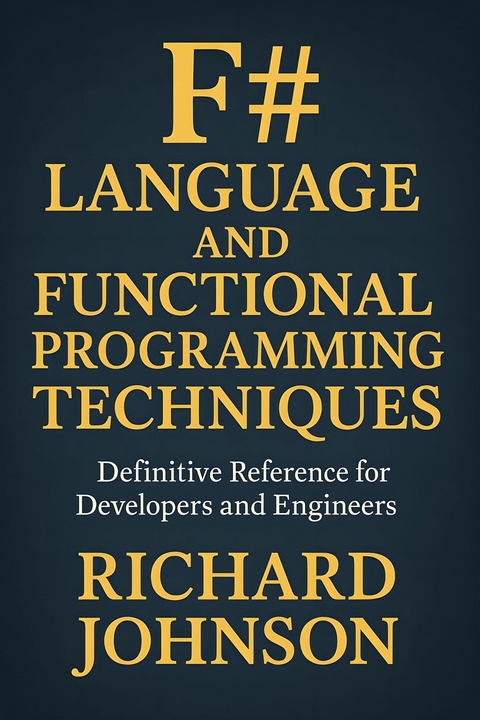
F# Language and Functional Programming Techniques (eBook)
250 Seiten
HiTeX Press (Verlag)
978-0-00-106502-4 (ISBN)
'F# Language and Functional Programming Techniques'
Explore the strengths and elegance of modern functional programming with 'F# Language and Functional Programming Techniques.' This comprehensive book guides readers through the landscape of F# within the powerful .NET ecosystem, starting from its historical roots and unique role in contemporary software development. By addressing practical setup, advanced project management, and in-depth performance profiling, the text equips both newcomers and seasoned developers to harness F#'s full capabilities in building robust and performant applications.
Delving into the heart of functional programming, the book offers a deep exploration of F#'s type system, including sophisticated features such as discriminated unions, records, and type providers for seamless data integration. Readers will master foundational and advanced concepts: immutability, higher-order functions, lazy evaluation, pattern matching, and sophisticated error handling. Specialized chapters illuminate advanced techniques in concurrency, computation expressions, and metaprogramming-enabling creation of scalable, composable, and safe solutions.
Beyond language features, the narrative expands to architectural design, functional patterns, and integration with .NET and other languages such as Python and R, making it an indispensable resource for analytical, scientific, and distributed applications. Insights into ecosystem tooling, testing, open-source engagement, and the future of F# ensure that readers will not only build expertise in the language, but also contribute effectively to the next generation of functional software engineering.
Chapter 2
Typing and Data Structures: The F# Type System Explored
Journey into the heart of F#: its expressive type system and powerful data structures. This chapter reveals how F# leverages strong static typing, type inference, and immutable constructs to deliver robust, error-resistant code. Through practical examples, you’ll discover how the careful modeling of data becomes the cornerstone of functional programming—and how these core concepts elevate both safety and productivity.
2.1 Primitive Types and Type Inference
F#’s robust type system is anchored on a well-defined set of primitive types and a sophisticated type inference mechanism. At the foundation, primitive types provide the fundamental data representations essential for all programming constructs. F# supports conventional primitive types such as integers, floating-point numbers, characters, booleans, and strings, which underpin more complex abstractions. These primitives come in multiple precise forms allowing fine control over data size and semantics, reflecting the needs of performance-sensitive applications as well as high-level programming tasks.
Integral types in F# include int, int8, int16, int32, and int64, each specifying both signedness and bit-width explicitly. Unsigned variants such as uint8, uint16, uint32, and uint64 provide additional options for binary data manipulation or when only non-negative values are logically sound. The int type is an alias for int32 on most platforms, balancing efficiency with memory usage. Floating-point numbers are represented primarily by float (64-bit double precision) and float32 (32-bit single precision), which accommodate scientific computing requirements. The atomic types like char and bool are straightforward but critical: char holds Unicode scalar values enabling global text processing, whereas bool represents logical truth with the two values true and false.
Significantly, primitive types in F# are not just containers for raw data; they also enforce type safety at compile time. Every operation involving primitives must respect their declared or inferred types, allowing the compiler to catch type errors early and reduce runtime faults. This strictness helps maintain program correctness, particularly in large codebases or critical systems.
Despite the explicit nature of primitive types, F# programmers seldom need to specify types manually. The language’s type inference system automatically deduces the most general and consistent types for all expressions by analyzing their construction and usage context. This feature reduces verbosity without compromising type safety, making F# programs concise, readable, and less error-prone.
Type inference leverages Hindley-Milner style algorithms, extended to accommodate F#’s additional features such as overloading, units of measure, and algebraic data types. During compilation, the context-such as literals, function parameters, and operators-guides the compiler toward a precise type assignment. For instance, when encountering a numeric literal like 42, the compiler infers an int unless stricter constraints specify a different numeric type. When an expression combines different numeric literals or variables, the inference engine examines the operations involved (e.g., addition, comparison) and where the result flows to determine the appropriate common type.
The inference process handles polymorphism by assigning generic type variables where appropriate. For example, a function to identity-preserving transformations can be inferred with a generic type ’a -> ’a, allowing it to operate uniformly over any type, yet still statically type-checked. This polymorphic inference supports reuse and abstraction without sacrificing explicit type safety.
Consider the following example illustrating type inference on primitive types:
let square x = x * x
let a = square 5
let b = square 3.0
Here, square is a function where the parameter x is not explicitly typed. When square is first applied with argument 5, an integer literal, the compiler infers x : int making square : int -> int in this context. Conversely, the second application, square 3.0, involves a floating-point float, causing square to be interpreted as float -> float in that instance. In practice, F# requires explicit type annotations here to avoid ambiguity, or to define square as a generic function using appropriate operators for numeric types (e.g., via statically resolved type parameters).
Literal values strongly influence type inference as well. Integer literals default to int unless annotated, floating-point literals default to float, character literals are deduced as char, and string literals as string. This base inference for literals sets the stage for more complex deductions in composite expressions or when literals interact with other variables or functions.
Beyond standard inference, F# type inference integrates seamlessly with advanced features such as units of measure. By attaching physical or domain-specific units (e.g., meters, seconds) to numeric types, the compiler enforces the correctness of operations involving quantities. Units act as phantom types, tracked through type inference and checked statically, preventing inadvertent unit mismatches at compile time while retaining all expressiveness of primitive numeric types.
Due to F#’s strong yet flexible type inference, code tends to be succinct without losing clarity. For example:
let circumference radius = 2.0 * 3.14159 * radius
Here, circumference takes a float argument implicitly because 2.0 and 3.14159 are float literals-the multiplication operation funnels the type, and the compiler infers circumference : float -> float automatically.
Type inference also ameliorates code maintainability. Developers can refactor or extend codebases with minimal disruption to existing type annotations. The inferred types adapt naturally to new contexts, enhancing evolvability and reducing boilerplate. Moreover, inferred types serve as documentation aids, readable via compiler tooling, which display the deduced types helping programmers understand hierarchical relationships and dependencies.
The interplay between F#’s primitive types and its powerful type inference is central to its type safety guarantees. Primitive types ensure precise, predictable data representations and operations, while type inference removes unnecessary annotation overhead, all the while preserving compile-time correctness. These capabilities foster expressive, maintainable, and performant functional programming suited for a diverse range of applications.
2.2 Discriminated Unions and Records
Algebraic data types constitute a cornerstone of expressive type systems in functional programming languages, enabling robust domain modeling through a combination of discriminated unions and records. Discriminated unions, also known as tagged unions or sum types, provide a mechanism to define a type by enumerating its distinct variants, each optionally carrying its own data. Records, by contrast, organize related fields into a single, named composite type, much like a lightweight struct, ensuring clear and self-documenting data representation. The synergy of discriminated unions and records allows precise, extensible modeling of complex domains while fostering correctness by construction.
Consider a domain representing shapes on a canvas. A discriminated union enables direct encoding of the fact that a shape is exactly one of a finite set of cases, each bearing its own state:
type Shape =
| Circle of radius: float...
| Erscheint lt. Verlag | 25.6.2025 |
|---|---|
| Sprache | englisch |
| Themenwelt | Mathematik / Informatik ► Informatik ► Programmiersprachen / -werkzeuge |
| ISBN-10 | 0-00-106502-5 / 0001065025 |
| ISBN-13 | 978-0-00-106502-4 / 9780001065024 |
| Informationen gemäß Produktsicherheitsverordnung (GPSR) | |
| Haben Sie eine Frage zum Produkt? |
 EPUB (Adobe DRM)
Größe: 839 KB
Kopierschutz: Adobe-DRM
Adobe-DRM ist ein Kopierschutz, der das eBook vor Mißbrauch schützen soll. Dabei wird das eBook bereits beim Download auf Ihre persönliche Adobe-ID autorisiert. Lesen können Sie das eBook dann nur auf den Geräten, welche ebenfalls auf Ihre Adobe-ID registriert sind.
Details zum Adobe-DRM
Dateiformat: EPUB (Electronic Publication)
EPUB ist ein offener Standard für eBooks und eignet sich besonders zur Darstellung von Belletristik und Sachbüchern. Der Fließtext wird dynamisch an die Display- und Schriftgröße angepasst. Auch für mobile Lesegeräte ist EPUB daher gut geeignet.
Systemvoraussetzungen:
PC/Mac: Mit einem PC oder Mac können Sie dieses eBook lesen. Sie benötigen eine
eReader: Dieses eBook kann mit (fast) allen eBook-Readern gelesen werden. Mit dem amazon-Kindle ist es aber nicht kompatibel.
Smartphone/Tablet: Egal ob Apple oder Android, dieses eBook können Sie lesen. Sie benötigen eine
Geräteliste und zusätzliche Hinweise
Buying eBooks from abroad
For tax law reasons we can sell eBooks just within Germany and Switzerland. Regrettably we cannot fulfill eBook-orders from other countries.
aus dem Bereich


