


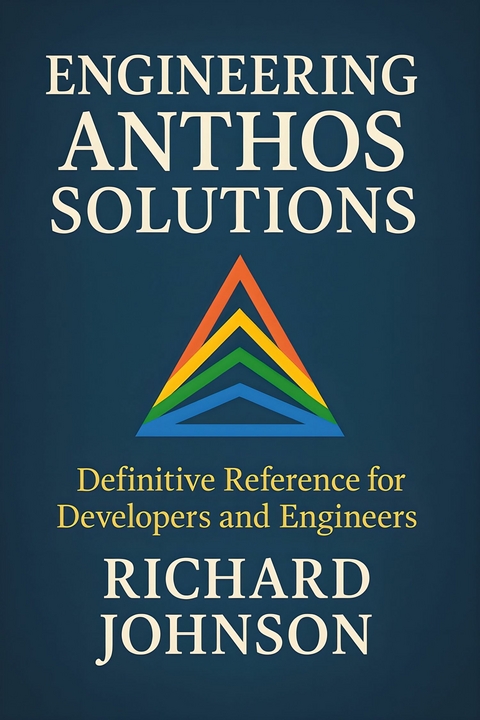
Engineering Anthos Solutions (eBook)
250 Seiten
HiTeX Press (Verlag)
978-0-00-106489-8 (ISBN)
'Engineering Anthos Solutions'
Engineering Anthos Solutions is a comprehensive and practical guide for architects, engineers, and technologists navigating the complexities of hybrid and multi-cloud environments with Google Cloud Anthos. The book systematically unpacks Anthos' architecture, from its origins to advanced implementations, offering deep technical analysis of cluster management, federated operations, and seamless integration with GKE in on-premises, bare metal, and cloud settings. Core foundational topics such as service mesh, identity and access management, and topology optimization are explored in detail, equipping readers with the frameworks to modernize applications across diverse infrastructures.
Beyond the technical underpinnings, this book addresses the strategic deployment patterns for hybrid and multi-cloud operations, demonstrating how Anthos enables unparalleled workload portability, disaster recovery, and high availability-even at the edge. Readers will find expert guidance on workload migration, policy automation, compliance engineering, and secure network segmentation, underscored by real-world patterns for workload resilience, observability, and operational excellence. Dedicated chapters focus on service mesh engineering, automated GitOps workflows, and robust CI/CD pipelines that drive scalable, repeatable, and auditable deployments.
Completing the journey, Engineering Anthos Solutions delves into the broader ecosystem, revealing how Anthos extends its capabilities through APIs, SDKs, third-party integrations, and emerging trends like machine learning and IoT at the edge. Practical guidance on legacy modernization, advanced monitoring, automated operations, and compliance solidifies the book as an all-encompassing field manual. Whether modernizing legacy workloads or building the next generation of cloud-native applications, readers will discover best practices, hands-on blueprints, and enduring strategies to unlock the full potential of Anthos for enterprise innovation.
Chapter 1
Anthos Architecture and Core Concepts
Delve into the architectural foundation of Google Cloud Anthos and discover how it revolutionizes infrastructure and application management across cloud, on-premises, and edge environments. This chapter unlocks the building blocks of Anthos, illuminating how its hybrid core, automation, and advanced control plane empower organizations to achieve unprecedented flexibility, resilience, and security with modern, containerized workloads.
1.1 Anthos Overview and Evolution
Anthos emerges from the intersection of two pressing trends that have reshaped enterprise IT infrastructure: the widespread adoption of Kubernetes as the de facto container orchestration standard and the accelerating need for application modernization across hybrid and multi-cloud environments. Initially conceived to address the complexities of managing containerized workloads consistently across on-premises data centers and public clouds, Anthos has evolved into a comprehensive platform designed to unify operational control, security, and developer productivity in heterogeneous cloud landscapes.
The origins of Anthos trace back to Google Cloud’s early Kubernetes-based hybrid solutions, notably the introduction of Google Kubernetes Engine (GKE) On-Prem and Google Cloud’s Config Connector. These components laid the groundwork for managing Kubernetes clusters deployed outside the Google Cloud Platform (GCP), allowing organizations to incrementally embrace cloud-native architectures without abandoning their existing infrastructure investments. The initial challenge was to abstract away disparities in network topology, security policies, and platform-specific configurations while preserving consistency and minimizing operational overhead.
Anthos was officially announced in 2019, emerging as a natural evolution of Google’s hybrid strategy. The platform was designed to address three principal motivations:
- Uniformity of Operations: Providing a consistent management plane that abstracts over varying underlying infrastructures-be it on-premises, Google Cloud, or other public clouds. This uniformity aimed to reduce the cognitive load on operators and developers by centralizing policy, configuration, and lifecycle management.
- Multi-cloud Flexibility: Enabling true multi-cloud deployments where Kubernetes clusters and workloads could be orchestrated in a decoupled manner, allowing enterprises to avoid vendor lock-in and optimize workload placement based on cost, performance, or compliance requirements.
- Security and Policy Enforcement: Integrating robust, scalable mechanisms to enforce security and governance policies across distributed clusters in real time, ensuring compliance without fragmenting control across diverse environments.
These motivations highlight the complexity of enterprise environments that often feature a mix of legacy systems, diverse cloud providers, and varying regulatory constraints. Google’s key innovation was to leverage Kubernetes as the foundational abstraction layer while extending it with tools that operationalize application modernization principles at scale.
A significant technical milestone was the introduction of Anthos Config Management (ACM), which introduced GitOps principles as first-class citizens in cluster management. ACM allows declarative configuration and policy enforcement across all Anthos-managed clusters, regardless of their location, sourced from a single version-controlled repository. This innovation dramatically increased operational consistency and auditability, facilitating rapid and reliable deployment pipelines.
The platform also integrated Istio as a service mesh to enhance traffic management, observability, and security for microservices architectures, incorporating advanced features like mutual TLS, fine-grained access control, and telemetry. This integration further exemplified Anthos’ commitment to providing a cohesive, enterprise-grade platform that supports complex, distributed applications.
From an infrastructure perspective, Anthos introduced the Anthos Service Mesh and Anthos Migrate capabilities, enabling both better service connectivity and straightforward migration of traditional virtual machine workloads into containers. This breadth of tooling illustrates Anthos’ holistic approach to modernization-not just refactoring applications for Kubernetes but also facilitating transition phases where legacy and cloud-native workloads coexist.
Key milestones in Anthos’ evolution include:
- 2019 Launch: Formal release of Anthos as a hybrid and multi-cloud solution encompassing GKE On-Prem, Config Management, and initial service mesh integrations.
- 2020 Expansion: Introduction of multi-cloud GKE clusters, extending operational capability beyond Google Cloud to AWS and Azure environments, reaffirming Anthos’ neutrality toward cloud providers.
- 2021 Feature Enhancements: Expansion of security capabilities and automated policy enforcement, deeper integration with Google Cloud’s AI/ML services, and maturation of workload migration tools.
- 2022 and Beyond: Emphasis on edge computing and IoT, refining lightweight Kubernetes distributions within Anthos to support highly distributed and resource-constrained environments.
Anthos’ evolution reflects ongoing efforts to resolve the perennial enterprise dilemma: how to unlock agility and innovation through cloud-native technologies without sacrificing control, security, or investment protection. The platform’s layered architecture-with a standardized control plane, extensible configuration model, and integrated service mesh-embodies a strategic direction that harmonizes vendor innovations with open-source ecosystems.
The challenges that guided Anthos’ design remain relevant as environments grow more dynamic and diverse. These include simplifying operational complexity without oversimplifying unique infrastructure demands, ensuring security in multi-tenanted, globally distributed deployments, and enabling continuous modernization without forcing wholesale rewrites of mission-critical applications.
Anthos’ journey from hybrid Kubernetes solutions to a sophisticated, unified multi-cloud platform illustrates a methodical response to enterprise needs for consistent operations, flexible deployment, and robust security. Its ongoing refinement and extension continue to shape the landscape of cloud-native application modernization, setting a paradigm for managing distributed workloads across future heterogeneous infrastructures.
1.2 Cluster Lifecycle and Topology
The lifecycle of Kubernetes clusters within Anthos encompasses several critical phases: provisioning, scaling, upgrading, and teardown. Each phase demands rigorous planning to maintain operational integrity and optimize resource utilization. Anthos abstracts the complexity inherent in managing clusters across hybrid environments, yet understanding its lifecycle intricacies remains essential for architects responsible for robust infrastructure design.
Provisioning and Initial Topology Planning
Cluster provisioning in Anthos begins with defining a control plane and worker node topology tailored to the expected workload characteristics and service-level objectives. Anthos supports deployment on Google Cloud, as well as on-premises with Anthos clusters on VMware or bare metal, requiring careful consideration of platform-specific resource constraints and network configurations.
Topology planning entails selecting node pools with the appropriate machine types, geographic distribution, and node capacities. Multi-zone or multi-region clusters enhance resilience by distributing nodes across failure domains. A failure domain is a segment of infrastructure that can fail independently without affecting other parts of the cluster. Properly architected failure domains mitigate correlated failures spanning geographic or resource boundaries.
High-availability control planes are provisioned with multiple control plane replicas distributed across independent failure domains. This ensures Kubernetes API availability even in the event of zone or rack failures. Anthos leverages Kubernetes’ built-in etcd replication and leader election mechanisms, but cloud-specific networking and storage considerations must be aligned to prevent single points of failure. For example, control plane nodes must have access to consistent storage backends with synchronous replication across zones.
Network topology must also be incorporated, including virtual private clouds (VPCs), subnets, and firewall rules, shaping inter-node communication efficiency and security. On-premises deployments require network overlays such as Calico or...
| Erscheint lt. Verlag | 20.6.2025 |
|---|---|
| Sprache | englisch |
| Themenwelt | Mathematik / Informatik ► Informatik ► Programmiersprachen / -werkzeuge |
| ISBN-10 | 0-00-106489-4 / 0001064894 |
| ISBN-13 | 978-0-00-106489-8 / 9780001064898 |
| Informationen gemäß Produktsicherheitsverordnung (GPSR) | |
| Haben Sie eine Frage zum Produkt? |
 EPUB (Adobe DRM)
Größe: 700 KB
Kopierschutz: Adobe-DRM
Adobe-DRM ist ein Kopierschutz, der das eBook vor Mißbrauch schützen soll. Dabei wird das eBook bereits beim Download auf Ihre persönliche Adobe-ID autorisiert. Lesen können Sie das eBook dann nur auf den Geräten, welche ebenfalls auf Ihre Adobe-ID registriert sind.
Details zum Adobe-DRM
Dateiformat: EPUB (Electronic Publication)
EPUB ist ein offener Standard für eBooks und eignet sich besonders zur Darstellung von Belletristik und Sachbüchern. Der Fließtext wird dynamisch an die Display- und Schriftgröße angepasst. Auch für mobile Lesegeräte ist EPUB daher gut geeignet.
Systemvoraussetzungen:
PC/Mac: Mit einem PC oder Mac können Sie dieses eBook lesen. Sie benötigen eine
eReader: Dieses eBook kann mit (fast) allen eBook-Readern gelesen werden. Mit dem amazon-Kindle ist es aber nicht kompatibel.
Smartphone/Tablet: Egal ob Apple oder Android, dieses eBook können Sie lesen. Sie benötigen eine
Geräteliste und zusätzliche Hinweise
Buying eBooks from abroad
For tax law reasons we can sell eBooks just within Germany and Switzerland. Regrettably we cannot fulfill eBook-orders from other countries.
aus dem Bereich


