


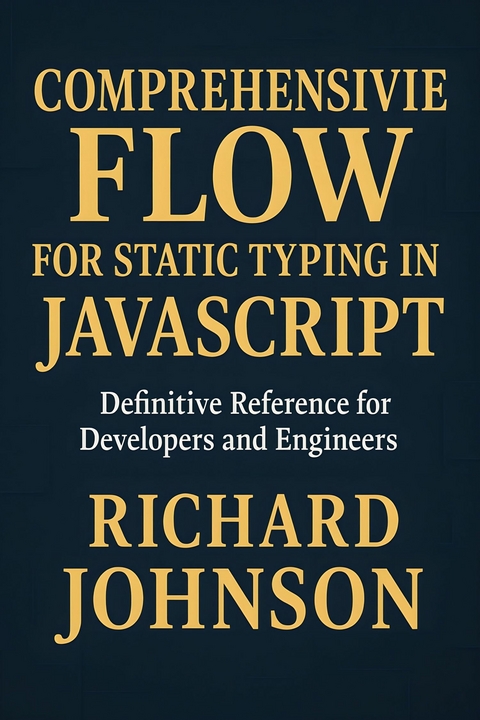
Comprehensive Flow for Static Typing in JavaScript (eBook)
250 Seiten
HiTeX Press (Verlag)
978-0-00-106483-6 (ISBN)
'Comprehensive Flow for Static Typing in JavaScript'
'Comprehensive Flow for Static Typing in JavaScript' delivers an in-depth, modern guide to mastering Flow, a robust static type checker for JavaScript. The book begins with a thoughtful exploration of JavaScript's inherently dynamic type system, articulating the theoretical and practical advantages of introducing static typing to real-world projects. It thoughtfully compares leading static type solutions-Flow, TypeScript, and Closure Compiler-providing essential context for readers aiming to select or deepen their expertise in effective type safety strategies. Through rigorous explanations, the book grounds readers in the motivations behind static typing, explores the historical context and unique strengths of Flow, and presents pragmatic strategies for migrating codebases from dynamic to secure, statically typed architectures.
The core chapters systematically disassemble Flow's powerful type system, from primitives and complex data shapes to advanced features like generics, variance, intersection types, discriminated unions, and mixed typing paradigms. A practical and actionable focus threads through every topic, guiding the reader through project setup, seamless toolchain integration, incremental adoption in large-scale codebases, and the maintenance of high type coverage in collaborative environments. Attention is also devoted to advanced topics such as recursive types, pattern matching, type guards, branding, and the nuanced orchestration of type-driven safety in class-based architectures and React applications-ensuring robust safety at scale for both modern and legacy codebases.
Beyond technical mastery, the book serves as an invaluable reference for team leaders and architects aiming to enforce reliability, auditability, and security via type-driven practices. It details how Flow integrates with testing frameworks, CI/CD pipelines, API contract enforcement, and regulatory workflows, while candidly addressing the limits and open challenges of static typing in JavaScript. The concluding chapters provide forward-looking perspectives, highlighting the Flow ecosystem's community-driven evolution and proposing best practices for sustainable, long-term maintainability. Exhaustively researched and replete with actionable insights, 'Comprehensive Flow for Static Typing in JavaScript' stands as the definitive handbook for engineers seeking to elevate JavaScript correctness, scalability, and developer confidence.
Chapter 1
Foundations of Static Typing in JavaScript
JavaScript’s flexibility has enabled its explosive growth, but its dynamic type system is a double-edged sword—fueling innovation while exposing codebases to subtle, hard-to-catch errors. In this chapter, we peel back the layers of JavaScript’s type system, explore the motivations for introducing static typing, and trace the historical and practical pathways that led to Flow’s creation. Whether you’re new to types or evaluating how best to harden your existing JavaScript architecture, this foundation is your gateway to type-driven reliability and maintainable software at scale.
1.1 JavaScript’s Typing Paradigm
JavaScript was designed with a dynamic typing model from its inception, reflecting both the constraints and goals of rapid web scripting in the mid-1990s. Unlike statically typed languages where variable types are fixed at compile-time, JavaScript variables hold values of any type interchangeably, with types resolved and enforced at runtime. This fundamental characteristic defines a significant aspect of JavaScript’s flexibility and also its complexity.
Runtime Type Resolution
In JavaScript, each value possesses an intrinsic type that is determined during execution rather than declaration. Variables themselves are untyped containers, allowing reassignment across all primitive and object types without explicit casting. The primitive types recognized by JavaScript include undefined, null, boolean, number, string, bigint, and symbol, with object covering all structured data, including arrays and functions treated as first-class citizens.
This policy shifts type checking from compile-time into runtime, providing great flexibility for developers but also introducing potential type-related errors that manifest only when specific code paths are executed. For example, a variable initialized to a number can later hold a string, and the program must correctly handle operations under these circumstances dynamically.
Type Coercion and Its Mechanisms
Central to JavaScript’s dynamic typing is type coercion: the implicit conversion of values from one type to another during evaluation, which occurs both in abstract operations and operator expressions. Coercion is pervasive in JavaScript’s semantics and can be explicit-via constructors or conversion functions such as Number(), String(), and Boolean()-or implicit, where the engine performs conversions automatically as dictated by the language specification (ECMAScript).
For instance, the + operator is overloaded to serve both numeric addition and string concatenation. When one operand is a string and the other a number, JavaScript coerces the number to a string before concatenation:
"5" + 10 // returns "510"
In contrast, arithmetic operators such as -, *, and / implicitly coerce operands to numbers:
"5" - 2 // returns 3
"10" * "2" // returns 20
Boolean contexts, such as conditionals, trigger coercion to true or false according to the language’s truthy and falsy value rules, which can produce unintuitive behavior:
if ("") { // empty string is falsy
// does not execute
}
if ([]) { // empty array is truthy
// executes
}
The underpinning mechanism for coercion relies on the ToPrimitive and ToNumber abstract operations defined in ECMAScript, which are influenced by object property methods like valueOf() and toString(), allowing user-defined types to influence coercion behavior.
Loosely-Typed Design Rationale
JavaScript’s loosely-typed paradigm stems from its original purpose as a lightweight scripting language embedded in web pages, where ease of use and rapid development were paramount over rigorous type discipline. The language design prioritized reducing friction for developers by avoiding explicit type declarations, thereby lowering the entry barrier and accommodating heterogeneous data from the Document Object Model (DOM) and user interactions.
Dynamic typing also enabled JavaScript to adapt flexibly to evolving program states, for example, by treating data retrieved from server responses, DOM elements, or user inputs, which might not adhere to rigid types. This adaptability was critical during the early web era when interoperability with diverse data formats and rapid prototyping dominated development priorities.
Pitfalls and Defects of Dynamic Typing
While dynamic typing affords agility, it seeds numerous well-documented pitfalls predominantly related to unexpected type coercions and the absence of early type error detection. These issues contribute to bugs that are often subtle, context-dependent, and challenging to debug.
One common pitfall is the surprising behavior of equality comparisons using the abstract equality operator ==, which performs type coercion prior to comparison, often producing unintuitive results:
0 == false // true
"" == 0 // true
null == undefined // true
[] == false // true
0 === false // false (strict equality, no coercion)
This coercion-based equality introduces a significant source of logic errors, prompting the modern practice of employing the strict equality operator === to avoid implicit conversions.
Another class of errors arises from the interplay between dynamic typing and automatic coercion in arithmetic and logical expressions. For instance:
[] + {} // "[object Object]" (empty array coerced to "")
{} + [] // 0 (ambiguous, parsed as block plus expression)
Such expressions illustrate how operator overloading and automatic coercion can produce cryptic behavior, further complicated by JavaScript’s syntactic nuances and parsing strategies.
Dynamic typing also limits static analysis capabilities, since type errors cannot be caught prior to runtime. This leads to runtime exceptions that may manifest late into program execution, often in production environments, increasing maintenance and debugging costs.
Setting the Stage for Supplemental Static Typing
These inherent weaknesses in dynamic typing have motivated the adoption of supplemental static typing layers atop JavaScript, designed to reconcile expressiveness with robustness. Tools such as TypeScript and Flow provide type annotations, enforcement, and compile-time checking while compiling down to standard JavaScript, preserving the dynamic nature at runtime.
Static typing addresses the deficiencies by detecting type mismatches before execution, enhancing editor tooling, code navigation, refactoring safety, and documentation clarity. It mitigates common errors stemming from implicit coercion and loose typing without fundamentally altering the language’s runtime semantics.
Understanding JavaScript’s dynamic typing model-including its runtime type resolution, pervasive type coercion, and loosely-typed origins-provides critical context for appreciating how and why these static typing solutions integrate with the language, balancing flexibility with reliability in contemporary software development.
1.2 Static Typing: Theory and Impact
Static typing enforces type constraints during compile-time, distinguishing itself fundamentally from dynamic typing, where types are checked during runtime. This distinction establishes a key duality in programming language theory: compile-time type safety versus...
| Erscheint lt. Verlag | 20.6.2025 |
|---|---|
| Sprache | englisch |
| Themenwelt | Mathematik / Informatik ► Informatik ► Programmiersprachen / -werkzeuge |
| ISBN-10 | 0-00-106483-5 / 0001064835 |
| ISBN-13 | 978-0-00-106483-6 / 9780001064836 |
| Informationen gemäß Produktsicherheitsverordnung (GPSR) | |
| Haben Sie eine Frage zum Produkt? |
 EPUB (Adobe DRM)
Größe: 866 KB
Kopierschutz: Adobe-DRM
Adobe-DRM ist ein Kopierschutz, der das eBook vor Mißbrauch schützen soll. Dabei wird das eBook bereits beim Download auf Ihre persönliche Adobe-ID autorisiert. Lesen können Sie das eBook dann nur auf den Geräten, welche ebenfalls auf Ihre Adobe-ID registriert sind.
Details zum Adobe-DRM
Dateiformat: EPUB (Electronic Publication)
EPUB ist ein offener Standard für eBooks und eignet sich besonders zur Darstellung von Belletristik und Sachbüchern. Der Fließtext wird dynamisch an die Display- und Schriftgröße angepasst. Auch für mobile Lesegeräte ist EPUB daher gut geeignet.
Systemvoraussetzungen:
PC/Mac: Mit einem PC oder Mac können Sie dieses eBook lesen. Sie benötigen eine
eReader: Dieses eBook kann mit (fast) allen eBook-Readern gelesen werden. Mit dem amazon-Kindle ist es aber nicht kompatibel.
Smartphone/Tablet: Egal ob Apple oder Android, dieses eBook können Sie lesen. Sie benötigen eine
Geräteliste und zusätzliche Hinweise
Buying eBooks from abroad
For tax law reasons we can sell eBooks just within Germany and Switzerland. Regrettably we cannot fulfill eBook-orders from other countries.
aus dem Bereich


