


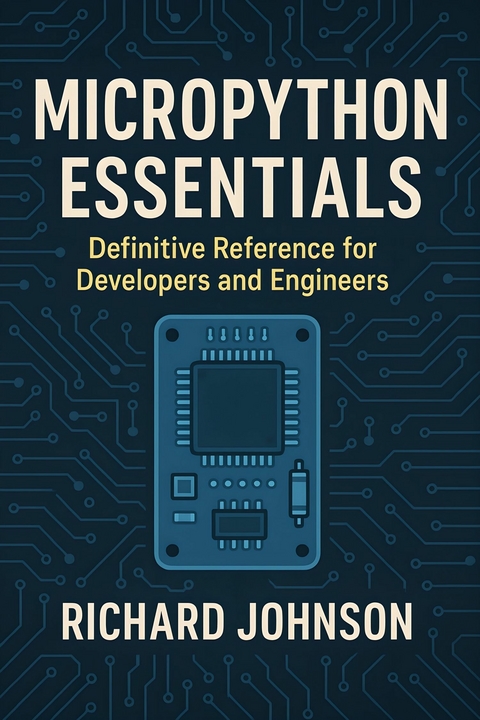
Micropython Essentials (eBook)
250 Seiten
HiTeX Press (Verlag)
978-0-00-106471-3 (ISBN)
'Micropython Essentials'
'Micropython Essentials' is a comprehensive guide designed for engineers, developers, and enthusiasts eager to harness the full power of Python on microcontrollers. Meticulously structured, the book delves into the architecture and core principles shaping Micropython, offering clear explanations of its interpreter internals, memory management, and the rationale behind key design decisions. Readers will find authoritative comparisons to CPython, thorough analyses of supported hardware platforms, and step-by-step strategies for porting Micropython to new devices-laying a robust foundation for both beginners and advanced users seeking deep technical insight.
Across its well-defined chapters, the book walks the reader through Micropython's unique approach to Python language features, the streamlined standard library, and mechanisms for extending functionality. Practical topics cover everything from efficient manipulation of data structures, file systems, networking, and hardware IO to the intricacies of asynchronous programming and real-time system design. Comprehensive hands-on examples, guidance on integrating peripherals and sensors, and best practices for security, optimization, and power management illustrate how Micropython empowers responsive, robust, and scalable solutions for embedded applications.
Rounding out this essential resource are chapters devoted to professional development workflows-including toolchain integration, debugging, deployment, and device fleet management-along with real-world case studies across industrial, educational, and IoT domains. 'Micropython Essentials' not only equips readers with the technical mastery required for cutting-edge embedded development, but also offers an informed perspective on emerging trends, future language directions, and the vibrant community accelerating Micropython's ecosystem.
Chapter 1
Architecture and Core Concepts
Dive beneath the surface of Micropython and discover what makes it uniquely efficient and powerful for embedded systems. This chapter reveals the intentional design philosophies, technical innovations, and key trade-offs that enable Python to run on resource-constrained hardware. Understanding these foundational concepts will empower you to fully leverage Micropython’s strengths in embedded development.
1.1 Micropython Design Philosophy
MicroPython emerged as a response to the growing need for an efficient, high-level programming environment tailored specifically for constrained embedded systems. The deliberate choices in its design reflect a convergence of three overarching principles: minimalism, portability, and usability. These guiding tenets are foundational to both the architecture and feature set of the MicroPython project, differentiating it from conventional Python implementations and shaping its evolution.
Minimalism lies at the core of MicroPython’s philosophy. The resource-constrained nature of microcontrollers necessitates an environment that remains lean without sacrificing essential functionality. Unlike standard Python interpreters designed for desktops or servers, MicroPython operates within limited RAM (often less than 512 KB) and modest CPU capabilities. Consequently, the interpreter has been engineered to have a very small memory footprint, avoiding bulky dependencies and extraneous features present in CPython. This is evident in the microkernel approach utilized by the MicroPython virtual machine, which implements only the most critical language constructs and runtime mechanisms. The design avoids complexity by favoring simple, direct implementations of constructs such as generators, coroutines, and exception handling. For example, memory management relies on a compact garbage collector tailored to the constraints of embedded hardware. This minimalist approach minimizes overhead and facilitates predictable performance, crucial for real-time embedded applications.
Portability constitutes the second pillar of MicroPython’s design. Embedded systems span a wide range of architectures, from 8-/16-bit microcontrollers to more capable 32-bit processors with diverse peripheral sets. To address this heterogeneity, MicroPython’s codebase is written predominantly in standard ANSI C, minimizing dependencies on platform-specific libraries. The hardware abstraction layer (HAL) and board support packages (BSP) isolate platform-specific code, enabling a modular structure where new architectures can be supported with minimal modifications. This separation of concerns is complemented by a well-defined and stable bytecode format, ensuring that core interpreter logic is portable across platforms without recompilation of higher-level code. The reliance on standard C and the modular HAL also allows MicroPython to be ported to non-traditional environments such as desktop simulators and specialized processor cores. This architectural choice significantly lowers the barriers for maintaining consistent behavior across diverse hardware while fostering a growing ecosystem of supported platforms.
Usability is the final and arguably most critical dimension influencing MicroPython’s development. While minimalism and portability answer the “how” and “where” of execution, usability addresses the “who” and “for what purpose.” MicroPython targets embedded software engineers and makers who benefit from a familiar, expressive, and interactive programming language. This user-centric design manifests in several ways:
- An interactive REPL (Read-Eval-Print Loop) that enables rapid prototyping and direct hardware interfacing, dramatically reducing development cycle times relative to traditional compiled languages such as C or assembly.
- Dynamic typing and a subset of the Python standard library thoughtfully adapted to microcontroller needs.
- Language features carefully selected to balance expressiveness against resource usage-dynamic memory allocation is controlled but not eliminated, and common Python idioms are preserved where feasible.
- A standard library, while reduced, offering essential modules for hardware interaction, including GPIO, ADC, PWM, and communication protocols such as I2C, SPI, and UART.
Hence, MicroPython strives not only for functional completeness but also for code clarity and maintainability, empowering users to implement complex behaviors with concise, readable scripts.
The influence of these guiding principles extends deeply into MicroPython’s internal architecture and external interfaces. Internally, the interpreter design accommodates incremental parsing and execution, enabling an efficient interactive experience on devices with limited memory. The virtual machine adopts a register-based bytecode format, which reduces instruction dispatch overhead compared to stack-based approaches. This contributes to higher execution performance within embedded constraints. Externally, the minimalistic core is complemented by modular native code emitters and just-in-time compilation capabilities, accessible for select architectures when additional performance is required. These extensions coexist harmoniously with the minimalist base, preserving the project’s core ethos.
Furthermore, MicroPython’s architecture supports extensibility through native C modules, enabling developers to write performance-critical code while preserving the high-level interface. This design choice reflects the pragmatic balance between minimalism and usability, permitting sophisticated applications without bloating the core interpreter. The firmware image is therefore typically composed of a base interpreter plus optional modules tailored to the application, preserving a streamlined footprint.
MicroPython’s design philosophy represents a deliberate synthesis of minimalism, portability, and usability to address the distinctive challenges posed by microcontroller environments. The minimalist interpreter core and modular architecture ensure efficient resource utilization and broad hardware support. The emphasis on usability, through accessible language features and hardware abstraction, lowers barriers for embedded developers. This foundational philosophy not only defines MicroPython’s current capabilities but also guides its future evolution as embedded systems continue to demand more capable, flexible, and developer-friendly tools.
1.2 Interpreter Internals
The Micropython interpreter is a compact yet sophisticated Python implementation tailored for constrained environments. Its core workflow involves several key stages: parsing Python source code into an intermediate bytecode representation, managing resources efficiently, executing instructions within a virtual machine, and supporting interactive features such as the Read-Eval-Print Loop (REPL). This section unpacks these processes to illuminate how Micropython achieves a balance between expressiveness and resource frugality.
At the forefront of the interpreter’s operation is the parsing phase. Source code is tokenized and syntactically analyzed by a recursive descent parser designed for low memory overhead. The parser generates an abstract syntax tree (AST) which is subsequently converted into a stream of bytecode instructions. The bytecode format is a compact, 16-bit opcode system optimized to minimize both size and dispatch complexity. Each opcode may be followed by one or more operands encoded as small integers or offsets. This compact encoding not only reduces memory demands but also accelerates decoding during execution.
Resource management is a fundamental concern due to the limited RAM available on target hardware such as microcontrollers. Micropython circumvents the costliness of traditional reference counting or precise garbage collection by employing a hybrid strategy. It uses a conservative mark-and-sweep garbage collector triggered at allocation thresholds, alongside manual reference counting for critical internal objects when feasible. Memory allocation for objects like code blocks, strings, and various runtime structures is performed through a specialized heap allocator tuned for small, frequent allocations and deallocations. The allocator minimizes fragmentation by segregating memory blocks by size classes and reusing freed blocks aggressively.
The execution engine of Micropython is a stack-based virtual machine (VM). When bytecode is fed to the VM, it maintains an instruction pointer (IP) to track the current opcode and leverages a value stack for intermediate results and operand storage. Each opcode maps to a handler function-these handlers execute operations such as arithmetic, control flow, function calls, and object manipulation. The interpreter loop employs a computed goto or switch-case dispatch to reduce overhead per instruction. Tail call optimization is implemented in function call handling to conserve stack space during recursion.
Micropython extends the VM with a set of internal runtime objects that underpin Python semantics-including variable scopes, closures, class instances, and built-in types....
| Erscheint lt. Verlag | 16.6.2025 |
|---|---|
| Sprache | englisch |
| Themenwelt | Mathematik / Informatik ► Informatik ► Programmiersprachen / -werkzeuge |
| ISBN-10 | 0-00-106471-1 / 0001064711 |
| ISBN-13 | 978-0-00-106471-3 / 9780001064713 |
| Informationen gemäß Produktsicherheitsverordnung (GPSR) | |
| Haben Sie eine Frage zum Produkt? |
 EPUB (Adobe DRM)
Größe: 817 KB
Kopierschutz: Adobe-DRM
Adobe-DRM ist ein Kopierschutz, der das eBook vor Mißbrauch schützen soll. Dabei wird das eBook bereits beim Download auf Ihre persönliche Adobe-ID autorisiert. Lesen können Sie das eBook dann nur auf den Geräten, welche ebenfalls auf Ihre Adobe-ID registriert sind.
Details zum Adobe-DRM
Dateiformat: EPUB (Electronic Publication)
EPUB ist ein offener Standard für eBooks und eignet sich besonders zur Darstellung von Belletristik und Sachbüchern. Der Fließtext wird dynamisch an die Display- und Schriftgröße angepasst. Auch für mobile Lesegeräte ist EPUB daher gut geeignet.
Systemvoraussetzungen:
PC/Mac: Mit einem PC oder Mac können Sie dieses eBook lesen. Sie benötigen eine
eReader: Dieses eBook kann mit (fast) allen eBook-Readern gelesen werden. Mit dem amazon-Kindle ist es aber nicht kompatibel.
Smartphone/Tablet: Egal ob Apple oder Android, dieses eBook können Sie lesen. Sie benötigen eine
Geräteliste und zusätzliche Hinweise
Buying eBooks from abroad
For tax law reasons we can sell eBooks just within Germany and Switzerland. Regrettably we cannot fulfill eBook-orders from other countries.
aus dem Bereich


