


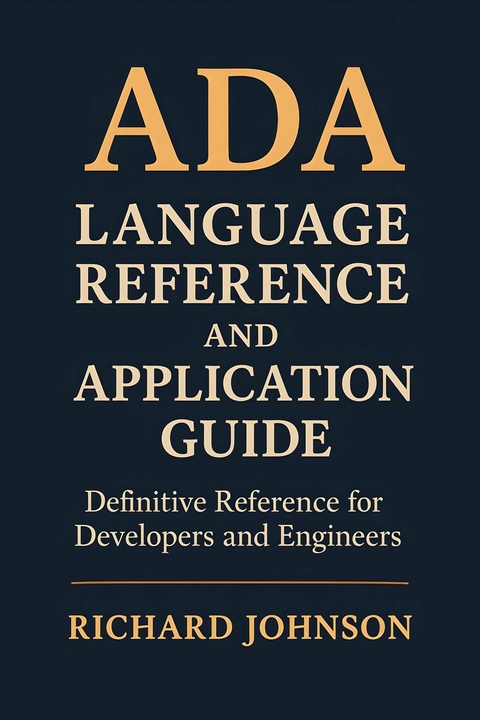
Ada Language Reference and Application Guide (eBook)
250 Seiten
HiTeX Press (Verlag)
978-0-00-106467-6 (ISBN)
'Ada Language Reference and Application Guide'
The *Ada Language Reference and Application Guide* is an authoritative and comprehensive resource for software engineers, system architects, and technical managers working in high-integrity or mission-critical environments. This guide thoroughly explores Ada's foundational principles-reliability, safety, maintainability, and rigorous error handling-while placing the language's evolution within the context of real-world needs and international standardization. Readers are introduced to core language concepts, including robust program structuring, advanced typing, modularity, and effective namespace management, all with an eye toward both clarity and practical application.
Distinctive attention is given to Ada's support for complex software engineering paradigms, spanning object-oriented design, concurrency, and real-time system development. The guide delves deeply into fine points of control flow, strong typing discipline, generic programming, synchronization primitives, and safe low-level access, covering both core language facilities and advanced features such as contract-based programming and formal verification. Real-world considerations, including interfacing with foreign languages, direct hardware manipulation, and integrating testing, analysis, and build automation tools, are addressed in detail to empower users to develop robust, secure, and efficient systems.
Concluding with insightful case studies and overviews of Ada's role in aerospace, industrial automation, embedded and distributed computing, the book captures the language's unique adaptability and trusted application in demanding sectors. It also examines the current state of Ada's toolchain and open-source ecosystem, while offering a forward-looking perspective on the language's ongoing innovation and community-driven evolution. Whether you are building real-time embedded controllers or high-assurance distributed networks, this guide equips you with the expertise and context necessary to fully leverage the enduring strengths of the Ada programming language.
Chapter 1
Ada Language Core Concepts
Discover the design philosophy and structural essence that distinguish Ada from other programming languages. This chapter peels back the layers of Ada’s foundational principles, revealing how its evolution, strong typing, rigorous modularity, and safety-first ethos set the tone for building high-integrity, maintainable software. Prepare to see why Ada remains the language of choice for critical systems and how its architecture empowers robust, portable code.
1.1 Ada Language Philosophy and Design Rationale
The Ada programming language emerged from a distinct set of motivations centered around the development of reliable, safe, and maintainable software systems. Initiated by the United States Department of Defense (DoD) during the late 1970s, Ada was conceived to address the proliferation of diverse and often incompatible programming languages used across defense projects. The overarching goal was to create a standardized language that could unify development efforts, reduce duplication, and increase software quality in mission-critical applications.
Prioritization of Reliability and Safety
At the core of Ada’s design philosophy lies an uncompromising commitment to reliability and safety. This priority was driven by the critical nature of embedded and real-time systems prevalent in defense and aerospace sectors, where errors could result in catastrophic consequences. Consequently, Ada incorporated extensive language features intended to minimize common programming errors, enforce disciplined software construction, and facilitate early detection of faults.
Strong typing is one of the foremost mechanisms by which Ada enforces reliability. Unlike many contemporaneous languages, Ada mandates explicit type declarations, disallows implicit conversions between unrelated types, and supports user-defined types with full semantic distinction. This strict type system greatly reduces errors caused by unintended data misuse, encouraging programmers to think carefully about data representation and operation. Additionally, Ada’s subtype system supports rich constraints (such as range restrictions on integers and floating-point values) that perform run-time checks, catching invalid states before they propagate.
Another significant design choice motivated by safety is Ada’s explicit support for exception handling. Unlike languages that rely on ad hoc error codes or unstructured jumps, Ada provides a structured mechanism for detecting, responding to, and recovering from exceptional conditions. This approach not only aids in preventing program crashes but also improves readability by segregating normal control flow from error processing logic.
Emphasis on Readability and Structured Programming
Ada’s syntax and semantics reflect a deliberate effort to enhance code readability and maintainability. Drawing on principles of structured programming that were well-established by the 1970s, Ada enforces a block-structured programming model. This enforces clear delineation of scopes and hierarchical program structures, discouraging goto statements and other unstructured control flows that confound understanding and maintenance.
The language’s syntactic design favors verbosity over terseness, intentionally including self-descriptive keywords and explicit control constructs which improve clarity. For instance, instead of terse symbols, Ada uses words like end if, loop, and begin to mark program structure boundaries explicitly. This design choice greatly aids code comprehension, especially in large codebases developed collaboratively over extended periods.
Ada also incorporates modularity at a fundamental level through packages, which provide encapsulated components consisting of specification and implementation parts. This modular design enforces strict separation of concerns, enables better abstraction, and supports information hiding. Components can be developed, compiled, and tested independently, thereby facilitating incremental development and localized reasoning about correctness.
Long-Term Maintainability and High-Integrity Systems
A critical rationale behind Ada’s design is its facilitation of long-term maintainability, a necessity in systems expected to endure multiple decades of operational use and revision. The language encourages writing code that is not only correct at the moment of creation but is also comprehensible and modifiable by engineers who might be unfamiliar with the original authors’ intent.
By integrating strong typing, explicit constructs, and modular design, Ada reduces the cognitive burden on maintainers. Detailed and enforceable interfaces promote stable contracts between software components, minimizing unintended side effects during evolution. Furthermore, Ada’s compile-time and run-time checks increase the safety margin against accidental misuse and change-induced errors.
The language also caters directly to the requirements of high-integrity, mission-critical systems through built-in support for real-time concurrency and deterministic behavior. Tasks (Ada’s concurrency abstraction) are defined with controlled synchronization primitives, and the language allows configuration of scheduling policies. These features enable developers to craft systems with predictable timing properties, essential in avionics, railway systems, and other safety-critical domains.
Moreover, Ada’s standardization process incorporated rigorous review and formal validation methods, underscoring its commitment to correctness. The language’s built-in support for contracts, such as preconditions, postconditions, and invariants (introduced in later revisions), directly supports design-by-contract methodologies. These enable developers to specify formal correctness properties that can be checked dynamically or statically, further enhancing program correctness and maintainability.
Synthesis of Design Motivations into Ada’s Features
All of these motivations collectively influenced the foundational design choices of Ada. For example, the decision to include user-defined numeric types with strong constraints stems from the necessity to model real-world phenomena precisely and prevent subtle arithmetic errors. The coexistence of high-level abstractions (such as generic units and controlled types) alongside low-level access to hardware resources allows Ada to accommodate both application-level logic and system-level control within a single framework.
Ada’s insistence on explicitness—such as explicit initialization of variables, explicit parameter modes (in, out, in out), and explicit exception handlers—ensures that code behavior is transparent rather than implicit, which is indispensable for rigorous testing and verification.
Ada’s philosophy intertwines stringent correctness guarantees, transparency, and modularity to serve the life-cycle demands of large-scale, long-lived, and safety-critical software projects. These principles continue to influence modern practices in software engineering and inform the evolution of Ada itself.
1.2 Language Evolution and Standardization
The Ada programming language, originally commissioned by the United States Department of Defense (DoD) in the late 1970s, was designed to meet stringent requirements for embedded, real-time, and mission-critical systems. Its development and refinement occurred in successive stages marked by distinct language versions—Ada 83, Ada 95, Ada 2005, and Ada 2012—each reflecting both feedback from its user community and contemporary advances in software engineering methodologies. Central to Ada’s evolution was the rigorous ISO (International Organization for Standardization) standardization process, which ensured a formal and consensus-driven development path.
Ada 83: The Foundational Standard
Ada 83, officially standardized as ANSI/MIL-STD-1815A in 1983, was the inaugural version of the language. It introduced a strongly typed, modular programming approach designed to reduce common programming errors in embedded and real-time domains. Ada 83’s key features emphasized robustness, such as explicit tasking for concurrency, exception handling, and packages for modularization and information hiding. The standard reflected a comprehensive attempt to support large-scale software development for defense systems, emphasizing reliability, maintainability, and safety-critical requirements.
The language was largely the work of the original Ada design team led by Jean Ichbiah, and the initial standard captured the language’s essential characteristics without initial consideration for object-oriented programming or widespread portability beyond DoD systems. The standardization process...
| Erscheint lt. Verlag | 12.6.2025 |
|---|---|
| Sprache | englisch |
| Themenwelt | Mathematik / Informatik ► Informatik ► Programmiersprachen / -werkzeuge |
| ISBN-10 | 0-00-106467-3 / 0001064673 |
| ISBN-13 | 978-0-00-106467-6 / 9780001064676 |
| Informationen gemäß Produktsicherheitsverordnung (GPSR) | |
| Haben Sie eine Frage zum Produkt? |
 EPUB (Adobe DRM)
Größe: 736 KB
Kopierschutz: Adobe-DRM
Adobe-DRM ist ein Kopierschutz, der das eBook vor Mißbrauch schützen soll. Dabei wird das eBook bereits beim Download auf Ihre persönliche Adobe-ID autorisiert. Lesen können Sie das eBook dann nur auf den Geräten, welche ebenfalls auf Ihre Adobe-ID registriert sind.
Details zum Adobe-DRM
Dateiformat: EPUB (Electronic Publication)
EPUB ist ein offener Standard für eBooks und eignet sich besonders zur Darstellung von Belletristik und Sachbüchern. Der Fließtext wird dynamisch an die Display- und Schriftgröße angepasst. Auch für mobile Lesegeräte ist EPUB daher gut geeignet.
Systemvoraussetzungen:
PC/Mac: Mit einem PC oder Mac können Sie dieses eBook lesen. Sie benötigen eine
eReader: Dieses eBook kann mit (fast) allen eBook-Readern gelesen werden. Mit dem amazon-Kindle ist es aber nicht kompatibel.
Smartphone/Tablet: Egal ob Apple oder Android, dieses eBook können Sie lesen. Sie benötigen eine
Geräteliste und zusätzliche Hinweise
Buying eBooks from abroad
For tax law reasons we can sell eBooks just within Germany and Switzerland. Regrettably we cannot fulfill eBook-orders from other countries.
aus dem Bereich


