


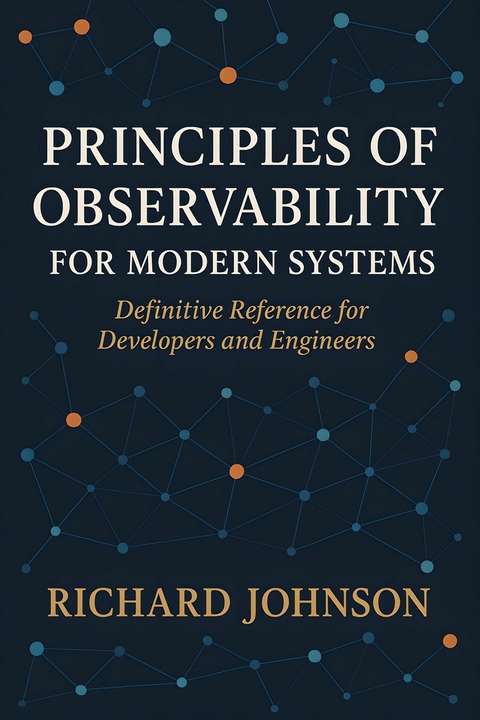
Principles of Observability for Modern Systems (eBook)
250 Seiten
HiTeX Press (Verlag)
978-0-00-106466-9 (ISBN)
'Principles of Observability for Modern Systems'
In an era defined by architectural complexity and relentless change, 'Principles of Observability for Modern Systems' delivers a comprehensive treatise on illuminating the inner workings of contemporary distributed infrastructures. Addressing the diverse challenges introduced by containers, microservices, serverless deployments, and dynamic cloud-native orchestration, this book equips engineers and leaders alike with frameworks for understanding, diagnosing, and mastering uncertainty in multi-tenant and hybrid computing environments. Through astute analysis of modern failure modes and emergent behaviors, it underscores the necessity for robust, context-rich observability in maintaining resilient, scalable, and secure systems.
The book is meticulously structured to bridge foundational theory and advanced best practices. Key chapters explore the evolution of observability from control theory to its practical realizations-clarifying core distinctions between observability and monitoring, and mapping the intricate landscapes of metrics, logs, and traces. Readers will find in-depth discussions of instrumentation techniques, trade-offs, and signal taxonomy, complemented by actionable guidance on implementing low-overhead data collection, standardizing telemetry with OpenTelemetry, and effectively managing confidentiality and compliance. Emphasis on interoperability, scalable data architectures, and adaptive analytics empowers organizations to transform raw telemetry into operational wisdom.
Looking forward, 'Principles of Observability for Modern Systems' offers strategic insight into the future of the field-covering topics such as AIOps, autonomous remediation, unified observability across cloud and edge, and the ethical and societal ramifications of system-wide visibility. This volume is essential reading for architects, SREs, platform engineers, and technical decision-makers intent on building sustainable, compliant, and future-ready observability solutions that support organizational excellence and innovation.
Bibliography
[1] L. Lamport, “Time, clocks, and the ordering of events in a distributed system,” Communications of the ACM, vol. 21, no. 7, pp. 558–565, 1978.
1.5 Multi-tenancy and Shared Infrastructure
Multi-tenant architectures underpin many modern cloud services and platform-as-a-service offerings, enabling efficient utilization of physical infrastructure by hosting multiple tenants—distinct users or organizations—on shared resources. While multi-tenancy brings substantial benefits in terms of cost reduction, scalability, and maintenance, it simultaneously introduces significant observability challenges that complicate diagnosing performance issues, ensuring security, and maintaining consistent service levels for all tenants.
A fundamental difficulty arises from resource sharing. Compute, network, and storage subsystems are multiplexed among tenants, leading to interdependent performance characteristics. This coupling can obscure causal relationships between workload behaviors and observed system metrics. Resource contention scenarios, where high usage by one tenant depletes shared capacity, induce variable and unpredictable performance degradation for co-located tenants. This phenomenon, commonly referred to as the noisy neighbor effect, complicates root cause analysis and often results in mistaken attributions, where latency or throughput issues in one tenant’s workload are misdiagnosed as originating within its own code or configuration, rather than external interference.
Performance isolation mechanisms, such as container resource limits, cgroup settings, network queuing policies, and storage IOPS caps, partially mitigate these noisy neighbor problems by enforcing upper bounds on resource consumption per tenant. However, they also mask the underlying resource dynamics and introduce additional layers of complexity to observability. For example, throttling triggered by kernel or hypervisor policies may not manifest explicitly in tenant-facing metrics but can significantly alter observed latency percentiles or error rates. The interplay of these isolation mechanisms with tenant workloads requires observability systems to carefully correlate signals from infrastructure-level telemetry with tenant-specific indicators.
Tenant-aware instrumentation is essential to untangle this complexity. Unlike traditional single-tenant systems, where instrumentation focuses predominantly on application internals and homogeneous infrastructure, multi-tenancy demands observability tools that incorporate explicit tenant context at every telemetry collection point. This contextualization hinges on tagging logs, traces, and metrics with unique tenant identifiers, enabling cross-layer aggregation and partitioning of observability data. Without tenant-aware data, the analysis must operate on aggregate signals, losing granularity and often rendering noisy neighbor effects indistinguishable from genuine tenant behavior anomalies.
Implementing tenant-aware instrumentation requires both architectural and operational enhancements. At the architectural level, telemetry collection agents integrated into the compute platform, orchestration system, and network fabric must be capable of attributing signals to tenants reliably and with minimal overhead. For instance, in containerized environments using Kubernetes, integration with the orchestration API allows for automatic retrieval of tenant metadata associated with pods or namespaces, which can be appended to telemetry streams automatically. Involving unified identity frameworks or tenancy metadata stores further enhances traceability across distributed subsystems.
From an operational perspective, observability pipelines must support efficient filtering and querying by tenant identifier to empower rapid isolation of tenant-specific issues. This is crucial as multi-tenant platforms handle data volumes at massive scale. High-cardinality tenant dimension demands scalable backend support in time-series databases and tracing stores, necessitating indexing strategies and data lifecycle policies optimized for tenant-scoped queries. Moreover, anomaly detection and alerting systems must incorporate tenant-aware baselines, distinguishing between expected tenant workload variability and outliers indicative of noisy neighbor interference or other cross-tenant impacts.
The observability challenge extends to security and compliance auditing within multi-tenant infrastructures. Shared resource usage can inadvertently expose side-channel information or enable cross-tenant attacks if monitoring lacks precise tenant boundaries. Tenant-aware instrumentation aids in continuous verification of isolation guarantees and rapid detection of suspicious cross-tenant interactions. Effective observability thus becomes a cornerstone not only for performance management but also for maintaining tenant trust and regulatory adherence.
Finally, the temporal dynamics of multi-tenant workloads exacerbate observability demands. Tenant workloads vary independently, often with bursty, asynchronous traffic patterns. This variability can induce transient resource contention that is difficult to detect and correlate across layers without fine-grained, temporally aligned telemetry enriched with tenant context. Observability platforms optimized for multi-tenancy often feature adaptive sampling and event correlation algorithms that preserve tenant signal fidelity during periods of high system load.
The multi-tenancy paradigm fundamentally challenges traditional observability methods by introducing complex resource sharing dynamics, necessitating sophisticated tenant-aware instrumentation and analysis frameworks. Achieving effective observability in shared infrastructure environments requires in-depth integration of tenant metadata across telemetry systems, scalable data architectures that accommodate high-cardinality tenant identifiers, and operational practices that contextualize and isolate noisy neighbor effects without compromising performance or security. Only through these means can multi-tenant platforms ensure reliable, performant, and secure experiences for every tenant sharing the underlying infrastructure.
1.6 Cloud-Native Operations and Implications
The evolution of modern application deployment frameworks has been fundamentally shaped by dynamic orchestration platforms, with Kubernetes emerging as the de facto standard for managing cloud-native workloads. This paradigm provides a foundational shift from traditional monolithic systems to highly distributed, microservices-based architectures, catalyzing new operational complexities and demanding sophisticated observability solutions.
Kubernetes orchestrates containers in clusters that abstract underlying compute resources, enabling applications to be composed of multiple loosely coupled components running across heterogeneous environments. A defining characteristic of these workloads is their ephemerality: containers and pods are frequently created, terminated, or rescheduled in response to application demands and infrastructure state. Unlike static server-based deployments, where application nodes have long lifespans and relatively stable configurations, cloud-native workloads exhibit volatile lifecycles. This volatility presents a challenge for operational monitoring because traditional endpoint-based monitoring systems depend on consistent, long-lived hosts to collect metrics and logs.
Elastic scaling further compounds complexity. Kubernetes, through declarative resource specifications and autoscaling policies, dynamically adjusts the number of active instances based on real-time load metrics such as CPU utilization, memory consumption, or custom application signals. Horizontal Pod Autoscalers (HPAs) can spin up or down replicas in seconds, while Vertical Pod Autoscalers modify resource requests on the fly. Such elasticity ensures optimal resource utilization and responsiveness but requires observability systems to seamlessly integrate with changing cluster states. The fluid nature of workload scale necessitates observability pipelines that can rapidly register and deregister telemetry sources without manual intervention or significant reconfiguration.
Additionally, the network topology within a Kubernetes cluster is inherently mutable. Service discovery mechanisms, implemented via DNS and service proxies, constantly update routing tables to balance traffic across available pods. Sidecar containers inject monitoring and logging agents into application pods at runtime, augmenting operational visibility while adhering to the ephemeral lifecycle. This distributed and ever-changing topology demands observability architectures to be context-aware, capable of associating telemetry data with dynamic service instances, and maintaining continuity of insight despite constant change.
A critical implication is the necessity for real-time insights into system health, performance, and security posture. Persistent latency or error tracking, anomaly detection, and capacity forecasting require continuous streams of telemetry. Observability must therefore integrate across multiple...
| Erscheint lt. Verlag | 11.6.2025 |
|---|---|
| Sprache | englisch |
| Themenwelt | Mathematik / Informatik ► Informatik ► Programmiersprachen / -werkzeuge |
| ISBN-10 | 0-00-106466-5 / 0001064665 |
| ISBN-13 | 978-0-00-106466-9 / 9780001064669 |
| Informationen gemäß Produktsicherheitsverordnung (GPSR) | |
| Haben Sie eine Frage zum Produkt? |
 EPUB (Adobe DRM)
Größe: 658 KB
Kopierschutz: Adobe-DRM
Adobe-DRM ist ein Kopierschutz, der das eBook vor Mißbrauch schützen soll. Dabei wird das eBook bereits beim Download auf Ihre persönliche Adobe-ID autorisiert. Lesen können Sie das eBook dann nur auf den Geräten, welche ebenfalls auf Ihre Adobe-ID registriert sind.
Details zum Adobe-DRM
Dateiformat: EPUB (Electronic Publication)
EPUB ist ein offener Standard für eBooks und eignet sich besonders zur Darstellung von Belletristik und Sachbüchern. Der Fließtext wird dynamisch an die Display- und Schriftgröße angepasst. Auch für mobile Lesegeräte ist EPUB daher gut geeignet.
Systemvoraussetzungen:
PC/Mac: Mit einem PC oder Mac können Sie dieses eBook lesen. Sie benötigen eine
eReader: Dieses eBook kann mit (fast) allen eBook-Readern gelesen werden. Mit dem amazon-Kindle ist es aber nicht kompatibel.
Smartphone/Tablet: Egal ob Apple oder Android, dieses eBook können Sie lesen. Sie benötigen eine
Geräteliste und zusätzliche Hinweise
Buying eBooks from abroad
For tax law reasons we can sell eBooks just within Germany and Switzerland. Regrettably we cannot fulfill eBook-orders from other countries.
aus dem Bereich


