


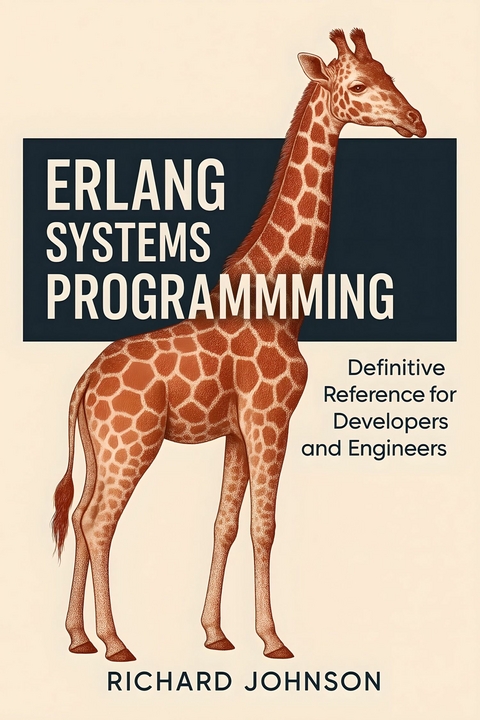
Erlang Systems Programming (eBook)
250 Seiten
HiTeX Press (Verlag)
978-0-00-106465-2 (ISBN)
'Erlang Systems Programming'
'Erlang Systems Programming' is an advanced guide to building robust, concurrent, and distributed systems using the Erlang programming language. Through a logical progression from underlying philosophy to practical engineering solutions, this book explores the unique features and architectural decisions that make Erlang an ideal choice for fault-tolerant systems programming. Readers are introduced to the core principles of the actor model, deep internals of the BEAM virtual machine, and the language's hallmark support for lightweight process isolation, hot code swapping, and dynamic fault recovery.
With a deliberate focus on real-world challenges, the book provides a thorough understanding of supervision trees, error containment, and the essential 'let it crash' approach to error handling. It expertly details message passing, distributed communication, and state management, offering precise patterns for high-availability, systemic resilience, and interoperation with native system resources. From node discovery and geo-redundancy to integrating with external databases and orchestrating with foreign runtimes, professionals will discover actionable guidance for designing and scaling reliable, production-grade systems.
Security, observability, and performance engineering are treated as first-class concerns, emphasizing safe deployment, runtime hardening, in-depth tracing, and automated self-healing. Extensive coverage of benchmarks, scheduling, garbage collection optimization, and scaling strategies empower system architects and engineers to leverage Erlang's strengths across the full lifecycle. Meticulously structured and comprehensive, 'Erlang Systems Programming' is an indispensable resource for anyone building mission-critical, fault-tolerant applications in modern, distributed environments.
Chapter 2
Concurrency and Fault Tolerance Principles
Concurrency in Erlang isn’t just a feature—it’s a way of life. From the very beginning, Erlang anticipated a world of failures, race conditions, and unexpected load spikes. This chapter invites you to discover how Erlang transforms failure from a dreaded anomaly into a manageable, isolated event, and how its concurrency model makes deliberate chaos not just tolerable, but productive. You’ll emerge with a pragmatic understanding of how robust systems are composed, maintained, and gracefully resurrected when the inevitable happens.
2.1 Supervision Trees and Error Containment
Supervision trees form the cornerstone of Erlang’s fault-tolerance philosophy, providing a structured approach to managing process failures and system reliability. At their core, supervision trees organize processes into a hierarchical topology, where supervisors oversee worker processes and potentially other supervisors, creating nested supervision subtrees. This hierarchical oversight enables localized error recovery and containment, preventing fault propagation from cascading through the entire system.
A supervisor is a dedicated process whose sole responsibility is to monitor child processes according to a defined strategy. These child processes may be workers-processes performing the business logic-or subordinate supervisors managing further subprocesses. Each supervisor is configured with a restart strategy and a child specification describing how and when each child should be restarted if it terminates unexpectedly.
The primary restart strategies employed by supervisors include:
- One-for-one: Only the failed child process is restarted.
- One-for-all: If any child terminates, all other children are terminated and then all are restarted.
- Rest-for-one: If a child process fails, that process and all subsequently started children are terminated and restarted.
This flexibility allows fine-grained control over failure semantics relative to the interdependencies of the child processes. For instance, one-for-one is suitable when children operate independently, whereas one-for-all is appropriate when failure in one child compromises the integrity of others, necessitating a coordinated restart.
The supervision tree leverages Erlang’s lightweight process model and asynchronous message passing to contain errors locally. When a worker process crashes-due to exceptions, resource exhaustion, or other faults-the supervising process detects the failure via monitoring mechanisms intrinsic to the runtime (such as linked processes and exit signals). Instead of letting the failure ripple uncontrolled throughout the system, the supervisor applies its restart logic to bring the child back to a known-good state. This containment prevents the faulty process from destabilizing other, unrelated parts of the system.
Error containment in supervision trees can be conceptualized as creating fault domains that isolate faults to minimal regions within the hierarchy. A failed process does not cause supervisor or sibling processes to crash unless explicitly configured by the restart strategy. This modularization simplifies both fault diagnosis and recovery, as failures can be localized to well-defined subtrees without compromising entire services.
Consider the following simplified supervision tree:
In this design, the top_supervisor directly manages worker_1 and sub_supervisor, which itself supervises two workers. A crash in worker_2 triggers only sub_supervisor’s restart logic, isolating the error from worker_1 and preserving broader system stability.
To build a supervisor, Erlang provides the supervisor module, with processes started using supervisor:start_link/2. A children specification includes tuples describing each child process:
{ChildId, StartFunc, RestartStrategy, ShutdownTimeout, Type, Modules}
- ChildId: Unique identifier for the child.
- StartFunc: A tuple indicating the module, function, and arguments for starting the child process.
- RestartStrategy: Specifies when the child should be restarted (e.g., permanent, transient, temporary).
- ShutdownTimeout: Time allowed for graceful shutdown.
- Type: worker or supervisor.
- Modules: List of modules implemented by the child.
An example child specification appears as:
{worker1, {worker_module, start_link, []}, permanent, 5000, worker, [worker_module]}
Supervisors themselves can be nested to arbitrary depths, creating extensive hierarchies suited to complex applications. This nesting also facilitates hot code upgrades, where supervised processes can be replaced or updated without global system downtime, thanks to the controlled restart and supervision semantics.
Error handling implications of supervision trees extend beyond restart policies. Supervisors establish fault isolation boundaries, ensuring that unexpected terminations of workers do not escalate into supervisor crashes. Supervisors trap exit signals from children (through process flags) and decide whether to act, restart, or escalate based on the configured strategy. This contrasts sharply with more traditional monolithic error handling, where unhandled exceptions often lead to cascading failures or total application shutdown.
The robustness of supervision trees hinges on principled design of the tree structure and correct classification of processes according to their behavior and fault dependencies. Misconfiguration, such as improper restart strategies or lack of adequate shutdown timeouts, can undermine error containment and reduce availability.
Supervision trees in Erlang embody a well-engineered balance of hierarchical monitoring, localized recovery, and fault isolation. By modeling system components as processes under supervisors, failures remain manageable, predictable, and recoverable. This architecture eliminates single points of failure and enables continuous operation even under adverse conditions, fulfilling Erlang’s mission of building highly reliable distributed systems.
2.2 Let-It-Crash: Error Handling and Recovery
The let-it-crash philosophy constitutes a cornerstone in the design principles of Erlang’s fault-tolerant systems. It stands in contrast to conventional error-handling paradigms that emphasize defensive programming, anticipating and handling every conceivable fault within a single process. Instead, Erlang embraces the inevitability of runtime failures by allowing processes to fail fast and recover cleanly, thereby promoting system robustness and maintainability.
At the heart of this philosophy is a simple but profound insight: efforts to recover from every failure within the same process tend to yield complex, fragile code. This fragility arises primarily because manual error recovery mechanisms must contend with an exponentially growing combination of partial failures, inconsistent internal states, and intricate control flows. Attempting to explicitly handle all error cases induces code complexity that often obfuscates the original logic, introducing subtle bugs and maintenance difficulties.
Erlang avoids these pitfalls by conceptualizing processes as isolated, lightweight computational units designed to do one thing well and to fail if any unexpected condition arises. When a process encounters an error, it is terminated promptly rather than entangled in elaborate recovery attempts. This crash, rather than being a defect, signals an exceptional condition that triggers the supervision infrastructure’s orchestrated recovery.
The supervision tree architecture in Erlang is pivotal for the let-it-crash philosophy. Supervisors are specially designed processes whose sole responsibility is to monitor worker processes and restart them upon failure according to specified strategies. By separating the concerns of computation and error recovery, supervisors encapsulate recovery logic cleanly outside workers’ business logic. This separation reduces cognitive load on developers, improves system clarity, and facilitates controlled...
| Erscheint lt. Verlag | 11.6.2025 |
|---|---|
| Sprache | englisch |
| Themenwelt | Mathematik / Informatik ► Informatik ► Programmiersprachen / -werkzeuge |
| ISBN-10 | 0-00-106465-7 / 0001064657 |
| ISBN-13 | 978-0-00-106465-2 / 9780001064652 |
| Informationen gemäß Produktsicherheitsverordnung (GPSR) | |
| Haben Sie eine Frage zum Produkt? |
 EPUB (Adobe DRM)
Größe: 776 KB
Kopierschutz: Adobe-DRM
Adobe-DRM ist ein Kopierschutz, der das eBook vor Mißbrauch schützen soll. Dabei wird das eBook bereits beim Download auf Ihre persönliche Adobe-ID autorisiert. Lesen können Sie das eBook dann nur auf den Geräten, welche ebenfalls auf Ihre Adobe-ID registriert sind.
Details zum Adobe-DRM
Dateiformat: EPUB (Electronic Publication)
EPUB ist ein offener Standard für eBooks und eignet sich besonders zur Darstellung von Belletristik und Sachbüchern. Der Fließtext wird dynamisch an die Display- und Schriftgröße angepasst. Auch für mobile Lesegeräte ist EPUB daher gut geeignet.
Systemvoraussetzungen:
PC/Mac: Mit einem PC oder Mac können Sie dieses eBook lesen. Sie benötigen eine
eReader: Dieses eBook kann mit (fast) allen eBook-Readern gelesen werden. Mit dem amazon-Kindle ist es aber nicht kompatibel.
Smartphone/Tablet: Egal ob Apple oder Android, dieses eBook können Sie lesen. Sie benötigen eine
Geräteliste und zusätzliche Hinweise
Buying eBooks from abroad
For tax law reasons we can sell eBooks just within Germany and Switzerland. Regrettably we cannot fulfill eBook-orders from other countries.
aus dem Bereich


